
ULOGA DIGITALNOG MARKETINGA U OBLIKOVANJU KOMUNIKACIONIH PRAKSI OTT PLATFORMI

Apstrakt
Rad analizira ulogu digitalnog marketinga u pozicioniranju OTT (Over-the-Top) platformi u savremenom medijskom okruženju, sa posebnim fokusom na komunikacione prakse koje se odvijaju izvan njihovog tehničkog ekosistema. OTT platforme, kao jedan od najdinamičnijih segmenata globalne medijske industrije, oblikuju percepciju vrednosti svojih usluga kroz strateško upravljanje brendom, prisustvo na digitalnim mrežama i kontinuirano podsticanje angažovanja publike. Istraživanje je zasnovano na komparativnoj studiji slučaja, u okviru koje su analizirane digitalne marketinške strategije globalne komercijalne platforme Netflix i nacionalne OTT platforme Javne medijske ustanove Radio-televizije Srbije - RTS Planeta. Analiza obuhvata kvalitativno razmatranje komunikacionih praksi i sadržajnih formata, kao i kvantitativne pokazatelje angažovanosti publike na društvenim mrežama. Rezultati istraživanja ukazuju na različite obrasce korišćenja digitalnih kanala: Netflix koristi digitalne mreže prvenstveno za globalno pozicioniranje brenda i razvoj serijalizovanih, viralnih kampanja, dok RTS Planeta digitalni marketing dominantno usmerava ka informisanju, aktiviranju publike i ostvarivanju javne medijske misije u okviru nacionalnog medijskog sistema.
Članak
Introduction
The development of digital technologies and the widespread availability of the Internet have led to significant changes in the distribution and consumption of audiovisual content. The traditional model of linear television broadcasting is increasingly being replaced by non-linear, on-demand services, with OTT (Over-the-Top) platforms emerging as some of the most influential actors in the contemporary media system (Portals, 2017; Audience Evolution, 2011). OTT platforms rely on business and communication models based on continuous content availability, personalized recommendations, and multi-device accessibility, significantly influencing audience habits, expectations, and the dynamics of the video streaming market.
In the digital media environment, the recognition and reputation of OTT platforms are not shaped solely by the scale and production quality of their content, but also by the ways in which platforms position themselves within the communication space. Of particular importance are patterns of public communication, narratives, and symbolic strategies through which relationships with audiences are established and brand identity is constructed (Van Dijck, Poell, De Waal, 2018). Digital marketing has become an integral component of business strategy that influences platform visibility, perceived value, and user loyalty patterns (Kotler, Kartajaya, Setiawan, 2017).
OTT platforms engage audiences continuously through social media presence, collaborations with content creators, and data-driven insights into user behaviour. The practices support both the promotion of individual titles and the long-term positioning of the brand within a highly competitive digital environment (Mangold & Faulds, 2009). Digital marketing functions as a main mechanism for capturing user attention, fostering engagement, and maintaining platform retention. Similar conclusions regarding the growing importance of digital communication and multichannel marketing strategies in contemporary media systems are also supported by earlier research on the digital transformation of marketing communications (Tankosić & Trifunović, 2015).
Existing research on OTT platforms has predominantly addressed shifts in audience behaviour, the transformation of television markets, and the rise of subscription-based models (Lotz, 2017; Jenkins, Ford, & Green, 2013). However, less attention has been devoted to a systematic examination of digital marketing strategies within OTT services, particularly in comparative analyses of global commercial platforms and national services operating within different regulatory and institutional frameworks. The application of marketing mix elements in the OTT digital environment, and their role in shaping brand identity and enhancing audience engagement, remains insufficiently explored.
Building on the identified research gap, this study examines the role of digital marketing in positioning OTT platforms, with a particular focus on communication practices that extend beyond their core technological ecosystem. Special attention is given to a comparative analysis of the digital marketing activities of the global OTT platform Netflix and the national OTT platform RTS Planeta, operated by the Radio Television of Serbia. The approach enables an examination of similarities and differences in digital communication and branding strategies within the contemporary, highly digitized media environment.
The study is structured as follows: the second section reviews the literature, the third outlines the methodology, the fourth presents empirical findings, and the final section provides conclusions.
Literature Review
The development of OTT (Over-the-Top) platforms and the transformation of the contemporary media market have been extensively studied in theoretical and empirical research, addressing shifts in audiovisual consumption patterns, audience attention management, and emerging communication models in the digital environment. Within the existing literature, three main research streams are particularly relevant to this study: audience behaviour and changing viewing practices, media platformisation, and digital marketing and branding in online services.
The first stream of research focuses on changes in audience habits and the shift from linear to non-linear, on-demand modes of content consumption. Scholars argue that personalisation, algorithmic recommendations, and increased flexibility in content access contribute to a redefinition of the relationship between audiences and media products (Lotz, 2017; Napoli, 2011). Audience loyalty is increasingly shaped not only by programming, but also by user experience, content accessibility, and the degree of personalised communication (Jenkins et al., 2013). The literature suggests that the relationship between audiences and OTT platforms is shaped through continuous interaction and perceived value, rather than passive content consumption.
The second research stream concerns the concept of media platformisation, which frames OTT platforms as complex socio-technical systems. Van Dijck, Poell and de Waal (2018) argue that platforms operate as hybrid ecosystems in which technological, economic, and communicative logics intersect, while algorithmic mechanisms actively shape content visibility, interaction patterns, and the market positioning of actors. Tarleton Gillespie (2010) further emphasises that platforms establish their own normative frameworks for content moderation and prioritisation, thereby directly influencing competitive relations and opportunities for brand differentiation. In this context, Cunningham and David Craig (2019) highlight differences between global and local platforms, arguing that global services possess more stable resources for developing digital campaigns and managing brand presence across diverse regulatory and cultural environments.
The third body of literature addresses digital marketing and branding practices in networked environments. The literature highlights a broader shift in marketing paradigms within the digital economy, where social media, user data analytics, and precise audience targeting have become central components of marketing strategy (Kotler et al., 2017). The interactive potential of digital channels, particularly within Web 2.0 environments, is recognised as a key factor in enabling two-way communication and fostering audience engagement (Tankosić, Ivetić, & Vučurević, 2016). Social media have increasingly been conceptualised as auxiliary promotional tools, but as key spaces for building and maintaining brand identity and audience relationships (Mangold & Faulds, 2009). In the field of media services, research indicates that digital platforms use user behavioural data not only to optimise content delivery, but also to design communication campaigns that encourage engagement and long-term audience loyalty (Smith & Telang, 2017). Studies on audience perception and evaluation of communication channels further indicate that engagement depends on message clarity, channel suitability, and consistency of communication (Tankosić, Manić, & Mikić, 2024).
A further strand of literature focuses on strategic brand management and the application of marketing mix elements in digital environments. Strategic brand positioning is recognised as a main process in achieving competitive advantage, with promotion and communication identified as dominant components of the marketing mix in digital industries (Garachkovska et al., 2021). Within the context of OTT platforms, the traditional marketing mix – product, price, place, and promotion – acquires specific meanings. Within OTT platforms, the product includes content offerings, interface design, and multi-device accessibility, and additional platform functionalities, while differentiation is primarily achieved through content exclusivity, user experience quality, and the strength of brand identity.
Differentiation strategies in digital environments enable platforms to distinguish themselves in an increasingly saturated market by offering distinctive experiences and content tailored to specific audience needs (Jerab & Mabrouk, 2023). The development of a strong and recognisable brand contributes to building trust, strengthening user loyalty, and ensuring the long-term sustainability of OTT business models.
Despite the extensive body of literature on media industry transformation and the evolution of digital marketing, relatively few studies have systematically examined the application of marketing mix elements in OTT environments, particularly through comparative analyses of global and national services. This gap underscores the need for an in-depth analysis of digital marketing strategies employed by OTT platforms operating in different market and institutional contexts, which forms the basis of the present study.
Aim and Methodology of the Study
The aim of the study is to analyse and compare the digital marketing strategies of OTT platforms operating within different market and institutional frameworks, with particular emphasis on their role in shaping brand identity and audience engagement. The study examines the adaptation of marketing mix elements to OTT environments and the extension of communication practices outside the platform ecosystems (Tankosić & Grbić, 2022) through social media and networked communication channels.
In line with the stated aim, the study addresses the following research questions: how OTT platforms employ digital marketing channels to position their brands and develop relationships with audiences; what similarities and differences can be identified in the implementation of digital marketing strategies between a global commercial OTT platform and a national public service OTT platform; and to what extent digital communication functions as a strategic instrument in achieving both business and public service objectives.
This study is guided by the following research hypotheses:
H1: Differences in digital marketing practices are reflected in variations in audience engagement levels across OTT platforms.
H2: Global OTT platforms employ a more extensive use of viral and data-driven marketing strategies compared to national public service OTT platforms.
H3: Public service OTT platforms tend to prioritise informational, cultural, and accessibility-oriented communication strategies rather than commercial branding strategies.
The hypotheses are operationalised through quantitative engagement metrics (views, likes, comments, shares) and qualitative content coding of communication strategies across platforms.
The study applies a mixed-methods research design based on a comparative case study approach (Yin, 2018), combining qualitative content analysis with quantitative engagement metrics. The comparative design is asymmetrical in nature, with Netflix serving as a reference case of global OTT platform practices, while RTS Planeta represents the primary empirical case due to its specific institutional and market context.
The unit of analysis in this study is defined as an individual digital content item, including video posts and accompanying social media posts published on Instagram and TikTok accounts of the analysed OTT platforms. The sample includes all publicly available posts published on the official Instagram and TikTok profile of RTS Planeta within the period from 18 August 2025 to 18 September 2025. A census sampling approach was applied, meaning that all available content units within the defined observation period were included in the analysis, ensuring full coverage of the population of posts.
The empirical analysis draws on multiple data sources. The first level of analysis is based on secondary sources, including relevant scholarly literature in communication studies, digital marketing, and media studies, as well as reports and publicly available data on the OTT market (Napoli, 2011; Lotz, 2017; Smith & Telang, 2017). The second level of analysis focuses on the digital marketing practices of Netflix, drawing on existing academic research, documented promotional campaigns, and analytical studies addressing branding strategies and audience engagement on global platforms (Gomez-Uribe & Hunt, 2016; Pal, 2024). The third level of analysis is based on audience engagement data derived from the analytical report by Marinković (2025), with all interpretations and analytical conclusions developed by the author of this study.
The qualitative analysis focuses on identifying and interpreting communication practices, including narratives, content formats, and types of campaigns used in the digital promotion of OTT platforms. The quantitative analysis examines audience engagement indicators such as views, interactions (likes, comments, and shares), and content reach, which enable an assessment of the visibility and effectiveness of digital communication (Mangold & Faulds, 2009). By combining these two approaches, the study provides a more comprehensive understanding of the relationship between digital marketing strategies and audience responses across different organisational and market contexts.
For the purpose of a systematic and transparent comparison of the case studies, an analytical matrix is applied, enabling a structured examination of the digital marketing strategies of Netflix and RTS Planeta across clearly defined analytical dimensions, including platform type, digital marketing objectives, dominant communication channels, content formats, and the role of marketing within the overall platform strategy (Table 1). The findings are interpreted through relevant theoretical frameworks on digital marketing, media platformisation, and contemporary branding practices.
Table 1. Digital Marketing Strategy Matrix: Netflix and RTS Planeta
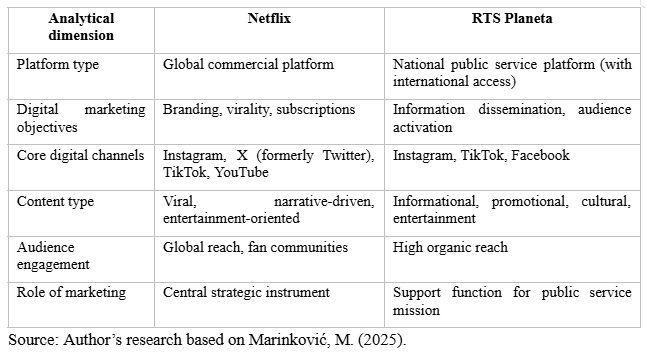
The comparative matrix (Table 1) indicates clear differences in the strategic orientation of digital marketing practices between Netflix and RTS Planeta, particularly in relation to the role of branding, content distribution strategies, and the functional positioning of marketing within global commercial and public service OTT environments.
Digital Marketing in OTT Platforms
In recent years, the video content market has undergone substantial transformation driven by the dominance of digital platforms, the rapid increase in content volume, and intensified competition for audience attention. Audiences are exposed to an expanding array of media offerings, digital services, and advertising messages, resulting in saturation and attention overload, which increasingly complicates user acquisition and retention.
Netflix represents a global commercial OTT platform with a vast content portfolio and highly developed digital marketing practices, while RTS Planeta functions as a national public service platform with a specific mandate to inform audiences and promote domestic production for users in Serbia, the region, and the Serbian diaspora. The contrast enables a comparative analysis of digital marketing strategies across different market, regulatory, and cultural contexts, with particular attention to audience engagement and brand identity.
The digital transformation of the media industry over the past decade has enabled the rapid expansion of global streaming platforms, while national platforms – typically established by public service media organisations or telecommunications operators – have been required to rely on digital marketing, content personalisation, algorithmic recommendation systems, branding strategies, and multichannel promotion in order to sustain relevance and maintain market position. A particular emphasis is placed on the post-COVID-19 period, during which increased market saturation and the entry of new competitors have further reinforced the strategic importance of digital marketing for user retention and platform growth.
The comparative analysis of Netflix and RTS Planeta is based on differences in scale, market presence, and institutional framework, which provide a basis for examining variations in digital marketing strategies across global commercial and public service OTT platforms. RTS Planeta operates as a VOD (Video on Demand) service providing live streams of 12 television and 9 radio channels of the Serbian public service broadcaster, along with a catalogue of approximately 40,000 audio and video items. By contrast, Netflix operates as a global platform offering tens of thousands of titles worldwide, with region-specific catalogues, including Iceland (9,765 titles), Slovenia (8,883), and Latvia (8,799) (Statista, 2025).
Netflix
An example of Netflix’s global commercial marketing is the “One Last Ride” activation, held three days prior to the premiere of the fifth season of Stranger Things on 23 November 2025. A section of Melrose Avenue in Los Angeles was temporarily closed to traffic, while participants were invited to take part in an experiential activation inspired by 1980s aesthetics and to complete a 6.4 km route designed to simulate the fictional town of Hawkins from the series. The route featured promotional installations and photo opportunities inspired by the Stranger Things narrative universe (Glassman, 2025).
The event illustrates the integration of experiential marketing and digital communication strategies aimed at generating viral content and strengthening Netflix’s global brand identity. The activity illustrates the integration of experiential marketing and digital engagement strategies aimed at enhancing visibility and strengthening global brand positioning.
In contrast, RTS Planeta implemented promotional activities in autumn 2025 with a focus on accessibility and inclusivity, including the promotion of the series Nobelovac with audio description for blind and visually impaired audiences at the Museum of Ivo Andrić. The initiative reflects the integration of socially responsible communication practices into the digital marketing activities of public service media platforms and their use of digital channels for audience engagement.
The digital marketing strategy of Netflix is grounded in extensive use of user data and algorithmic systems, which enable the personalisation of content and enhance audience engagement. Interface design optimisation, algorithm-based recommendations, and streamlined navigation contribute to increased content uptake (Ong et al., 2024). Previous research (Gómez-Uribe & Hunt, 2016) underlines the role of recommendation systems in shaping the user journey, while more recent studies (IT Network, 2023; Han, 2025) point to the expanding significance of artificial intelligence, automation, and behavioural analytics in contemporary digital marketing practices.
From a branding perspective, Netflix applies a glocalised strategy that combines a strong global brand identity with locally tailored content and campaign adaptations. The platform frequently implements promotional formats such as interactive contests, quizzes, and hashtag-based campaigns, thereby encouraging users to actively participate in promotional processes and reinforcing a sense of community (Xiao, 2023). Social media platforms, including X (formerly Twitter), Instagram, TikTok, and YouTube, are used for the dissemination of viral communication content, often relying on humour, memes, and interactive formats. This approach contributes to sustained audience engagement, particularly among younger demographic groups (Yuan, 2023).
The application of the AIDA model (Attention, Interest, Desire, Action) illustrates how Netflix effectively guides users through all stages of engagement, from initial attention to active content consumption and subscription. Original productions such as Squid Game and Wednesday function as central elements of its digital marketing strategy, integrating content promotion with platform promotion and contributing to the creation of global pop-culture phenomena (Pal, 2024).
The market position of Netflix remains dominant, supported by a high degree of personalisation, strong brand recognition, effective use of social media, and the production capacity of original content.
However, key challenges include rising global production costs, heterogeneous audience preferences, the risk of content fatigue, and increasingly intense competition from platforms that are adopting and adapting its pioneering models (Ma, 2025).
RTS Planeta
RTS Planeta is an independent OTT platform of the Serbian public service media organisation, designed for the distribution of audiovisual content both nationally and internationally. The platform’s primary digital marketing channels, aimed at enhancing interactivity, attracting new users, and informing existing audiences, include Instagram, TikTok, Facebook, and YouTube.
The official RTS Planeta accounts provide content overviews, recommendations, and information related to series, films, documentary programmes, and archival material. The content strategy is primarily focused on the promotion of domestic production, current premieres, and exclusive excerpts from the most viewed series and programmes.
Within the framework of this study, the period from 18 August 2025 to 18 September 2025 was analysed, with a focus on audience engagement across the Instagram and TikTok profiles of RTS Planeta. Since its launch on Instagram in 2018 up to the end of the observed period, the account had 66,795 followers, 2,791 posts, and 37 videos exceeding one million views, six of which surpassed two million views. The most viewed clip originated from the series “Branilac”, reaching 2.7 million views. At the time of writing (December 2025), 59 Instagram posts had exceeded one million views, while 13 had surpassed two million. For instance, a clip from the series “Biser Bojane” reached 2,757,338 views, whereas a clip from “Vojna akademija” recorded the highest performance with 2,970,434 views and 32,876 interactions. Analysis of account analytics indicates that approximately 1.6 million viewers of this video were not followers of the RTS Planeta Instagram account, suggesting a substantial level of organic reach.
The Instagram channel of RTS Planeta represents the primary link between the public service media organisation and its digital audience, with an emphasis on interactivity, information dissemination, and continuous communication with followers. During the observed period, a total of 8,664,337 views were recorded, of which 88.8% originated from non-followers, while 245,261 interactions were achieved, 84.1% of which were generated by users who were not following the account at the time. These findings confirm the significant impact of published content on audience behaviour and engagement (Marinković, 2025).
Table 2. RTS Planeta: Audience Engagement on Instagram and TikTok (18 August–18 September 2025)
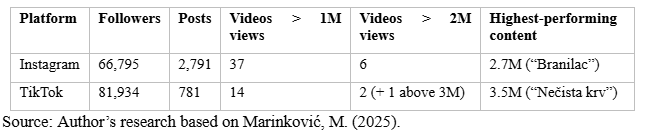
Table 2 provides a comparative overview of audience engagement metrics for RTS Planeta on Instagram and TikTok, indicating a high level of reach and interaction across both platforms, with a particularly strong performance in terms of organic visibility and the dissemination of video content beyond the existing follower base.
The TikTok account of RTS Planeta was launched in March 2024 with the objective of making public service content more accessible to a younger, digitally active audience. Since its establishment, the profile has rapidly developed a substantial user base and has become one of the most engaged media accounts in the region. The communication strategy is based on short-form, visually oriented content adapted to the platform’s fast-paced and interaction-driven logic.
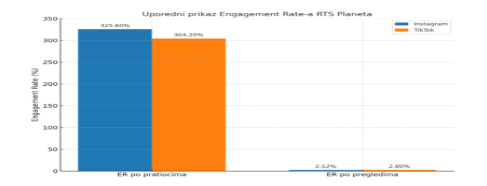
By the end of the observed period, the account recorded 81,935 followers, while exclusively organic content generated 8,903,151 views and 249,362 interactions. The audience engagement rate stands at 2.8%, indicating that approximately one in every 36 users who view the content engages through likes, comments, or shares (Figure 1).
Figure 1. Comparative Audience Engagement Rates: RTS Planeta (Instagram vs. TikTok)
Source: Author’s research based on Marinković, M. (2025).
The Facebook page of RTS Planeta, launched in 2018, has 76,538 followers and is primarily used for the distribution of content targeted at an older audience segment (45+), with an emphasis on information dissemination and direct communication.
Since February 2025, content has also been actively updated on the YouTube channel “RTS Planeta Official Channel”, which had 62,133 subscribers at the time of writing. This has provided an additional layer of digital visibility and facilitated further audience interaction across platforms.
Conclusion
The comparative analysis of digital marketing strategies of Netflix and RTS Planeta reveals clear differences in approach between global commercial and national public service OTT platforms, shaped by distinct institutional, regulatory, and market contexts. Netflix primarily utilises digital channels for brand positioning, viral content distribution, and active audience participation in promotional processes. RTS Planeta, by contrast, prioritises information dissemination, inclusivity, and the fulfilment of its public service mandate, while simultaneously sustaining high levels of audience engagement through social media platforms.
Empirical findings suggest that differentiated digital marketing approaches have a direct influence on brand perception and audience loyalty. Netflix achieves global reach and high levels of content virality, while RTS Planeta records strong organic reach and user interaction, particularly on Instagram and TikTok. The results confirm the importance of digital channels in supporting the strategic objectives of platforms with distinct institutional roles and market positions.
The empirical findings confirm all three proposed research hypotheses. The results support H1, demonstrating that differences in digital marketing practices between Netflix and RTS Planeta are reflected in variations in audience engagement levels across platforms. H2 is likewise confirmed, as the comparative analysis shows that Netflix applies considerably more intensive viral, data-driven, and globally coordinated marketing strategies, relying on algorithmic personalisation, interactive campaigns, and transmedia audience engagement. The findings further confirm H3, indicating that RTS Planeta primarily employs informational, cultural, and accessibility-oriented communication practices aligned with its public service mission, rather than commercially oriented branding strategies characteristic of global streaming platforms. These results suggest that digital marketing strategies on OTT platforms are strongly shaped by institutional frameworks, strategic priorities, and target audience structures, while simultaneously functioning as an important mechanism for strengthening audience relationships, visibility, and long-term platform positioning in the digital media environment.
The study also highlights the importance of integrating marketing mix elements with the strategic management of communication practices in the digital OTT environment. Personalisation, algorithm-based recommendations, and interactive campaigns contribute to sustained audience engagement and the strengthening of brand identity, which in turn represent key determinants of competitiveness in a highly digitised media market.
The limitations of the study relate to the restricted time frame of observation and the focus on two selected case studies, which suggests the need for broader comparative analyses including additional global and national OTT platforms. Future research could further examine the impact of emerging algorithmic models, trends in content personalisation, and specific user demographic segments on the digital marketing strategies of OTT platforms.
The findings contribute to a more nuanced understanding of digital marketing practices in OTT platforms across different institutional contexts, demonstrating how communication strategies are shaped by commercial objectives and public service media mandates.
Reference
Cunningham, S., & Craig, D. (2019). Social media entertainment: The new intersection of Hollywood and Silicon Valley. New York: NYU Press.
Garachkovska, O., Sytnyk, O., Fayvishenko, D., Taranskiy, I., Afanasieva, O., & Prosianyk, O. (2021). Strategic management of brand positioning in the market. Advances in Science, Technology and Engineering Systems Journal, 6(1), 947–953. https://doi.org/10.25046/aj0601104
Gillespie, T. (2010). The politics of „platforms”. New Media & Society, 12(3), 347–364. https://doi.org/10.1177/1461444809342738
Glassman, T. (November 21st, 2025). An Immersive Stranger Things Bike Ride Is Hitting the Streets of Los Angeles. Netflix Tudum. Retrieved from https://www.netflix.com/tudum/articles/stranger-things-los-angeles-bike
Gomez-Uribe, C. A., & Hunt, N. (2016). The Netflix Recommender System: Algorithms, business value, and innovation. ACM Transactions on Management Information Systems, 6(4), 1–19. https://doi.org/10.1145/2843948
Han, Y. (2025). Strategy management and market breakthrough of Netflix. Interdisciplinary Humanities and Communication Studies, 1(4). https://doi.org/10.61173/cr9p0152
IT Network. (2023). Uloga AI-a u sistemima preporuka (Netflix primer). Retrieved November 29, 2025, from https://www.itnetwork.rs/uloga-ai-a-u-sistemima-preporuka/
Jenkins, H., Ford, S., & Green, J. (2013). Spreadable media: Creating value and meaning in a networked culture. New York: NYU Press.
Jerab, Daoud & Mabrouk, Tarek, (2023). Strategic Excellence: Achieving Competitive Advantage through Differentiation Strategies http://dx.doi.org/10.2139/ssrn.4575042
Kotler, P., Kartajaya, H., & Setiawan, I. (2017). Marketing 4.0: Moving from traditional to digital. Hoboken, NJ: Wiley.
Lotz, A. D. (2017). Portals: A treatise on internet-distributed television. Ann Arbor: Michigan Publishing.
Ma, M. (2025). Critical analysis: Netflix’s future in a competitive landscape. Advances in Economics, Management and Political Sciences, 157, 156–159. https://doi.org/10.54254/2754-1169/2025.AB23064
Mangold, W. G., & Faulds, D. J. (2009). Social media: The new hybrid element of the promotion mix. Business Horizons, 52(4), 357–365. https://doi.org/10.1016/j.bushor.2009.03.002
Marinković, M. (2025). RTS Planeta - analiza angažovanosti publike Instagram i TikTok (za period 18.8. – 18.9.2025.) [neobjavljeni izveštaj]. Radio-televizija Srbije.
Napoli, P. M. (2011). Audience evolution: New technologies and the transformation of media audiences. New York: Columbia University Press.
Ong, A. K. S., Josue, N. L., Urbiztondo, A. M. B., German, J. D., & Espeño, P. R. E. (2024). Evaluation of consumer usage behavior for interactive entertainment: A Netflix case study. Entertainment Computing, 49, 100627. https://doi.org/10.1016/j.entcom.2023.100627
Pal, V. (2024). AIDA marketing strategy: The case of Netflix streaming to success. IOSR Journal of Humanities and Social Science, 29(7), 58–62. Retrieved from https://www.iosrjournals.org/iosr-jhss/papers/Vol.29-Issue7/Ser-9/J2907095862.pdf
Smith, M. D., & Telang, R. (2017). Streaming, sharing, stealing: Big data and the future of entertainment. Cambridge, MA: MIT Press.
Statista. (2025, February). Netflix library size worldwide (Statistic No. 1013571). Retrieved November 29, 2025, from https://www.statista.com/statistics/1013571/netflix-library-size-worldwide/
Tankosić, M., & Trifunović, D. (2015). The influence of digitization and new media on the system of companies marketing communication, consumers and business enterprises. Advances in Environmental Science and Energy Planning, WSEAS Press, Tenerife, Canary Islands, Spain, 1, 174–180. https://doi.org/10.4236/
Tankosić, M., Ivetić, P., & Vučurević, V. (2016). Features of interactive public relations: Using Web 2.0 to establish a two-way communication with the consumers. International Journal of Economics and Management Systems, 1, 290–295. 2367-8925.
Tankosić, M., Manić, Lj., & Mikić, A. (2024). Students’ perceptions and satisfaction in evaluating communication channels. Društvene i humanističke studije DHS (Social Sciences and Humanities Studies), 9(2), 1463–1483. https://doi.org/10.51558/2490-3647.2024.9.2.1463
Tankosić, M., & Grbić, A. (2022). Creating effective communications with users through the techniques web mining and its legal regulation. Oditor, 8(3), 268–303. ISSN 2217-401X.
Van Dijck, J., Poell, T., & de Waal, M. (2018). The platform society: Public values in a connective world. Oxford: Oxford University Press.
Xiao, H. (2023). Research on the brand marketing strategy of Netflix in the new media environment. Advances in Economics, Management and Political Sciences, 56(1), 195–202. https://doi.org/10.54254/2754-1169/56/20231087
Yin, R. K. (2018). Case study research and applications: Design and methods (6th ed.). Thousand Oaks, CA: Sage.
Yuan, C. (2023). A case study of Netflix’s marketing strategy. BCP Business & Management, 42, 185–190. https://doi.org/10.54691/bcpbm.v42i.4580
Objavljeno u
Vol. 32 No. 1 (2026)
Ključne reči
Licenca
Ovaj rad je objavljen pod Creative Commons Attribution 4.0 International (CC BY 4.0).
Autori zadržavaju autorska prava nad svojim radom.
Dozvoljena je upotreba, distribucija i adaptacija rada, uključujući i u komercijalne svrhe, uz obavezno navođenje originalnog autora i izvora.
Zainteresovani za slična istraživanja?
Pregledaj sve članke i časopise