
Tehnološki napredak i digitalizacija u funkciji razvoja e-obrazovanja u Srbiji

Apstrakt
Ovaj rad se bavi istraživanjem uticaja tehnološkog napretka i digitalizacije u funkciji razvoja e-obrazovanja u Srbiji. Tehnološki napredak u svim sferama života i digitalizacija su dovele do toga da obrazovanje bude efikasnije i efektivnije. Podizanje efikasnosti i efektivnosti obrazovanja je ostvareno uz pomoć digitalne transformacije praćene najnovijim dostignućima u elektronskom učenju uz usavršavanje nastavnih metoda i alata. U današnje vreme je nemoguće stvoriti kvalitetan obrazovni sistem Srbije bez uključivanja tehnologije i digitalizacije u isti. Živimo u vreme promena koje karakteriše brz razvoj informaciono komunikacionih tehnologija koje ostavljaju trag u svim oblastima života, a posebno na učenje i obrazovnu praksu. Vizija ukupnog društveno ekonomskog razvoja se može ostvariti samo uz kvalitetan obrazovni sistem koji u sebi podrazumeva upotrebu informaciono- komunikacionih tehnologija. Modernizacija obrazovanja jeste imperativ svih subjektivnih snaga jedne zemlje. To se ne može postići bez uvođenja digitalnih tehnologija u obrazovni proces. Rezultati rada govore o pozitivnom uticaju tehnološkog napretka i digitalizacije na razvoj e-obrazovanja u Srbiji, koje ima tendenciju da ga promeni iz korena.
Članak
Introduction
We are witnessing enormous changes taking place in a society. One of the tendencies in human development is the tendency towards digitization. The emergence of digitization is primarily a consequence of technological progress, the increase of information and knowledge in society. When considering technological progress and digitization, one must take into account the degree of influence of information and communication technologies (ICT), which are agents of change. Education is also exposed to changes, which results in the necessity of adapting it to new circumstances and requirements. Considering the subject of interest of this study, it can be said that "technological development and digitalisation create a favorable environment for the adaptation of the educational ecosystem to new needs by changing the modes of student-teacher interaction, streamlining the educational process, remodeling the assessment system, and supporting students' performance" (Sitnicki et al., 2023, 11). Nowadays, education is characterized by a massive penetration of information and telecommunication technology, which is reflected in changes in organization, work processes and the means used.
In the world, and therefore also in Serbia, there is a great interest in researching the impact of technological progress and digitization on the educational and teaching process (Amos, 2019; Bejinaru, 2019; Borin et al., 2022; Fedorenko et al., 2019; Gezici et al., 2021;
Hatos, 2019; Kolarski, 2022; Milićević et al., 2021; Nafea and Toplu,
2021; Osaula et al., 2021; Rakha, 2023; Rakic et al., 2020; Rastogi,
2019).
Kmecová (2020, 526) points to the "importance of innovative study programs and introducing new study programs, which focus on supporting the development of digital literacy and working with digital technologies". By developing e-education and using digital technologies for interactive learning, "students acquire new knowledge, deepen their education, develop creativity, become socially responsible citizens of the digital society, and form digital culture and thinking" (Voronkova et al., 2023, 537). Abdullaeva (2022) discusses the need to modernize education in the digital economy, where science is one of the priority areas of digital economy development. The study by Kulik et al. (2021, 110) came to the conclusion that "the development of e-learning helped to reduce the costs of the educational process, reduce the number of employees, as well as solve the problem of the classroom fund." Goloborodko (2022) studies the prerequisites and characteristics of the development of e-education in conditions of digitization.
In today's turbulent environment where changes happen every moment, the need for fast and efficient learning at all levels of education, from elementary to higher, appears as a necessity. The development of e-education opens up new opportunities both for an educational institution that applies this method of education, as well as for different people who want to complete their education in this way of acquiring knowledge. For example, through e- education it is possible to attract potential students from abroad, people with disabilities and employees who cannot give up work but want to continue their education (Schulz, 2023). Therefore, with the application of e-education nowadays, it is no longer necessary for students to stay in the same room, moreover, they do not even have to be in the same city, country, or continent. Thanks to the Internet, it is possible to create virtual classrooms in which students attend classes thousands of kilometers away from each other.
In addition to technological progress and digitization, the acceleration of the development of e-education was also influenced by the epidemiological crisis caused by the COVID-19 corona virus. It is the research of Suleimenov et al. (2020, 794) that showed "that this crisis encourages the digitalization of higher education as a social institution, and there are conditions under which this institution becomes much more stable with any type of crisis". E- education based on new technologies and digitization has become alternative and accessible to everyone at any time, which was especially evident during the COVID-19 pandemic when people's free movement was restricted. Due to the above, educational institutions had to " search for new opportunities in acquisition and validation of adopted knowledge" (Tomić et al., 2021, 363). The pandemic has led to a massive transition of educational institutions to digital forms of education, which has resulted in all participants in this process adapting to new trends and acquiring new skills. Kolpakova et al. (2022, 3358) note that "digital technologies in education require careful preparation and gradual and measured development of new forms and approaches to learning". In the past 2-3 years, there have been many studies indicating that e-learning was the safest way to teach during the period of the COVID-19 pandemic (Chikopela et al., 2021; Hoq, 2020; Maatuk et al., 2022; Makhlouf and Alani, 2024; Prastyanti et al., 2022).
Materials and methods
In the continuation of the study, we will analyze the current situation in Serbia regarding the development of e-education and the application of new technological achievements and digitization in it. The institution responsible for monitoring and controlling the implementation of digitization of higher education is the Ministry of Science, Education and Technological Development of the Republic of Serbia. Digitization in education is one of the strategic goals of the Government of the Republic of Serbia. Implementation is carried out through three basic activities (Ministry of Education, 2022):
- human and institutional capacity building;
- Equipping educational institutions with ICT infrastructure and connecting them to the Internet;
- Creation and establishment of electronic services (JISP, Es- Dnevnik, digital textbooks...).
Special attention will be paid to the analysis of the introduction of digital platforms, the electronic index and the electronic register of students in higher education institutions. After that, we will analyze the state of distance studies as a form of education based on the application of digital technologies. This analysis was made on the basis of official data of the National Entity for Accreditation and Quality Assurance in Higher Education, and includes all current study programs, both those that have not yet entered the re- accreditation process and those that have successfully completed that process. Given that the Internet is necessary for the organization and implementation of distance learning, we will finally analyze the share of Internet users in Serbia, because the Internet is a powerful tool for learning in the context of education. The methodology applied in this work primarily includes the analytical-synthetic method, the abstraction method, the deductive method, the statistical method, as well as the basic quantitative data analysis.
Results
Digitization of the education system in Serbia is one of the key reform measures aimed at modernizing the education system through the introduction of digital technologies. The use of new technologies should ensure: a higher level of achievement of learning outcomes; raising the quality of young people's digital competences; and enabling their competitiveness on the labor market. Digitization of the education system in Serbia is based on two pillars. The first is that digital technologies are introduced into teaching processes and programs, and the second is that the Ministry of Education works on the development and introduction of the Unique Education Information System which will represent one of the most important landmarks for the future definition of educational policies.
In addition to the traditional way of implementing the educational process, the possibility for distance education of students has been foreseen in the Republic of Serbia since 2017 pursuant to the Law on the Basics of the Education and Training System (Official bulletin RS, br. 88/2017, 27/2018 - other law, 10/2019, 27/2018 – other law, 6/2020, 129/2021 and 92/2023). The Article 14, paragraph 4 of the applicable law, which reads: "Teaching can be carried out both as home teaching and distance learning in accordance with a special law" and the Article 89 defined that distance learning can be organized by any educational institution that has conditions for organization of such classes.
The Government of the Republic of Serbia established the Public Information and Communication Institution "Academic Network of the Republic of Serbia - AMRES“ (https://www.amres.ac.rs/en/amres/about-amres) for the purpose of building, developing and managing the educational and scientific research computer network of the Republic of Serbia. The aforementioned network provides educational, scientific-research organizations and other users with access and use of the Internet, IT services in the country, as well as connections with national and international networks. AMRES represents one of the most significant resources of scientific research and educational work and is the carrier of the development of the information society.
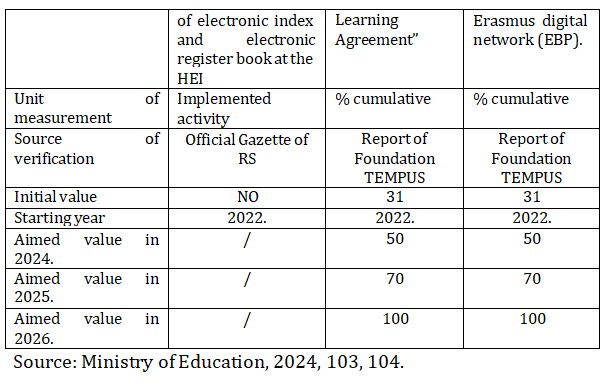
Within the Strategy for the Development of Education and Upbringing in the Republic of Serbia until 2030 (Government of the Republic of the Serbia, 2021), a special goal 2.4 was specified- Digitization of higher education. Achieving this goal is planned through the introduction of digital platforms, an electronic index and an electronic register of students (Special goal 2.4.1). Table 1 shows data from the Ministry of Education (2024) related to the introduction of digital platforms, the electronic index and the electronic register books of students.
Table 1: Introduction of digital platforms, an electronic index and an electronic register of students

Distance studies represent one type of modern approaches in education. They are based on the application of the Internet. Tables 2, 3, 4 and 5 show the representation of distance learning study programs at Universities, Faculties, Academies of Applied Studies and Colleges in Serbia.
Table 2: Representation of study programs of distance studies at Universities in Serbia (studies at the University)
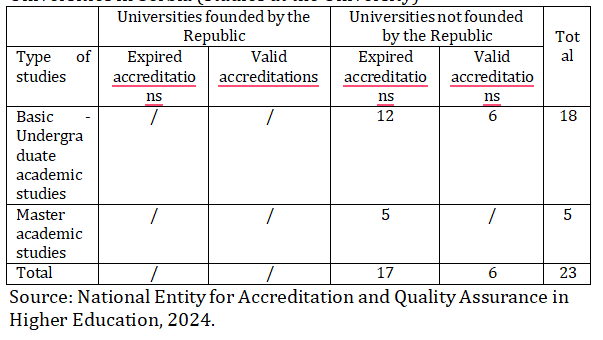
Table 3: Representation of distance learning study programs at faculties in Serbia
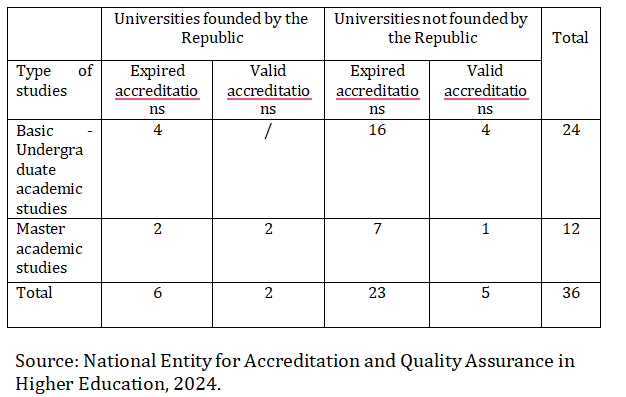
Table 4: Representation of study programs of distance learning at Academies of Applied Studies in Serbia

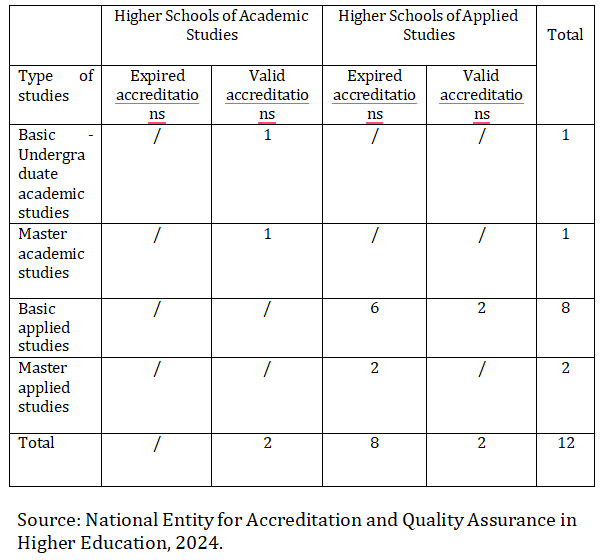
Table 5: Representation of distance learning study programs at universities in Serbia
Discussion
To achieve Special Objective 2.4. and 2.4.1. stated in the Strategy for the Development of Higher Education and Upbringing in the Republic of Serbia, it is necessary to undertake activities will include the development and adoption of legislation related to the use of electronic index and electronic register books at higher education institutions (HEIs), development of software for electronic indexes and electronic register books, development of guidelines for HEIs for issuing and using electronic index and electronic register books , development of guidelines for HEIs related to the activities of designing and introducing digital platforms at HEIs while respecting quality assurance standards and in accordance with the institutional framework at the state level.
From the table 1, it can be seen that 31% are cumulative HEIs that use the "Online Learning Agreement" platform and are part of the paperless Erasmus digital network (EBP). It is planned that this percentage in both categories will increase in 2024 to 50%, in 2025 to 70% and in 2026 to 100%. By introducing digital platforms, an electronic index and an electronic registry book, the Higher Education Institution will create an efficient system that facilitates the functioning and business of each Higher Education Institution, both for students and for employees working on administrative tasks. Technology has advanced so much that modern smart cards can store large amounts of data. These cards must also have mechanisms to preserve the secrecy of such data.
Distance studies represent one type of modern approaches in education. They are based on the use of the Internet. In the continuation of the study, we will explain the representation of distance studies in the modern educational system of Serbia. As per distance learning, it is widespread in the world. According to the data of Study Portals (https://www.distancelearningportal.com/), the USA offers the greatest number of study programs for distance learning (24,210). They are followed by Great Britain (8,931), Australia (4,167) and Canada (2,356). There are currently around 2,327 distance learning study programs offered in the countries of the European Union (EU) and this number is constantly increasing. Germany (377), Spain (369), Ireland (365), the Netherlands (313) lead the EU member states in terms of the number of distance study programs, while Lithuania (3), Romania (3) and Slovakia (5) have the fewest programs. In Article 43 of the Law on Higher Education (Official bulletin of RS", no. 88/2017, 73/2018, 27/2018
- other laws, 67/2019, 6/2020 - other laws, 11 /2021 - authentic interpretation, 67/2021, 67/2021 – other law and 76/2023) it is defined that the Higher Education Institutions can conduct a study program at a distance, in accordance with the work permit. The work permit, in addition to the study program, the number of students, the number of teachers, the facilities in which the activities are carried out, also defines whether the Higher Education Institution can carry out activities outside the headquarters, whether the study program is carried out remotely, as well as the maximum number of students who can study in this way. Organizing lectures and other forms of remote teaching is regulated by the detailed conditions and ways of realizing the study program at a distance in accordance with the general act of the Higher Education Institution. Within the National Entity for Accreditation and Quality Assurance, the Commission for Accreditation and Quality Assurance in Higher Education carries out accreditation procedures of higher education institutions, first-, second- and third-degree study programs as well as distance study programs every 7 years in accordance with the Standards and the Rulebook on Accreditation Standards and Procedures.
From the table 2, it can be seen that state universities (Universities founded by the Republic) neither have nor have had accredited distance studies at universities. When it comes to the private Universities (Universities whose founder is not the Republic), distance studies at the Universities have been and are being held by the Educons University and the Metropolitan University. The total number of expired accredited distance studies is 17 (University Educons - 2, University Metropolitan - 15), of which 12 are in Basic academic studies - BAS (University Educons - 2, University Metropolitan - 10) and 5 are in master's academic studies - MAS (Metropolitan University - 5). There are 6 valid distance study accreditations (Metropolitan University – 6), and all of them refer to Basic academic studies -BAS. Out of that number, 3 study programs have been accredited in the technical-technological (TT) field, 2 in the social-humanistic (SH) field, and 1 in the interdisciplinary, multidisciplinary and transdisciplinary (IMT) field. The number of students who can enroll in accredited distance learning programs is 206 per year (TT field - 86, SH field 96, IMT field 24) while the accreditation lasts (the period of validity of the accreditation is 7 years).
State faculties (table 3) had 6 accredited distance learning study programs (4 at BAS and 2 at MAS) and currently 2 accredited distance learning study programs in the SH field (2 at MAS). The total number of students who can enroll in accredited distance learning programs is 45. As for private faculties, the total number of accredited distance learning study programs whose accreditation has expired is 23 (16 at BAS and 7 at MAS). Out of those 23 study programs, 17 refer to the SH field (12 at BAS and 5 at MAS) and 6 at the TT field (4 at BAS and 2 at MAS). The total number of valid distance study accreditations is 5 (4 at BAS and 1 at MAS) and all are in the SH field. The number of students who can enroll in them is 198.
The number of expired distance study accreditations at the Academies of Applied Studies (table 4) is 5 (3 in the TT field and 2 in the SH field) and all relate to basic applied studies (OASS), while the number of valid distance study accreditations is 2 (1 in the TT field and 1 in the SH field). The number of students who can enroll in them is 55. At the Academies of Applied Studies in Serbia, there are no accredited distance studies for specialist applied studies (SSS) and master applied studies (MSS).
The total number of valid distance study accreditations at the Higher Schools of Academic Studies (table 5) is 2 (1 at BAS and 1 at MAS). Both study programs are in the SH field and can enroll 100 students per year. As for the Applied Study Colleges, we have 8 expired distance study accreditations (6 at OSS and 2 at SSS) and 2 valid distance study programs (both in the SH field) that can enroll 90 students per year.
The limitation of this study is the lack of comparative data for a longer period of time, on the basis of which the pace would be determined, i.e. speed of technological progress and digitization in the field of e-education in the Republic of Serbia. This is also the direction in which future research in this area should be directed.
As stated in the paper itself, it is impossible to imagine developed e-education without the use of the Internet. Thus, the foundation of the modern information society is the Internet, which connects billions of people around the world. We live in an era of digital transformation, which has enabled people to access information all over the world. As of January 2024, there were 5.35 billion internet users worldwide, which amounted to 66.2 percent of the global population. (Statista, 2024). Of course, there are differences between countries in terms of the share of the population that uses the Internet. Countries such as Norway, Saudi Arabia and the United Arab Emirates have a population share of 99% that uses the Internet, while on the other hand, North Korea is practically a country without the Internet, which ranks the last in the world in this parameter. The share of internet users in the EU was 92% in 2023, compared to 67% in 2010. (Eurostat, 2024).
According to the data of the Statistical Office of the Republic of Serbia (2023), 85.6% of households have an internet connection in the Republic of Serbia, which is an increase of 2.4 percentage points compared to 2022. The representation of computers in households is 75.9%, which represents a decrease of 1.1 percentage points compared to the previous year. As for the internet connection - 89.3% of internet users use a fixed broadband internet connection and it is the most common type of connection; 76.9% of households have a mobile broadband internet connection. Broadband internet connection is owned by 85.6% of households in the Republic of Serbia. In the last 3 months, 75.4% of people have used a computer, which is a decrease of 0.5
p.p. in comparison to 2022. The survey showed that 85.4% of people used the Internet, while 8.9% of people have never used it. In 2023 in the Republic of Serbia, over 91% of people using the Internet in the last three months use it several times during the day.
Since the Internet can be used for various purposes, we are interested in the use of the Internet for learning in the context of education. In 2023, there were 31% of participants in the EU using the Internet for learning. In 2023, the Netherlands (57%) and Finland (55%) reported the highest share among Member States of Internet users for learning purposes, while the lowest share was recorded in Romania (11%), followed by Bulgaria (15%) and Greece (16%). ). In Serbia, it is 27%, which puts us ahead of Bosnia and Herzegovina (23%), Montenegro (21%) and Turkey (16%) (Eurostat, 2024).
Realizing the importance of e-education and the application of digital technologies in it, the European Parliament (2020) adopted the European Digital Agenda for 2020-2030 defining adaptation to the digital age as one of the priorities. One of the policy areas of the EU is education - Articles 165 and 166 of the EU Treaty in the Functioning of the European Union (Eur-Lex, 2012). The Digital education action plan 2021-2027 (European Commission, 2021) helps the Member States to adapt their education systems to the digital era.
As stated, Serbia is part of the international, and especially the European educational, scientific, and artistic space. The adaptation of Serbia's educational system to the EU's educational system also applies to e-education. On this path, Serbia faces numerous problems, such as the competence of teachers who know how to use digital technologies in teaching, computer and IT literacy of students, access to the Internet, etc.
The Organization for Economic Co-operation and Development - OECD (2019) study named "The OECD Teaching and Learning International Survey - TALIS" found that less than 40% of educators are ready to use digital technologies. Differences in percentages are significant among EU member states. Serbia was not included in this research, so we do not have data on the percentage of educators ready to use digital technologies.
In 2018, the International Association for the Evaluation of Educational Achievement - IEA (2018) conducted a research in 13 countries (Chile; Denmark; Finland; France; Germany; Italy; Kazakhstan; Rep. of Korea; Luxembourg; Portugal; Russian Federation (Moscow); Uruguay; and United States) in which they monitored changes in the students' achievements related to digital skills. The results showed that more than one third of respondents do not have the most basic knowledge in the field of computer and information literacy in the context of teaching and learning. The percentage of students who have the ability to work independently when using computers as tools for information gathering and management was 21%, while only 2% of students showed that they have the ability to perform control and evaluation when searching for information online and creating informative displays.
Conclusion
Serbia's vision in the field of e-education should be compatible with the vision of high-quality, inclusive and accessible digital education in Europe. Nowadays, the progress of the country and society is unthinkable without progress in the education system, which includes the application of new technologies and digitization. Serbia has determined the main directions of digital literacy and formulated the key issues of quality e-education. On this path, Serbia faces numerous problems, primarily with insufficient investments in e-education, with weak technical equipment of HEIs, with insufficient internet speed and access of all actors in e- education to the Internet, low level of trust in the quality of e- education and e- learning, insufficient digital literacy of all actors in e-education (students, teachers) and others. We can achieve the reform of e-education directly (by applying the latest technological achievements in education, educating students how to use computers and new technologies and supporting teachers in the use of ICT in teaching, modernizing teaching, applying new educational technologies, improving the application of ICT in the implementation of study programs) and indirectly (by stimulating the economy and attracting investments, overcoming digital inequalities, deepening cooperation with the EU in the digital field and building innovative infrastructure and digital transformation of the country). The development of e-education must be based on new technological achievements. By solving these problems, we will raise e-education to a higher level. Without digital literacy, progress cannot be expected, and in order to achieve it, quality e- education is needed. Currently, work is being done in Serbia on the introduction of digital platforms, an electronic index and an electronic register of students. The representation of accredited study programs of distance studies in the Higher Education Institutions in Serbia is today at a lower level than in the previous distance study program accreditation period. Changes must be expected in this segment as well. Through the development of e- education, Serbia will experience positive effects on the development of the economy, greater competitiveness of the domestic economy on the international market, industrial growth, greater employment, greater competence and productivity of the workforce, technological and infrastructural development, as well as the distribution of social wealth.
Reference
https://inlibrary.uz/index.php/archive/article/view/8761
2.Academic Network of the Republic of Serbia – AMRES. About AMRES. https://www.amres.ac.rs/en/amres/about-amres
3.Amos, S.K. (2019). Digitization, Disruption, and the “Society of Singularities”: The Transformative Power of the Global Education Industry. In: Parreira do Amaral, M., Steiner- Khamsi, G., Thompson, C. (eds) Researching the Global Education Industry. Palgrave Macmillan, Cham. https://doi.org/10.1007/978-3-030-04236-3_11
4.Bejinaru, R. (2019). Impact of digitalization on education in the knowledge economy. Management Dynamics in the Knowledge Economy, 7(3), 367-380.
https://doi.org/10.25019/mdke/7.3.06
5.Borin, B., Caroli, M., Casalino, N., Cavallari, M., Di Carluccio, N., Di Nauta, P. et al. (2022). A New Approach to Enhance the Strategic Impact of Digital Education in Universities and to Foster the Development of a High Performing Common EU Smart Education Ecosystem. In: Uskov, V.L., Howlett, R. J., Jain, L. C. (eds) Smart Education and e-Learning - Smart Pedagogy. SEEL-22 2022. Smart Innovation, Systems and Technologies, vol 305. Springer, Singapore. https://doi.org/10.1007/978-981-19-3112-3_20
6.Chikopela, R., Sikanyika, F. S., Kalizinje, C. N. & Sondashi, G. (2021). Digitalization of Teaching and Learning: Experiences and Opportunities in Selected Higher Learning Institutions in Zambia. International Journal of Research and Innovation in Social Science (IJRISS), 5(9). 43-53. https://ideas.repec.org/a/bcp/journl/v5y2021i09p43- 53.html
7.Eur-Lex. (2012). EU Treaty in the Functioning of the European Union. Official Journal of the European Union, C 326/47. https://eur-
lex.europa.eu/LexUriServ/LexUriServ.do?uri=CELEX:12012 E/TXT:en:PDF
8.European Commission. (2021). Digital education action plan (2021-2027). Brussels. Author. https://education.ec.europa.eu/focus-topics/digital- education/action-plan
9.European Parliament. (2020). The European digital agenda for 2020-2030. https://www.europarl.europa.eu/erpl-app- public/factsheets/pdf/en/FTU_2.4.3.pdf
10.Eurostat. (2024). Digital economy and society statistics – households and individuals. https://ec.europa.eu/eurostat/statistics- explained/index.php?title=Digital_economy_and_society_sta tistics_-_households_and_individuals
11.Fedorenko, E. H., Velychko, V. Y., Stopkin, A. V., Chorna, A. V. & Soloviev, N. V. (2019). Informatization of education as a pledge of the existence and development of a modern higher education. CTE Workshop Proceedings [Online], 6, pp.20–32. https://doi.org/10.55056/cte.366
12.Gezici, H. S., Taspinar, Y. & Kocaoglu, M. (2021). Digitalization in International and Mass Education: A Model Proposal for Turkey. World Journal on Educational Technology: Current Issues, 13(4), 911-932. https://doi.org/10.18844/wjet.v13i4.6277
13.Goloborodko, A. (2022). Prerequisites and features of the development of e-education in the conditions of digitalization. In: Chova, L. G., Martinez, A. L., Lees, J. (eds.) EDULEARN22 Proceedings, 448-459. IATED.
https://doi.org/10.21125/edulearn.2022.0129
14.Government of the Republic of the Serbia. (2021). Strategy for the Development of Education and Upbringing in the Republic of Serbia until 2030. https://prosveta.gov.rs/wp- content/uploads/2021/10/SROVRS-2030-1.pdf
15.Hatos, A. (2019). The Impact of digitalization on educational achievement: a literature review from a sociological perspective. Calitatea vieţii, 30(1), 3-16.
16.Hoq, M. Z. (2020). E-Learning during the period of pandemic (COVID-19) in the kingdom of Saudi Arabia: an empirical study. American Journal of Educational Research, 8(7), 457-
464. https://doi.org/10.12691/education-8-7-2
17.International Association for the Evaluation of Educational Achievement – IEA. (2018). International Computer and Information Literacy Study. https://www.iea.nl/studies/iea/icils/2018
18.Kmecová, I. (2020). Digitization, digital technology, and importance of digital technology in teaching. In: Ashmarina, S., Vochozka, M., Mantulenko, V. (eds) Digital Age: Chances, Challenges and Future. ISCDTE 2019. Lecture Notes in Networks and Systems, vol 84. Springer, Cham. https://doi.org/10.1007/978-3-030-27015-5_63
19.Kolarski, L. (2022). Digitization in higher education: the case of digitization at universities in Tirana and Belgrade. Administracija i javne politike, 18(2), 49-65. https://doi.org/10.22182/ajp.1822022.3
20.Kolpakova, S., Yusupova, A., Ivanova, T. & Konovalova, Z. (2022). Current Trends in the Digitalization of University Education System. In: Chova, L. G., Lopez, A., Torres, I. C. (eds.) INTED2022 Proceedings, 3358-3366. IATED. https://doi.org/10.21125/inted.2022.0945
21.Kulik, S., Aladyshkin, I., Kalmykova, S. & Odinokaya, M. (2021). Development of E-Learning in a Modern Technical University. In: Dislere, V. (eds.) Rural Environment. Education. Personality. (REEP), 14, 110-119.
https://doi.org/10.22616/REEP.2021.14.012
22.Law on Higher Education, Official bulletin RS, No. 88/2017, 73/2018, 27/2018 - other law, 67/2019, 6/2020 – other law, 11/2021 – authentic interpretation, 67/2021, 67/2021
– other law and 76/2023. https://www.paragraf.rs/propisi/zakon_o_visokom_obrazo vanju.html
23.Law on the Basic of the Education and Training System, Official bulletin RS, br. 88/2017, 27/2018 - other law, 10/2019, 27/2018 – other law, 6/2020, 129/2021 and
92/2023.
https://www.paragraf.rs/propisi/zakon_o_osnovama_siste ma_obrazovanja_i_vaspitanja.html
24.Maatuk, A. M., Elberkawi, E. K., Aljawarneh, S., Rashaideh, H. & Alharbi, H. (2022). The COVID-19 pandemic and E- learning: challenges and opportunities from the perspective of students and instructors. Journal of computing in higher education, 34(1), 21-38.
https://doi.org/10.1007%2Fs12528-021-09274-2
Makhlouf, M. H. & Alani, R. (2024). COVID-19 and education: insights into the impact of E-learning on accounting education: evidence from Jordan. VINE Journal of Information and Knowledge Management Systems. 54(4), 930-945. https://doi.org/10.1108/VJIKMS-09-2021-0223
26.Milićević, V., Denić, N., Milićević, Z., Arsić, L., Spasić- Stojković, M., Petković, D. et al. (2021). E-learning perspectives in higher education institutions. Technological Forecasting and Social Change, 166(C), 120618. https://doi.org/10.1016/j.techfore.2021.120618
27.Ministry of Education. (2022). Digitalization in education. https://prosveta.gov.rs/prosveta/digitalizacija-u-prosveti-i- nauci/
28.Ministry of Education. (2024). Medium-term plan of the Ministry of Education for the period from 2024 to 2026 for the implementation of the strategy for the development of education and upbringing in the Republic of Serbia until 2030. https://prosveta.gov.rs/wp- content/uploads/2024/02/Srednjorocni-plan-MP-2024- 2026.pdf
29.Nafea, R. M. & Toplu, E. K. (2021). Future of Education in Industry 4.0: Educational Digitization–A Canadian Case Study. In I. Management Association (Ed.), Research Anthology on Digital Transformation, Organizational Change, and the Impact of Remote Work, 1977-1997. https://doi.org/10.4018/978-1-7998-7297-9.ch098
30.National Entity for Accreditation and Quality Assurance in higher education. (2024). A Guide to Accredited Higher Education Institutions and Study Programs in the Republic of Serbia. (2024). https://www.nat.rs/?script=cir https://www.nat.rs/en/default-page/?script=cir
31.OECD. (2019). TALIS 2018 Results (Volume I): Teachers and School Leaders as Lifelong Learners. https://doi.org/10.1787/1d0bc92a-en
32.Osaula, V., Parfeniuk, I., Lysyniuk, M., Haludzina-Horobets, V., Shyber, O. & Levchenko, O. (2021). Digitization of Education: Current Challenges of Education. International Journal of Computer Science & Network Security, 21(11), 368-
372. https://doi.org/10.22937/IJCSNS.2021.21.11.50
33.Prastyanti, S., Adi, T. N., Sulaiman, A. I. & Windiasih, R. (2022). Education Services for Students during the Covid-19 Pandemic. Education Quarterly Reviews, 5(3), 325-333. https://doi.org/10.31014/aior.1993.05.03.548
34.Rakha, N. A. (2023). Revolution in Learning Through Digitization: How Technology is Changing the Landscape of Education. International Journal of Cyber Law, 1(3). 1-16. https://doi.org/10.59022/ijcl.38
35.Rakic, S., Lolie, T., Lalic, B., Stefanovic, D. & Marjanovic, U. (2020). The acceptance of electronic learning in transition economies: evidence from the Republic of Serbia. In: František, J. (eds.) 18th International Conference on Emerging eLearning Technologies and Applications (ICETA), 552-557. IEEE.
https://doi.org/10.1109/ICETA51985.2020.9379173
36.Rastogi, H. (2019). Digitalization of education in India–An analysis. International Journal of Research and Analytical Reviews (IJRAR), 6(1), 160x-167x.
https://ijrar.com/upload_issue/ijrar_issue_20543139.pdf
37.Sitnicki, M. W., Horbas, I., Derkach, O. & Rozbeiko, K. (2023). The impact of digitalisation on the development of e- learning. E-mentor, 2(99), 11-21.
https://doi.org/10.15219/em99.1606
38.Statista. (2024). Number of internet and social media users worldwide as of January 2024.
https://www.statista.com/statistics/617136/digital- population-worldwide/
39.Statistical Office of the Republic of Serbia. (2023). The use of information - communication technologies in the Republic of Serbia.
https://publikacije.stat.gov.rs/G2023/Pdf/G202316018.pdf
40.Study portals. Browse Distance Learning Programmes Worldwide. https://www.distancelearningportal.com/
41.Suleimenov, I. E., Shaltykova, D. B. & Egemberdyeva, Z. M. (2020, May). Digitalization of higher education: the impact of the epidemiological crisis in the spring of 2020. In: Azarov, A. (eds.) 2nd International Scientific and Practical Conference “Modern Management Trends and the Digital Economy: from Regional Development to Global Economic Growth” (MTDE 2020), 138, 794-801. Atlantis Press. http://dx.doi.org/10.2991/aebmr.k.200502.129
42.Schulz, M. (2023). E-Learning as a Development Tool.
Sustainability, 15(20), 15012. https://doi.org/10.3390/su152015012
43.Tomić, S., Drljača, D. & Avramović, Z. Ž. (2021). E-education during COVID-19 pandemic: Apeiron University practical experiences. In: Bauk, S., Ilčev, S. D. (eds.) The 1st International Conference on Maritime Education and Development (ICMED). Springer, Cham. 363-373. Springer International Publishing. https://doi.org/10.1007/978-3- 030-64088-0_34
44.Voronkova, V., Nikitenko, V., Horodnycha, S., Kramar, V., Stanislavova, L. & Khavina, I. (2023). The Influence of Digital Technologies on the Development of Smart Education in a Technologically Advanced Society. Revista de la Universidad del Zulia, 14(41), 537-554.
https://doi.org/10.46925//rdluz.41.30
Objavljeno u
Vol. 30, No. 1, 2024.
Ključne reči
Licenca
Ovaj rad je objavljen pod Creative Commons Attribution 4.0 International (CC BY 4.0).
Autori zadržavaju autorska prava nad svojim radom.
Dozvoljena je upotreba, distribucija i adaptacija rada, uključujući i u komercijalne svrhe, uz obavezno navođenje originalnog autora i izvora.
Zainteresovani za slična istraživanja?
Pregledaj sve članke i časopise