
THE SIGNIFICANCE AND ROLE OF QUALITY MANAGEMENT FOR PROJECT SUCCESS

Abstract
Project management involves ensuring project quality from initiation through to completion. During project quality planning, it is essential to define quality standards across all processes involved in project development. Monitoring project process performance and implementing continuous performance improvements are key aspects of project success. Project success also involves delivering the expected level of project quality to all relevant stakeholders. Throughout the entire project life cycle, it is important to analyse the influence of all stakeholders. The aim of this paper is to highlight the significance and role of project quality management systems in order to provide a better understanding and assessment of the key factors that influence project success. Developing project management strategies enables a better understanding of all relevant stakeholders and an analysis of their expectations. Project quality planning, assurance, and control are key aspects that influence project success.
Article
Introduction
Project quality management involves clearly defining the concept of quality upon project initiation (Ouabira & Fakhravar, 2021; Project Quality Management, 2016; Jainendrakumar, 2015; Mosadeghrad, 2012). The project leader/manager, together with the members of the project team, should determine the quality standards that will be applied during project implementation (Mosadeghrad, 2012). The requirements for project funding, customers, the organisation, as well as other relevant project stakeholders should be taken into account in order to formulate appropriate definitions of project quality (Rose, 2014). In certain situations, the organisation itself or the specific field in which the project is carried out, as is the case with economic activities according to Ouabira & Fakhravar (2021), but also according to many researchers, for example education Jääskä & Aaltonen (2022), healthcare, Mosadeghrad (2012), Perez et al. (2022), construction Jallow et al. (2014), the automotive industry Kolter et al. (2025), and similar, may already possess established quality standards that can be directly applied to the initial project development (Jainendrakumar, 2015).
The concept of quality is defined in different ways. According to the definition of the author and quality pioneer Joseph M. Juran, quality is fitness for use (Juran, 1999). In addition, other prominent quality pioneers define quality differently: W. Edwards Deming defines quality as not only meeting customer requirements but also exceeding those requirements, while Philip B. Crosby defines quality as conformance to specifications (Živković, 2025; Suarez, 1992). Armand V. Feigenbaum defines quality as customer orientation (Feigenbaum, 1991), while Kaoru Ishikawa clearly emphasises that proof of a high level of quality is customer satisfaction, whose expectations continuously change (Suarez, 1992; Ishikawa & Loftus, 1990).
One of the models for ensuring project quality is the application of standards in order to meet the requirements and objectives of project implementation (Ouabira & Fakhravar, 2021; Project Quality Management, 2016). According to the ISO 21500 standard (Project, programme and portfolio management – Context and concepts, a project is defined as a temporary initiative undertaken to achieve one or more set objectives (ISO, 21500). Project quality is defined as the level to which the project fulfils requirements. Requirements refer to the establishment and application of policies and procedures in order to ensure that the project satisfies the defined needs for which it was conceived (Basu, 2014). According to the ISO 9000:2015 standard, requirements are defined as needs or expectations that are stated, generally implied, or obligatory (ISO, 9000). In the context of project management, requirements include the following (ISO, 9000):
– the requirements of relevant stakeholders, that is, what stakeholders expect from the project outcomes,
– legal requirements – obligations arising from laws or regulations related to the project,
– internal organisational system requirements – internal policies, procedures and standards that define quality during project implementation.
These requirements must be managed throughout the entire project implementation cycle (Jallow et al., 2014). Project requirements include the specified requirements in the project documentation (Basu, 2014). Project quality requirements are specific criteria and standards that the project must fulfil in order to ensure a higher level of quality and customer satisfaction (Ouabira & Fakhravar, 2021). They focus not only on the successful implementation of the project but also on ensuring that the results or outcomes satisfy defined standards, procedures and customer needs, and that the project also complies with legal regulations (Jallow et al., 2014).
According to the ISO 10006:2021 standard project management encompasses planning, organising, monitoring, controlling, and reporting on all aspects of the project, as well as motivating all participants in order to achieve objectives related to project quality (ISO, 10006).
The most important aspects of the significance of quality level according to this standard include the following (ISO, 10006):
a) understanding the needs and expectations of relevant stakeholders,
b) establishing or applying project quality management processes necessary to achieve the planned results,
c) identifying risks and opportunities associated with project processes and planned deadlines.
The role of project quality management involves managerial activities related to the project life cycle: from assessment, programme design, and pilot projects, up to the actual project implementation (Jainendrakumar, 2015; Jallow et al., 2014). In other words, these activities include the phases from project conception and development to its implementation in order to fulfil the requirements of relevant stakeholders. There is a lack of literature on project management, as well as a lack of broader discussion on whether this field belongs to practice or to wider academic circles (Davis, 2014). Therefore, the aim of this paper is to identify the key factors that influence project success in order to achieve a better understanding and insight into these factors through the significance and role of quality management, which has a substantial impact on project success.
The review and selection of relevant literature were conducted through a systematic search of available scientific and professional sources using the Kobson and Web of Science services, with the aim of identifying studies directly relevant to the subject and objectives of this review paper. The literature selection was based on the following criteria: relevance to the research topic related to project management, the scientific rigour of the sources, the currency of the publications, and their direct relevance to the key aspects of the issue under consideration. The review included articles published in relevant scientific journals, as well as other appropriate scholarly publications, with preference given to sources that provide theoretical and empirical contributions to the understanding of the topic under investigation.
Defining relevant project stakeholders
According to ISO 9000, relevant stakeholders are defined as parties that currently have or may have an impact on the organisational system. Project stakeholders include all members of the project team. These parties can be internal or external, with internal stakeholders encompassing members within the organisation, while external stakeholders include outside members. Furthermore, if many relevant stakeholders are involved in the project development process, they must be timely informed and engaged in all project development processes (Jallow et al., 2014). Project stakeholders include groups or individuals who invest resources in the project and expect potential benefits from them, most often financial compensation (Jääskä & Aaltonen, 2022). According to the ISO 21500 standard, project stakeholders are defined as a person, group, or organisation that has an interest in the project (ISO, 9000; ISO, 21500). The same standards further notes that stakeholders can also directly or indirectly influence the project, its performance, or outcome, either positively or negatively (ISO, 9000; ISO, 21500). Throughout the project duration, the different impacts of relevant stakeholders are analysed and defined as a method of data collection to determine whose interests should be considered (Jallow et al., 2014). This data collection method may include both quantitative and qualitative information. Stakeholders can influence many aspects of the project, some of which are highlighted (Project Management Institute, 2021; Jainendrakumar, 2015; Assudani & Kloppenborg, 2010):
– requirements – adding, removing, or adjusting project requirements,
– timeline – influence on accelerating or delaying the execution of project activities,
– project team – effective and efficient communication is needed to establish responsibilities and authorities,
– costs – impact on decreasing/increasing expenditures,
– planning – the achieved timeline should be in accordance with the planned activities,
– outcomes – results of the project implementation.
Quality culture includes knowledge-sharing activities and the promotion of interactive communication among stakeholders. Quality culture represents a way of thinking, behaving, and valuing within an organisation or project team that places quality at the centre of everything that is done.
Project stakeholders can include customers, the organisation entrusted with the project, financial organisations, the project team, legal government bodies, the wider community, and so on (Karlsen, 2002). Project managers should take into account the requirements of all relevant stakeholders (Jainendrakumar, 2015).
For a party to be considered a project stakeholder, it must possess one, two, or all three of the following aspects (Živković, 2012):
– power to influence project outcomes,
– legitimacy in relation to the project, and
– urgency of its claims in relation to the project.
The power to influence project outcomes indicates how much a stakeholder can affect the project or make decisions. Relevant stakeholders with significant power can directly or indirectly change the course of project development. Legitimacy as an aspect shows whether a stakeholder’s interest in the project is justified. If a relevant stakeholder is legitimate, this implies that their interest has the right to be considered. Urgency as an aspect indicates how important or time-sensitive it is to respond to the stakeholder’s demands. Urgency means that, if not addressed appropriately, problems may arise for subsequent activities during project implementation. For project quality management, it is very important to determine which relevant stakeholders have power, legitimacy, and urgency, as this forms the basis for prioritising whom to focus on, deciding how to communicate with them, and reducing the risk of potential non-conformities.
For the successful implementation of a project, the following stakeholders are most often identified according to Jainendrakumar (2015) and Karlsen (2002):
- project managers,
- project team,
- customers.
However, for different stakeholders, there is insufficient consensus regarding success factors, and deeper research is needed to address this complexity and the diversity of project success perceptions (Karlsen, 2002).
Project quality management system
To gain a competitive advantage in project implementation, organisational systems entrusted with the project invest significant efforts in improving quality at all levels of its development. Project teams should carry out intensive activities focused on investing in project quality in order to achieve the best possible performance. The modern business environment imposes the need for new, advanced, and innovative approaches to quality management for successful project implementation (Živković & Glogovac, 2015). Organisations in the public and private sectors should expand their business objectives to achieve the satisfaction of all project stakeholders through the application of sustainable approaches to the project quality management system (Filipović & Đurić, 2009). Such approaches enable continuous improvement of project performance, which can result in excellence in its implementation.
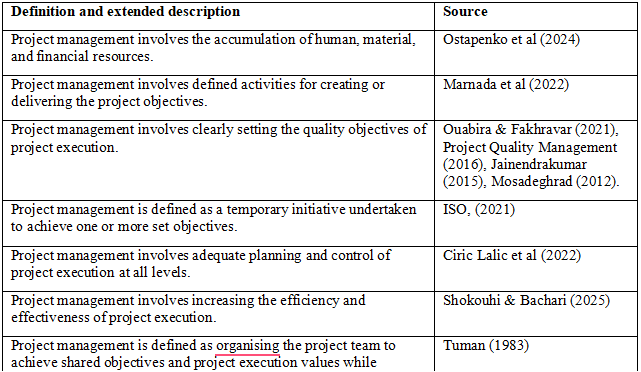
The project quality management system can be viewed as a system that has the commitment of the project’s top management and involves all members of the project team in order to achieve the defined project quality objectives (Filipović & Đurić, 2010). In this context, the quality management system gains increasing importance throughout the entire project life cycle. It can also be defined as an approach aimed at fulfilling, and preferably exceeding, the requirements, needs, and expectations of customers, as well as other project stakeholders (Filipović & Đurić, 2010). In earlier periods, the particular importance of developing a quality management system within a project was recognised. The concept of the project quality management system has a long historical foundation and has developed alongside societal progress and market changes. Organisational systems in the public and private sectors, to which the project is assigned, continuously seek new approaches that will enable more efficient and effective project implementation (Karlsen, 2002). Table 1 presents different definitions of project management.
Table 1. Different definitions of project management

Fundamentals of project management based on the ISO 9001 standard
One way to achieve efficiency and effectiveness in project implementation could be the application of the ISO 9001 standard. This standard represents a generally accepted international standard used as a model for establishing and applying a project quality management system. The standard is generic and can be applied in any organisation, regardless of its manufacturing or service activities (Živković, 2025; ISO, 9001). This standard defines the requirements of a quality management system and provides a clear framework for its implementation (ISO, 9001). A quality management system in accordance with ISO 9001 is based on key quality management principles, including customer orientation, leadership, active employee involvement, process approach, system approach, continuous improvement, decision-making based on facts, and relationship management ISO, 9001).
The principles of quality management within project management are based on a focus on customers and stakeholders, with the project’s objective being to meet, and where possible, exceed their requirements and expectations (ISO, 9001). Project management leadership provides a clearly defined vision, guidance, and motivation to the project team to achieve quality objectives. Active participation of project team members at all levels contributes to more efficient use of their knowledge and skills. A process approach in project management enables systematic planning, monitoring, and control of project activities. Continuous improvement forms the basis for enhancing project performance throughout the entire project life cycle (ISO, 9001). Decision-making based on relevant data and facts increases the reliability of managerial decisions, while effective stakeholder relationship management contributes to more successful and sustainable project implementation. The adoption of these principles is encouraged by the numerous benefits that organisational systems can achieve through the application of the ISO 9001 standard.
Among the most significant effects of applying this standard is the achievement of a higher level of quality in project development and implementation. ISO 9001 is part of the ISO 9000 series of standards, which is considered the most widely adopted series within the International Organization for Standardization. These standards do not focus exclusively on the quality of products and services but also on process management, the satisfaction of relevant stakeholders, and comprehensive management of the project quality management system. The application of this standard is aimed at improving the performance of project development and implementation. This standard is intended for certification. In addition to the ISO 9001 standard, there is also a standard adapted and intended specifically for projects, such as ISO 10006.
The basis for ISO 9001 as a management process is the iterative application of four steps: „Plan“, „Do“, „Check“, „Act“ cycle (Živković & Glogovac, 2015; Živković, 2012).
This iterative cycle is also called the continuous improvement cycle and consists of the following steps (|Živković, 2012):
„Plan” – establish the project quality objectives,
“Do” – implement the processes related to project execution,
“Check” – monitor and measure the project processes,
“Act” – take actions for the continuous improvement of project performance.
Fundamentals of project management based on the ISO 10006 standard
ISO 10006 is an international standard that provides guidelines for the project quality management system (ISO, 10006). This standard relates to the establishment and maintenance of a project quality management system. Unlike the ISO 9001 standard, which defines requirements, this standard contains guidelines for achieving project sustainability (ISO, 10006). Both the project organisation and the parent organisation should implement this international standard, which can influence the project in achieving its planned results. The application of this standard consists of key aspects, including defining the project quality management system, the responsibility of the project’s top management, project resource management, and the realisation of products or services in projects, which involves planning, developing, and delivering products or services in accordance with defined procedures and quality standard guidelines. In addition, for potential improvements, a segment involving measurement, analysis, and enhancement of project performance should also be applied (ISO, 10006).
Project Quality Planning
According to the research by Zwikael & Globerson (2006), project quality planning achieved the highest success in the fields of engineering and construction, while the lowest success was recorded in manufacturing organisations. To achieve project objectives, it is necessary to manage all project processes within the project quality management system (Pellerin & Perrier, 2019; Jainendrakumar, 2015). If the project organisation operates within a parent organisation, the project quality management system should be aligned, to the greatest possible extent, with the quality management system of the parent organisation. In cases where part or all of the project organisation is external to the executing organisation, it may be necessary to define the requirements of the quality management system (Pellerin & Perrier, 2019).
According to the ISO 9000 standard, quality planning is a part of quality management focused on establishing plans and objectives related to achieving quality goals (ISO, 9000). Project quality planning should identify the activities and resources necessary to achieve the project’s quality objectives (Zwikael, 2009). In addition, quality planning should address the following questions regarding the project:
– What is the objective of the project?
– Who are the customers and other relevant project stakeholders?
– What do the customers and other relevant project stakeholders want?
– What should the project solution deliver?
– What?, Who?, Where?, Why?, When?, and How? represent the key questions that need to be answered regarding project quality planning.
In developing the quality plan, both the parent and project organisations should apply risk-based thinking in the processes of the quality management system that are involved in achieving project objectives. Risks and opportunities should be considered in planning and supporting processes, as well as in processes related to project risks (Pellerin & Perrier, 2019). The foundation of effective project leadership and management is based on the competence of the project team in project execution (Pellerin & Perrier, 2019). There is a positive relationship between planned project development activities and project success (Serrador, 2013). Furthermore, the integration of human knowledge and artificial intelligence (AI) contributes to improving project planning success (Barcaui & Monat, 2023). An improved project plan unequivocally contributes to project success (Ayele, 2023). Project team skills, enhanced communication, and the efficiency and effectiveness of teamwork are key factors influencing the success of project planning (Kolter et al., 2025).
Project Quality Management
Project quality management involves all activities and processes aimed at ensuring that the project’s product, service, or outcome meets the defined requirements and expectations of relevant project stakeholders (Pellerin & Perrier, 2019). The goal is to ensure that the project is successfully executed in accordance with quality standards while minimising errors and risks. According to the ISO 9000 standard, quality management is a part of overall quality management focused on fulfilling quality requirements (ISO, 9000).
Project quality management comprises (ISO, 10006):
– project quality planning,
– project quality assurance,
– project quality control,
– project quality improvement.
Project quality management is a systematic approach that ensures all aspects of a project – from planning to execution and delivery of results – meet specific quality standards and the expectations of project stakeholders through the dynamic capabilities of the project team (Barbosa & Carvalho, 2024). It is not only about controlling the final product or service depending on the project’s objective, but also involves planning, monitoring, and continuously improving all processes within the project. Project quality management covers all project phases, aiming to ensure that the results achieve the highest possible level of quality, are reliable, and acceptable to all relevant project stakeholders, while continuously improving processes and preventing errors.
Project Quality Improvement
Organisations, whether parent or those entrusted with the project, invest continuous efforts in improving its quality. Project quality improvement encompasses all activities aimed at the continuous enhancement of project execution processes to meet the requirements of customers and other relevant project stakeholders (Pellerin & Perrier, 2019). The concept of continuous improvement used in quality management and project management is specific and characteristic of the Japanese term Kaizen, which translates as “continuous improvement or change for the better,” emphasising in practice that it is not a one-time improvement but involves ongoing enhancements (Vieira et al., 2022).
Project quality improvement includes the following steps:
– Reducing variation or deviations in project execution;
– Applying new ideas and innovations in project solutions;
– Eliminating existing and potential non-conformities during project work;
– Applying Kaizen throughout all project management processes.
According to the ISO 9000 standard, quality improvement represents an increase in the ability to meet quality objectives. Project quality improvement is a continuous process of enhancing project performance, enabling all project team members to consistently raise the level of quality, ensure the satisfaction of customers and other relevant project stakeholders, and minimise errors and deviations from the planned initial concepts (Moso & Olanrewaju, 2024). Project quality improvement means making intensive efforts to ensure that the project is better planned, organised, and executed so that the final result achieves a higher level of quality and meets the needs and requirements of customers, other project stakeholders, or project objectives (Pellerin & Perrier, 2019).
In other words, project quality improvement involves investing significant effort to make the project function better, become more efficient, and deliver improved outcomes. According to ISO 9001, project quality improvement refers to the continuous enhancement of the project quality management system, enabling the organisation to consistently meet the requirements of customers and other relevant stakeholders, as well as legal obligations, while also continuously improving the project’s results or outcomes. ISO 9001 not only ensures that the project’s quality level is maintained but also that it is continuously improved throughout all project activities (Moso & Olanrewaju, 2024).
Discussion and conclusions
The aim of this study was to examine the key aspects that influence the success of project outcomes. Project management is a managerial discipline whose application increases the likelihood of project success. Many factors affect project success, including adequate planning, management, and improvement of project execution. In addition, relevant stakeholders play a crucial role, such as the project team, customers, and regulatory bodies. As noted by researchers such as Davis (2014), different stakeholders and their perceptions influence project success. The establishment of strategic and operational plans is highly significant for project success. Project teams, led by efficient and effective management, also contribute to achieving project goals. Furthermore, a focus on quality and the application of quality standards represent a widely accepted model for improving process performance. Establishing a quality culture within project execution, which encourages teamwork, also contributes to enhancing project performance. Within the project team and among all relevant stakeholders, establishing efficient and effective communication is essential. Long-term success in project execution results from the synergy of strategy and planning, competent project team members, effective and efficient leadership, and the continuous improvement of project performance. Effective project execution is based on an innovative strategy as well as effective risk management, as suggested by Hindarto (2023). An innovative project strategy also involves integrating digital technologies with human knowledge (Tran & Nguyen, 2024). Through these approaches, project managers can respond more efficiently and effectively to new challenges in project management.
The synthesis of the reviewed literature shows that quality management is an important determinant of project success. The key factors identified include top management support, clearly defined quality objectives and standards, effective quality planning and control, continuous monitoring and improvement, effective communication and stakeholder collaboration, employee competence and involvement, and proactive risk management. The scientific contribution of this study lies in the systematic synthesis of existing findings and the identification of these interrelated factors as key mechanisms through which quality management contributes to successful project outcomes. The findings confirm that quality management should be integrated throughout the project life cycle rather than treated solely as a control activity.
This study has certain limitations. Firstly, no empirical research was conducted in specific project areas that would allow for a deeper understanding of the key factors influencing project success, which also represents directions for future research. Future studies could cover various areas, such as economic projects funded by non-repayable grants from EU funds aimed at improving infrastructure or addressing specific issues in the field of digitalisation.
References
2.Ayele, Y. G. (2023). The significance of planning and scheduling on the success of projects. Economics & Management Information, 1-10. https://doi.org/10.58195/emi.v2i1.66
3.Barbosa, M. T., & Carvalho, M. M. (2024). Toward a multilevel framework of dynamic capabilities through the lens of project management, project portfolio management, and project-based organizations. Project Management Journal, 55(3), 247-263. https://doi.org/10.1177/87569728231207028
4.Barcaui, A., & Monat, A. (2023). Who is better in project planning? Generative artificial intelligence or project managers?. Project Leadership and Society, 4, 100101. https://doi.org/10.1016/j.plas.2023.100101
5.Basu, R. (2014). Managing quality in projects: An empirical study. International journal of project management, 32(1), 178-187. https://doi.org/10.1016/j.ijproman.2013.02.003
6.Ciric Lalic, D., Lalic, B., Delić, M., Gracanin, D., & Stefanovic, D. (2022). How project management approach impact project success? From traditional to agile. International Journal of Managing Projects in Business, 15(3), 494-521. https://doi.org/10.1108/IJMPB-04-2021-0108
7.Davis, K. (2014). Different stakeholder groups and their perceptions of project success. International journal of project management, 32(2), 189-201. https://doi.org/10.1016/j.ijproman.2013.02.006
8.Feigenbaum, A. V. (1991). Total quality control (3rd ed., rev.). McGraw-Hill.
9.Filipović, J., & Đurić, M. (2009). Osnove kvaliteta. Fakultet organizacionih nauka.
10.Filipović, J., & Đurić, M. (2010). Sistem menadžmenta kvaliteta. Fakultet organizacionih nauka.
11.Hartman, F., & Ashrafi, R. (2004). Development of the SMARTTM Project Planning framework. International Journal of Project Management, 22(6), 499-510. https://doi.org/10.1016/j.ijproman.2003.12.003
12.Hindarto, D. (2023). The management of projects is improved through enterprise architecture on project management application systems. International Journal Software Engineering and Computer Science (IJSECS), 3(2), 151-161. https://doi.org/10.12821/ijispm100203
13.International Organization for Standardization. (2015). 9001:2015. Quality management systems–Requirements. ISO.
14.International Organization for Standardization. (2015). ISO 9000:2015 quality management systems-fundamentals and vocabulary.
15.International Organization for Standardization. (2021). ISO 21500:2021 (E)-Project, Programme and Portfolio Management: Context and Concepts. ISO.
16.International Organization for Standardization. (2021). SRPS ISO 10006:2021 Menadžment kvaliteta – Smernice za menadžment kvaliteta u projektima.
17.Ishikawa, K., & Loftus, J. H. (1990). Introduction to quality control (Vol. 98, p. 31). Tokyo: 3A Corporation.
18.Jääskä, E., & Aaltonen, K. (2022). Teachers’ experiences of using game-based learning methods in project management higher education. Project Leadership and Society, 3, 100041. https://doi.org/10.1016/j.plas.2022.100041
19.Jainendrakumar, T. D. (2015). Project quality management for project managers. PM World Journal, 4(7), 1–17.
20.Jallow, A. K., Demian, P., Baldwin, A. N., & Anumba, C. (2014). An empirical study of the complexity of requirements management in construction projects. Engineering, Construction and Architectural Management, 21(5), 505–531. https://doi.org/10.1108/ECAM-09-2013-0084
21.Juran, J. M., & Godfrey, A. B. (Eds.). (1999). Juran's quality handbook (5th ed.). McGraw-Hill.
22.Karlsen, J. T. (2002). Project stakeholder management. Engineering management journal, 14(4), 19-24. https://doi.org/10.1080/10429247.2002.11415180
23.Kolter, M., Grunow, M., Kolisch, R., & Stäblein, T. (2025). Strategic workforce and project planning for engineering automotive production systems: tackling the transition to electric vehicles. International Journal of Production Research, 63(3), 1105-1125. https://doi.org/10.1080/00207543.2024.2371097
24.Marnada, P., Raharjo, T., Hardian, B., & Prasetyo, A. (2022). Agile project management challenge in handling scope and change: A systematic literature review. Procedia Computer Science, 197, 290–300. https://doi.org/10.1016/j.procs.2021.12.143
25.Mosadeghrad, A. M. (2012). Towards a theory of quality management: An integration of strategic management, quality management and project management. International Journal of Modelling in Operations Management, 2(1), 89–118. https://doi.org/10.1504/IJMOM.2012.043962
26.Moso, M., & Olanrewaju, O. A. (2024). Application of a problem-solving lean model to evaluate kaizen projects for good quality assurance. In 2024 IEEE International Conference on Industrial Engineering and Engineering Management (IEEM) (pp. 1226–1229). IEEE. https://doi.org/10.1109/IEEM62345.2024.10857164
27.Ostapenko, T., Ponomarov, O., Turlo, Y., Osypova, Y., & Onopriienko, O. (2024). Defining the directions for the impact of administrative management tools on the project management system. Eastern-European Journal of Enterprise Technologies, 128(13). https://doi.org/10.15587/1729-4061.2024.302633
28.Ouabira, M. M., & Fakhravar, H. (2021). Effective project management and the role of quality assurance throughout the project life cycle. European Journal of Engineering and Technology Research, 6(5). https://doi.org/10.24018/ejers.2021.6.5.2345
29.Pellerin, R., & Perrier, N. (2019). A review of methods, techniques and tools for project planning and control. International Journal of Production Research, 57(7), 2160-2178. https://doi.org/10.1080/00207543.2018.1524168
30.Project Management Institute. (2021, July). A Guide to the Project Management Body of Knowledge (PMBOK® Guide)–Seventh Edition and The Standard for Project Management. Project Management Institute.
31.Project Quality Management. (2016). Project Management for Development Organizations.
32.Riveros Perez, E., Kerko, R., Lever, N., White, A., Kahf, S., & Avella-Molano, B. (2022). Operating room relay strategy for turnover time improvement: A quality improvement project. BMJ Open Quality, 11(3), e001957. https://doi.org/10.1136/bmjoq-2022-001957
33.Rose, K. H. (2014). Project quality management: Why, what and how (2nd ed.). J. Ross Publishing.
34.Serrador, P. (2013). The impact of planning on project success-a literature review. The Journal of Modern Project Management, 1(2), 27–33.
35.Shokouhi, M., & Bachari, M. S. (2025). An overview of the aspects of sustainability in project management. Progress in Engineering Science, 2(1), 100048. https://doi.org/10.1016/j.pes.2024.100048
36.Suarez, J. G. (1992). Three experts on quality management: Philip B. Crosby, W. Edwards Deming, Joseph M. Juran (TQLO Publication No. 92-02). Department of the Navy, Total Quality Leadership Office.
37.Tran, H. V. V., & Nguyen, T. A. (2024). A review of challenges and opportunities in BIM adoption for construction project management. Engineering Journal, 28(8), 79-98. https://doi.org/10.4186/ej.2024.28.8.79
38.Tuman, G. J. (1983). Development and implementation of effective project management information and control systems. In D. I. Cleland & W. R. King (Eds.), Project management handbook (pp. 495–532). Van Nostrand Reinhold.
39.Vieira, J., Etges, B. M. B. S., Pellegrino, R. A., Lins, M. A., & Costa, L. L. (2022). Kaizen as an improvement method for concrete walls construction in social housing project. In Annual Conference of the International Group for Lean Construction. https://doi org/10.24928/2022/0136
40.Wanjau, C. M. (2025). Project Team Planning and Performance of Housing Projects in Kenya.
41.Živković, N. (2012). Integrisani sistemi menadžmenta. Fakultet organizacionih nauka.
42.Živković, N. (2025). Model zrelosti sistema menadžmenta kvaliteta visokoškolskih ustanova (Doctoral dissertation, Univerzitet u Beogradu-Fakultet organizacionih nauka).
43.Živković, N., & Glogovac, M. (2015). Upravljanje kvalitetom. Fakultet organizacionih nauka, Univerzitet u Beogradu.
44.Zwikael, O. (2009). Critical planning processes in construction projects. Construction innovation, 9(4), 372-387. https://doi.org/10.1108/14714170910995921
45.Zwikael, O., & Globerson, S. (2006). Benchmarking of project planning and success in selected industries. Benchmarking: An International Journal, 13(6), 688-700. https://doi.org/10.1108/14635770610709059
Published in
Vol. 32 No. 2 (2026)
Keywords
Licence
This work is published under the Creative Commons Attribution 4.0 International (CC BY 4.0).
Authors retain copyright over their work.
Use, distribution, and adaptation of the work, including commercial use, is permitted with clear attribution to the original author and source.
Interested in Similar Research?
Browse All Articles and Journals