
INTERNATIONAL TRADE EXCHANGE OF THE REPUBLIC OF SERBIA: ANALYSIS OF EXPORTS, IMPORTS AND TRADE BALANCE IN THE PERIOD 2015–2024

Abstract
The paper analyzes the international trade exchange of the Republic of Serbia in the period 2015-2024, with special reference to trade relations with Europe, Asia, Africa, America, Oceania and the Polar region. The aim of the research is to analyze the dynamics of exports, imports, trade balance and the degree of coverage of imports by exports using descriptive statistics and comparative analysis. The results indicates the continuous growth of international trade of the Republic of Serbia, with the permanent presence of a trade deficit. Europe represents Serbia's most important international trade partner, while trade with Asia is characterized by a high deficit, and with Africa a predominantly surplus. The findings confirms the need for strengthening export competitiveness, technological modernization and diversification of export markets in order to improve international trade performance and sustainable economic development.
Article
Introduction
International trade turnover represents one of the most important indicators of economic development, competitiveness and economic openness (Kang & Dagli, 2018). The exchange of goods and services with foreign countries achieves a more efficient allocation of resources, encourages specialization, enables the transfer of technology and knowledge, as well as the more intensive involvement of national economies in international economic flows (Burstein & Vogel, 2017; Makioka & Zhang, 2024). In the conditions of globalization, growing markets interdependence and accelerated technological changes, international trade exchange becomes one of the key factors of economic and productivity growth as well as the improvement of international competitiveness (Coşar & Fajgelbaum, 2016; Susanto et al., 2024).
The analysis of international trade enables an overview of the economic performance of a country, since exports, imports, trade balance and export to import ratio represents significant indicators of the ecoonomy competitiveness as well as its ability to respond to international market demand (Moon, 2018; Gani, 2017). In addition, the structure and dynamics of international trade exchange provide insight into the production capacity, the level of technological development, the degree of export diversification and dependence on the import of certain products and raw materials (Xu et al., 2020; Hayakawa & Mukunoki, 2021). Therefore, their analysis represents an important basis for the creation of development, industrial and trade policy.
In the last decade, the Republic of Serbia achieved significant changes in the international trade sector that were conditioned by the process of European integration, the inflow of foreign direct investments, the modernization of production capacities and the more intensive inclusion of the domestic economy in international economic flows (Janković & Golubović, 2025; Nikolić & Lobanova, 2025; Božić & Nikolić, 2016). At the same time, international trade flows were strongly influenced by global economic development, including the COVID-19 pandemic, disruptions in international supply chains, the energy crisis, rising raw material prices and geopolitical instability (Getman, 2025; Beraha, & Jovičić, 2021). The aforementioned factors had a significant impact on the dynamics of exports and imports with pronounced declines in certain years, but also the growth of international trade in the following years (Gruszczynski, 2020).
Despite the continuous growth of exports, Serbia still faces challenges related to a high level of import dependence, trade deficit and the need for further improvement of export competitiveness (Ristanović et al., 2019; Nikolić & Petrović, 2018). Increasing the share of products with higher stages of processing in the export structure, diversifying export markets and strengthening the domestic industrial base are key prerequisites for achieving sustainable economic growth and reducing external macroeconomic imbalances (Kırcıcek & Ozparlak, 2023).
Materials and methods
The research is based on a quantitative approach and the application of descriptive statistical analysis of secondary data with the aim of analyzing the basic characteristics and trends of the international trade exchange of the Republic of Serbia in the 2015-2024 period. The subject of the research includes the analysis of the total international trade of the Republic of Serbia, as well as the exchange with certain geographical regions - Europe, Asia, Africa, America, Oceania and the Polar region. The analysis identifies the changes in the volume of exports and imports, the movement of the trade balance and the export to import ratio, with the aim of assessing the competitiveness of the Serbian economy on the international market.
The research used secondary data from the official statistical publications of the Statistical Office of the Republic of Serbia, which represent a relevant and reliable source of information on international trade flows. A time period of ten consecutive years (2015–2024) enabled the observation of long-term trends, as well as the impact of significant economic events, including the COVID-19 pandemic, the energy crisis and disruptions in international supply chains.
Descriptive statistics methods were used for processing and data analysis. Basic measures of central tendency (arithmetic mean and median), measures of dispersion (minimum and maximum value, standard deviation and coefficient of variation) were calculated, which enable assessment of the level and variability of the analyzed indicators. The analysis was conducted for four basic indicators of international trade: value of exports, value of imports, trade balance (exports minus imports) and the export to import ratio. In addition to descriptive statistics, a comparative analysis was applied in order to compare the characteristics of the exchange of the Republic of Serbia with different geographical regions, as well as a time series analysis which identified the basic development trends during the observed period.
The research results were interpreted in accordance with the economic theory of international trade and modern scientific knowledge in the field of foreign trade. The obtained results allow to see the changes in the volume and structure of the exchange of the Republic of Serbia, to assess the stability of certain indicators and to identify the regions that have the greatest importance for the development of international trade. Thus, this research provides the basis for an objective assessment of the competitiveness of the Serbian economy and the formulation of recommendations for improving export orientation and reducing the external trade imbalance.
International trade of the Republic of Serbia at the global level
The following table presents the export, import, trade balance of the Republic of Serbia as well as the export to import ratio as vital indicators of economic success or stability.
Table 1. International trade of the Republic of Serbia in the period 2015–2024. (in million USD)
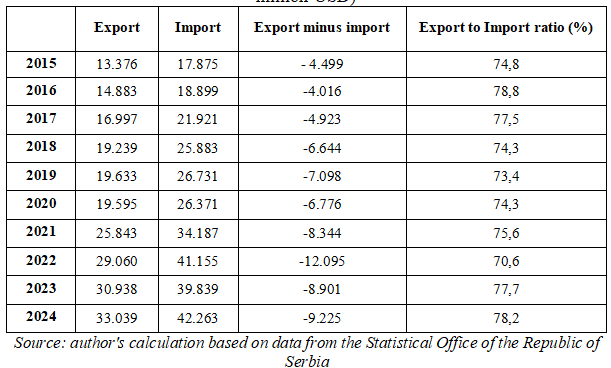
Analysis of the international trade exchange of the Republic of Serbia in the period 2015–2024. shows the continuous growth of exports and imports, with the permanent presence of a trade deficit. The values of exports and imports indicates the intensification of international trade, but also the long-term imbalance between the export and import components of the Serbian economy. In 2015, exports amounted to 13.376 million USD, while imports reached 17.875 million USD, resulting in a trade deficit of 4.499 million USD and an export to import ratio of 74.8%. By 2019, exports increased to 19,633 million USD (46.8%), while imports increased to 26,731 million USD (49.5%). As a result, the trade deficit increased to 7,098 million USD, which means that the growth of the domestic economy was accompanied by an even more intensive growth of imports.
The COVID-19 pandemic during 2020 did not significantly change the basic flows of international trade. Exports decreased by only 0.2%, while imports decreased by 1.3%, so the trade deficit remained at a high level (6.776 million USD), with the export to import ratio of 74.3%. Such results indicates the relative resilience of the export sector despite global disruptions.
The pandemic was followed by a strong recovery of international trade. In 2021, exports reached 25.843 million USD, while imports increased to 34.187 million USD. The largest trade deficit was recorded in 2022 (12,095 million USD), when the export to import ratio fell to the lowest level of 70.6%. Such developments are associated with rising energy prices, inflationary pressures and disruptions in international supply chains.
During 2023 and 2024 was noticeable a stabilization of international trade. The trade deficit was reduced to 8.901 million USD in 2023, i.e. 9.225 million USD in 2024, while the export to import ratio increased to 77.7%, i.e. 78.2%. These indicators indicates a gradual strengthening of export competitiveness and a more favorable export to import ratio after the unfavorable developments in 2022.
Observed for the entire period, the export of the Republic of Serbia increased by approximately 147%, and the import by approximately 136%. Despite the faster growth of exports, the trade deficit remained a permanent feature of international trade, while the export to import ratio ranged between 70.6% and 78.8%. The obtained results indicates that for the long-term reduction of the external imbalance, it is necessary to improve the technological competitiveness of the economy and reduce import dependence, especially in the segment of energy products and investment equipment.
Table 2. Descriptive statistics of the basic indicators of the international trade of the Republic of Serbia in the period 2015–2024.
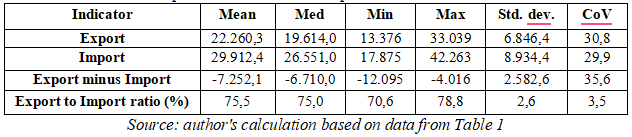
Descriptive statistical analysis of exports, imports, trade balance and export to import ratio was carried out in order to assess the basic characteristics of the international trade of the Republic of Serbia in the period 2015-2024. The results shows that the average annual value of exports was 22,260.3 million USD, while the average import was 29,912.4 million USD, which indicates the continued presence of a trade deficit. The average value of the trade balance was -7,252.1 million USD.
The coefficients of variation for exports (30.8%) and imports (29.9%) indicates moderate volatility of these indicators during the observed period, while the trade balance showed the greatest variability (35.6%), due to different dynamics of export and import growth. In contrast, export to import ratio was relatively stable, with an average value of 75.5% and a coefficient of variation of only 3.5%. This indicates that the export to import ratio has not changed significantly despite the growth of their absolute values. The obtained results confirms the continuous growth of the volume of international trade of the Republic of Serbia, but also the permanent presence of a trade deficit during the analyzed period.
International trade trends of the Republic of Serbia with Europe
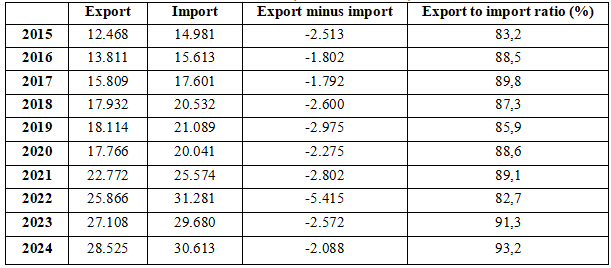
Analysis of exchange between the Republic of Serbia and the European market in the period 2015-2024. shows that Europe represented Serbia's dominant foreign trade partner, with continuous growth in exports and imports and the presence of a trade deficit throughout the observed period. The values are expressed in millions of US dollars and indicates a high degree of economic connection between Serbia and the European market, where exports largely followed the dynamics of imports.
Table 3. International trade of the Republic of Serbia with Europe in the period 2015–2024. (in million USD)
Source: author's calculation based on data from the Statistical Office of the Republic of Serbia
At the beginning of the analyzed period, in 2015, exports to European countries amounted to 12,468 million USD, while imports reached 14,981 million USD, resulting in a trade deficit of 2,513 million USD. Export to import ratio was 83.2%. By 2019, exports increased to 18,114 million USD, i.e. by approximately 45.3%, while imports increased to 21,089 million USD (40.8%). Despite the growth of foreign trade, the trade deficit increased to 2.975 million USD, which indicates that the growth of exports was accompanied by a continuous increase in imports from European countries.
The COVID-19 pandemic in 2020 led to a temporary decrease in the volume of trade exchange. Exports fell to 17.766 million USD, while imports decreased to USD 20.041 million. At the same time, the trade deficit was reduced to 2.275 million USD, and the export to import ratio increased to 88.6%, which indicates that the decline in imports was more pronounced than the decline in exports. Such trends confirm the relative resilience of Serbia's export sector towards the European market in the conditions of the global economic crisis.
The pandemic was followed by a strong recovery of trade exchange. In 2021, exports increased to 22.772 million USD, while imports reached 25.574 million USD. The most pronounced trade deficit was recorded in 2022, when it amounted to 5.415 million USD, with the lowest export to import ratio of 82.7%. Such developments are connected with the energy prices growth, inflationary pressures and the increase in the value of imports on the European market.
During 2023 and 2024, a significant improvement in foreign trade indicators can be noticed. The trade deficit was reduced from USD 5,415 million in 2022 to 2,572 million USD in 2023, and 2,088 million USD in 2024. At the same time, export to import ratio increased to 91.3%, and then to 93.2%, which represents the highest value in the observed period. This trend indicates the strengthening of the competitiveness of Serbian exports on the European market and the gradual establishment of a more balanced relationship between exports and imports.
Observed for the period 2015–2024. Serbia's exports to Europe increased by approximately 129%, while imports increased by approximately 104%. Although the trade deficit was present throughout the years, its value remained significantly lower than in the total international trade exchange of Serbia, and the export to import rati ranged between 82.7% and 93.2%. The obtained results confirms that the European market represents the most stable and competitive segment of Serbia's international trade, with a gradual approach to
the balance between exports and imports evident. Such developments indicates economy competitiveness growth and additionally the importance of the European market for the sustainable growth of Serbian exports and the improvement of overall international trade performance.
Table 4. Descriptive statistics of the basic indicators of the international trade of the Republic of Serbia with Europe in the period 2015–2024.
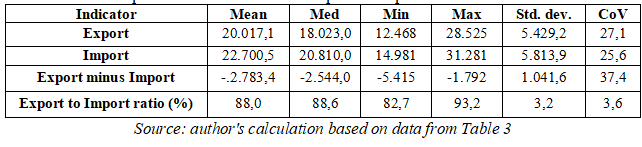
Descriptive statistical analysis of exports, imports, trade balance and export to import ratio was carried out in order to assess the basic characteristics of the international trade of the Republic of Serbia with Europe in the period 2015-2024. The results shows that the average annual value of exports was 20,017.1 million USD, while the average import reached 22,700.5 million USD, which indicates the continued presence of a trade deficit in exchange with the European market. The average value of the trade balance was -2,783.4 million USD, with the largest deficit occurring in 2022.
The coefficients of variation of exports (27.1%) and imports (25.6%) indicates moderate volatility of the analyzed indicators, while the trade balance showed the highest variability (37.4%), due to different dynamics of export and import movements during the observed period. On the other hand, the export to import ratio was extremely stable, with an average value of 88.0% and a coefficient of variation of only 3.6%. The obtained results confirms that the European market represented a relatively stable international trade partner of the Republic of Serbia, with a continuous growth of commodity exchange and a significantly higher degree of coverage of imports and exports than in the total foreign trade exchange of Serbia.
International trade trends of the Republic of Serbia with Asia
Analysis of the trade exchange of the Republic of Serbia with the Asian market in the period 2015–2024. shows a continuous growth of exports and imports, with a particularly high and permanent trade deficit. The values are expressed in millions of US dollars and indicate Serbia's significant import dependence on Asian countries. It is important to note that during the entire period, imports exceeded the value of exports many times over. Such an exchange structure is characteristic of trade relations with the Asian market, which as such represents one of the most significant sources of imports of industrial products, electronic equipment, machines and other products of higher technological complexity.
Table 5. International trade of the Republic of Serbia with Asia in the period 2015–2024. (in million USD)
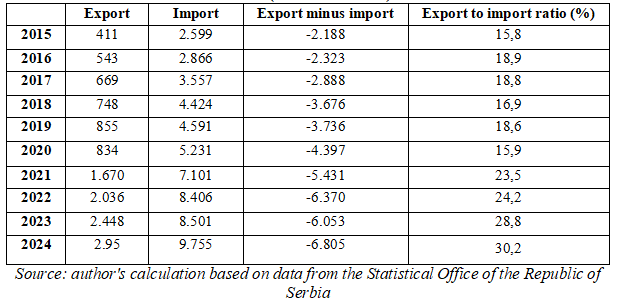
At the beginning of the analyzed period, in 2015, exports to Asia amounted to only 411 million USD, while imports reached 2,599 million USD, resulting in a trade deficit of 2,188 million USD. Export to import ratio amounted only 15.8%, which indicates a marked imbalance in trade. By 2019, exports increased to 855 million USD, or by approximately 108%, while imports increased to 4,591 million USD (76.6%). As a consequence of the faster absolute growth of imports, the trade deficit increased to 3,736 million USD.
The COVID-19 pandemic during 2020 did not lead to a decrease in imports from Asia, but on the contrary, imports increased further to 5,231 million USD, while exports slightly decreased to 834 million USD. Because of this, the trade deficit reached 4,397 million USD, and the export to import ratio decreased to 15.9%. Such trends confirm that Serbia has maintained a high level of import dependence on Asian markets, especially when it comes to industrial products and raw materials, even in conditions of global disturbances.
The pandemic was followed by a period of intense growth in trade. In 2021, exports almost doubled and reached a value of 1,670 million USD, while imports increased to 7,101 million USD. The growth trend continued during the following years, so in 2024, exports reached 2,950 million USD, and imports as much as 9,755 million USD. At the same time, the trade deficit increased to a record of 6,805 million USD. Although the deficit grew, there is a continuous improvement of the export to import ratio, which increased from 23.5% in 2021 to 24.2% in 2022, 28.8% in 2023 and 30.2% in 2024. This
indicates that exports to the Asian market grew faster than imports in the last years of the analyzed period.
Observed for the entire period 2015–2024. Serbia's exports to Asia increased by approximately 618%, while imports increased by approximately 275%. Despite the significantly higher growth rate of exports, the absolute difference between exports and imports remained very pronounced, as the trade deficit increased from 2,188 to 6,805 million USD. The export to import ratio also increased from 15.8% to 30.2%, but it was still many times lower than in Serbia's exchange with the European market. The obtained results indicates that the Asian market is the dominant source of imports for the Serbian economy, while exports, despite accelerated growth in recent years, have not yet reached a level that could significantly alleviate the existing trade imbalance. Further improvement of export competitiveness and diversification of the export structure are key prerequisites for a more balanced development of Serbia's trade relations with Asian countries.
Table 6. Descriptive statistics of the basic indicators of the international trade of the Republic of Serbia with Asia in the period 2015–2024.
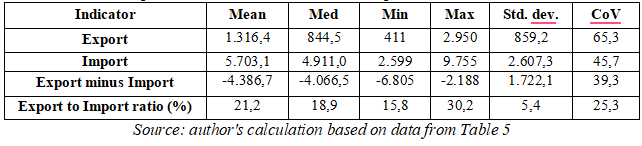
Descriptive statistical analysis of exports, imports, trade balance and export to import ratio was carried out in order to assess the basic characteristics of the international trade of the Republic of Serbia with Asia in the period 2015-2024. The results shows that the average annual value of exports amounted to 1,316.4 million USD, while the average import reached 5,703.1 million USD, which indicates a marked imbalance in trade with the Asian market. The average value of the trade deficit was -4,386.7 million USD, with the largest deficit recorded in 2024.
The coefficient of variation of exports (65.3%) indicates a very pronounced volatility, which reflects the strong growth of exports in the second part of the observed period. Imports was more stable, but still showed significant variability (45.7%), while the trade balance had a coefficient of variation of 39.3%, confirming the continued deepening of the trade deficit. The export to import ratio averaged only 21.2%, with a coefficient of variation of 25.3%, which indicates a gradual improvement, but still a very low level of coverage in relation to the exchange with Europe and the total international trade exchange of the Republic of Serbia. The obtained results confirms that Asia represents a market with an intensive growth of trade exchange, but also with an extremely high trade deficit in favor of imports.
International trade trends of the Republic of Serbia with Africa
Analysis of goods exchange between the Republic of Serbia and the African market in the period 2015–2024. shows a significantly different structure compared to trade with Europe and Asia. The values are expressed in millions of US dollars, and the characteristic of the exchange with Africa is a relatively small volume of trade, with marked annual fluctuations in exports and imports. During most of the analyzed period, Serbia achieved a trade surplus (with the exception of 2017), while a deficit was recorded only in the last two years.
Table 7. International trade of the Republic of Serbia with Africa in the period 2015–2024. (in million USD)
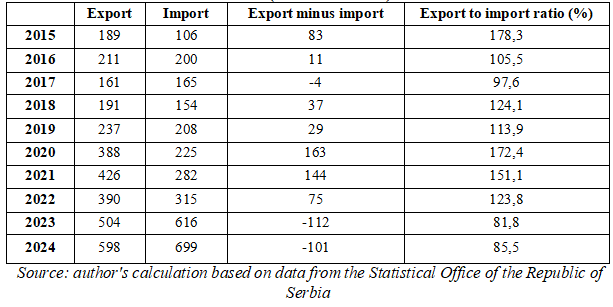
At the beginning of the analyzed period, in 2015, exports to African countries amounted to USD 189 million, while imports reached USD 106 million, resulting in a trade surplus of USD 83 million. The export to import ratio amounted to an extraordinary 178.3%, which means that the value of exports almost doubled the value of imports. In the following years were recorded pronounced oscillations. In 2016, the surplus was reduced to only 11 million USD, while in 2017 was achieved a slight trade deficit of 4 million USD, with almost complete equalization of exports and imports (97.6% coverage).
In the period 2018-2022. was established a positive trade balance. Exports increased from USD 191 million in 2018 to 426 million USD in 2021, while imports increased from 154 million USD to 282 million USD. The largest trade surplus was achieved in 2020 and amounted to 163 million USD, with export to import ratio of 172.4%. Such developments indicate that Serbia's exports to the African market grew significantly faster than imports during the pandemic, which contributed to the improvement of the trade balance. In 2022, the surplus was reduced to 75 million USD, while the export to import ratio amounted to 123.8%, which still confirms the favorable relationship between exports and imports.
However, during 2023 and 2024, there was a significant change in the structure of trade exchange. Imports from Africa increased from 315 million USD in 2022 to 616 million USD in 2023 and 699 million USD in 2024. Exports, however, grew at a slower pace and reached 504 million USD in 2023 and 598 million USD in 2024. As a result of the faster growth of imports, Serbia for the first time after 2017 realized a trade deficit that amounted to 112 million USD in 2023 and 101 million USD in 2024. At the same time, the export to import ratio decreased to 81.8% and 85.5%, which indicates a deterioration of the trade balance with the African market.
Observed for the entire period 2015–2024. Serbia's exports to Africa increased by approximately 216%, while imports increased by approximately 559%. Although exports were higher than imports during most of the period, the extremely accelerated growth of imports in the last two years led to the transition from a trade surplus to a deficit. Despite this, trade with Africa still constitutes a relatively small part of the value of international trade of the Republic of Serbia. The obtained results indicates that the African market has significant potential for further export growth, but also that in order to preserve a positive trade balance, it is necessary to strengthen export competitiveness and diversify the export offer, in order to mitigate the growing import and ensure a more sustainable development of trade relations with the countries of the African continent.
Table 8. Descriptive statistics of the basic indicators of the international trade of the Republic of Serbia with Africa in the period 2015–2024.
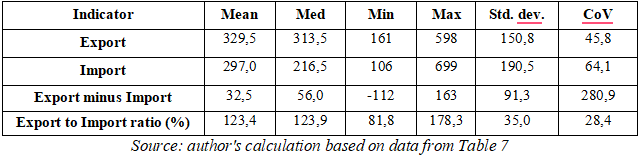
Descriptive statistical analysis of exports, imports, trade balance and export to import ratio was carried out in order to assess the basic characteristics of the international trade of the Republic of Serbia with Africa in the period 2015-2024. The results shows that the average annual export was 329.5 million USD, while the average import reached 297.0 million USD. In contrast to the exchange with Europe and Asia, the average trade balance with the African market was positive and amounted to 32.5 million USD, which indicates the achievement of an average surplus during the observed period.
The coefficient of variation of exports was 45.8%, while imports showed greater volatility (64.1%), which indicates more pronounced oscillations in the value of imports. The trade balance had the highest relative variability (280.9%), due to alternating years with surplus and deficit. The average export to import ratio was 123.4%, with a coefficient of variation of 28.4%, which confirms that in most of the analyzed period, Serbia achieved a surplus in trade with Africa, although a deficit was recorded in the last two years. The obtained results indicates that trade with Africa is significantly smaller in volume compared to Europe and Asia, but with a more favorable trade position of the Republic of Serbia during most of the observed period.
International trade trends of the Republic of Serbia with America
Analysis of the trade exchange of the Republic of Serbia with the American market in the period 2015–2024. shows the continuous growth of exports and imports, with the permanent presence of a trade deficit. Values are expressed in millions of US dollars, and the characteristic of trade relations with the American continent is a significantly smaller volume of exchange compared to Europe and Asia, with a gradual strengthening of Serbia's export activity and occasional reduction of the trade imbalance.
Table 9. International trade of the Republic of Serbia with America in the period 2015–2024. (in million USD)
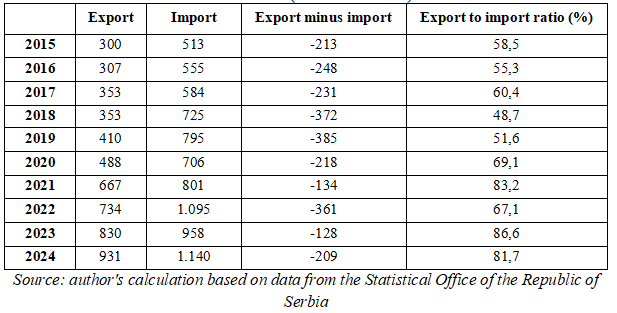
At the beginning of the analyzed period, in 2015, exports to the American countries amounted to 300 million USD, while imports reached 513 million USD, which resulted in a trade deficit of 213 million USD. The export to import ratio was 58.5%, which indicates that the value of exports was significantly lower than the value of imports. By 2019, exports increased to 410 million USD, or approximately 36.7%, while imports increased to 795 million USD (55.0%). As a result of faster import growth, the trade deficit increased to 385 million USD, and the export to import ratio ranged between 48.7% and 60.4%, with the lowest value recorded in 2018.
The COVID-19 pandemic in 2020 led to a decrease in imports from the US market, while exports continued to grow. Exports increased to 488 million USD, while imports decreased to 706 million USD, resulting in a reduction in the trade deficit to 218 million USD. At the same time, the coverage of imports by exports increased to 69.1%, which represents a significant improvement compared to previous years.
The post-pandemic period is characterized by more intense export growth. In 2021, exports reached 667 million USD, while imports amounted to 801 million USD, so the trade deficit was reduced to only 134 million USD, which represents the lowest deficit in the analyzed period. The export to import ratio increased to 83.2%, confirming the significant improvement of Serbia's export position on the American market. During 2022, imports increased sharply to 1,095 million USD, which led to the growth of the trade deficit to 361 million USD and a decrease of the export to import ratio up to 67.1%. In the following two years, exports continued to grow steadily and reached 830 million USD in 2023 and 931 million USD in 2024. At the same time, imports increased to 958 million USD, or 1,140 million USD, while the trade deficit remained relatively moderate compared to previous years. The export to import ratio was a high 86.6% in 2023 and 81.7% in 2024, which indicates the preservation of a more favorable relationship between exports and imports.
Observed for the entire period, Serbia's exports to American countries increased by approximately 210%, while imports increased by approximately 122%. Although the trade deficit was present throughout the years, exports grew at a significantly faster rate than imports, which contributed to the improvement of the export to import ratio from 58.5% to 81.7%. The obtained results indicates a gradual strengthening of the competitiveness of Serbian exports on the American market and a reduction of the trade imbalance in the long term. Although trade with the countries of America still constitutes a relatively small part of Serbia's total international trade, the evident growth of exports confirms the existence of significant potential for further improvement of economic relations and diversification of export markets.
Table 10. Descriptive statistics of the basic indicators of the international trade of the Republic of Serbia with America in the period 2015–2024.
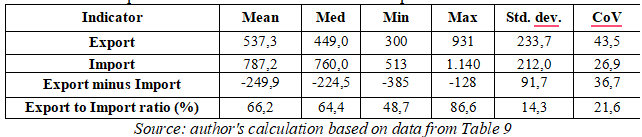
Descriptive statistical analysis of exports, imports, trade balance and export to import ratio was carried out in order to assess the basic characteristics of the international trade of the Republic of Serbia with America in the period 2015-2024. The results show that the average annual export value was 537.3 million USD, while the average import reached 787.2 million USD, which indicates the continued presence of a trade deficit in the exchange with the American market. The average value of the trade balance was -249.9 million USD, with the largest deficit occurring in 2019.
The coefficient of variation of exports was 43.5%, which indicates a more pronounced volatility compared to imports, whose coefficient of variation was 26.9%. The trade balance showed moderate variability (36.7%), while the average export to import ratio was 66.2%, with a coefficient of variation of 21.6%. The obtained results indicates that Serbia's trade exchange with America during the analyzed period recorded growth in both exports and imports, but without a significant reduction in the trade deficit, despite the improvement in the export to import ratio in recent years.
International trade trends of the Republic of Serbia with Oceania and the Polar Region
Analysis of the trade exchange of the Republic of Serbia with Oceania and the Polar region in the period 2015–2024. shows that it is a market with the smallest volume of international trade compared to other continents, but also a market where Serbia achieved a favorable trade balance during almost the entire analyzed period. The values are expressed in millions of US dollars, and the main characteristic of the exchange is the continuous growth of exports with a relatively low level of imports and a high export to import ratio.
Table 11. International trade of the Republic of Serbia with Oceania and the Polar Region in the period 2015–2024. (in million USD)

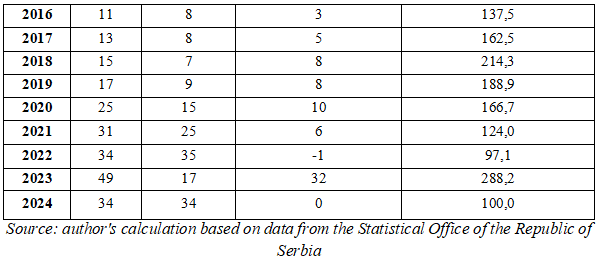
At the beginning of the analyzed period, in 2015, exports to the countries of Oceania and the Polar Region amounted to 10 million USD, while imports reached only 6 million USD, which resulted in a trade surplus of 4 million USD. The export to import ratio was 166.7%, which indicates that the value of exports was significantly higher than the value of imports. In the following years, the gradual growth of the trade exchange continued, with exports increasing from 10 million USD in 2015 to 17 million USD in 2019, while imports remained at a very low level and ranged between 7 and 9 million USD. As a result of such developments, Serbia continuously achieved a trade surplus during this period, with the export to import ratio ranging from 137.5% to 214.3%.
During the COVID-19 pandemic, trade with this market continued to grow. In 2020, exports increased to 25 million USD, while imports reached 15 million USD, resulting in a surplus of 10 million USD and an export to import ratio of 166.7%. In 2021, exports were further increased to 31 million USD, while imports reached 25 million USD, so the surplus amounted to 6 million USD. In contrast to previous years, in 2022 was realized a symbolic trade deficit of only 1 million USD, since exports amounted to 34 million USD and imports to 35 million USD. At the same time, the export to import ratio was 97.1%, which indicates an almost completely balanced trade exchange.
The most favorable results were achieved in 2023, when exports reached 49 million USD, while imports decreased to only 17 million USD. As a result, the trade surplus increased to a record 32 million USD, and the export to import ratio reached 288.2%, which represents the highest value in the analyzed period. In 2024, exports and imports were equal and amounted to 34 million USD each, which achieved a complete balance in trade, without a trade surplus or deficit, with export to import ratio of 100%.
Observed for the entire period 2015–2024. In 2008, Serbia's exports to Oceania and the Polar Region increased from 10 to 34 million USD, or about 240%, while imports increased from 6 to 34 million USD, or approximately 467%. Despite the faster relative growth of imports, Serbia achieved a trade surplus or a balanced trade exchange during almost the entire analyzed period, with a negligible deficit of 1 million USD recorded only in 2022. The obtained results indicate that, although Oceania and the Polar region participate with a very small share in the total interanational trade exchange of Serbia, trade relations with this market have a stable character and are characterized by a high degree of export competitiveness of domestic products.
Table 12. Descriptive statistics of the basic indicators of the international trade of the Republic of Serbia with Oceania and the Polar Region in the period 2015–2024.
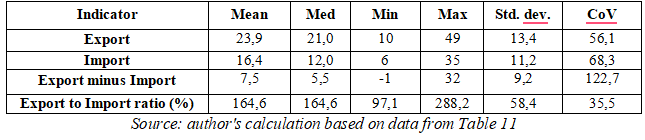
Descriptive statistical analysis of exports, imports, trade balance and export to import ratio was carried out in order to assess the basic characteristics of the international trade of the Republic of Serbia with Oceania and the Polar Region in the period 2015-2024. The results show that the average annual export value was 23.9 million USD, while the average import value was 16.4 million USD. The average value of the trade balance was 7.5 million USD, which indicates that on average Serbia achieved a trade surplus in exchange with this region.
The coefficients of variation of exports (56.1%) and imports (68.3%) indicates a pronounced volatility of commodity exchange, characteristic of smaller-scale markets. The trade balance showed a very high relative variability (122.7%), due to significant annual oscillations and changing surpluses and an almost balanced exchange. The average export to import ratio amounted to 164.6%, with a coefficient of variation of 35.5%, which confirms that the exports of the Republic of Serbia exceeded the value of imports in most of the observed period. Although the volume of trade with Oceania and the Polar region is relatively small compared to other continents, the results indicates a favorable international trade position of the Republic of Serbia in this segment of international exchange.
Conclusion
The conducted research made it possible to analyze the international trade exchange of the Republic of Serbia in the period 2015-2024. with Europe, Asia, Africa, America, Oceania and the Polar region. The results confirms the continuous growth of exports and imports, which indicates the strengthening of the involvement of the Republic of Serbia in international trade flows. At the same time, the trade deficit has remained a permanent feature of international trade, although in recent years there have been signs of its gradual reduction.
The analysis also confirms that Europe represents the most important international trade partner, with the largest volume of trade exchange and the most favorable export to import ratio. In contrast, trade with Asia is characterized by a marked trade deficit, while trade with Africa was in surplus during most of the analyzed period. Trade relations with America recorded a gradual increase in exports and an improvement of the export to import ratio, while trade with Oceania and the Polar Region, despite the small volume, was mostly balanced.
Descriptive statistical analysis showed that trade with Europe was the most stable, while trade flows with Asia, Africa and Oceania were more variable due to the smaller volume of trade and the influence of external economic factors. The COVID-19 pandemic and disruptions in international supply chains temporarily affected trade flows, but did not change their long-term trend.
The results also indicates that improving the international trade performance of the Republic of Serbia requires strengthening export competitiveness, increasing the share of products with higher added value, technological modernization and diversification of export markets. At the same time, the reduction of import dependence is an important condition for the long-term reduction of the trade deficit and sustainable economic growth.
The scientific contribution of the work is reflected in the comparative analysis of the international trade exchange of the Republic of Serbia with different geographical regions in the period 2015-2024. The obtained results can represent the basis for the improvement of development and trade policies, while future research should be focused on a more detailed analysis of the commodity structure of exports, technological competitiveness and the impact of international economic integration on the development of international trade of the Republic of Serbia.
Acknowledgement
This research is supported by the Ministry of Science, Technological Development and Innovation of the Republic of Serbia by the Decision on the scientific research funding for teaching staff at the accredited higher education institutions in 2026 (No. 451-03-34/2026-03/200375 of February 5, 2026).
References
2.Božić, D., & Nikolić, M. M. (2016). Obeležja spoljnotrgovinske razmene poljoprivredno-prehrambenih proizvoda Srbije. Marketing (0354-3471), 47(4).
3.Burstein, A., & Vogel, J. (2017). International trade, technology, and the skill premium. Journal of Political Economy, 125(5), 1356-1412.
4.Coşar, A. K., & Fajgelbaum, P. D. (2016). Internal geography, international trade, and regional specialization. American Economic Journal: Microeconomics, 8(1), 24-56.
5.Gani, A. (2017). The logistics performance effect in international trade. The Asian journal of shipping and logistics, 33(4), 279-288.
6.Getman, R. V. (2025). The world economic crisis of modern society. Održivi razvoj, 7(2), 73-80.
7.Gruszczynski, L. (2020). The COVID-19 pandemic and international trade: temporary turbulence or paradigm shift?. European Journal of Risk Regulation, 11(2), 337-342.
8.Hayakawa, K., & Mukunoki, H. (2021). The impact of COVID-19 on international trade: Evidence from the first shock. Journal of the Japanese and International Economies, 60, 101135.
9.Janković, G., & Golubović, M. (2025). Circular economy as the basis of today's sustainable development. Održivi razvoj, 7(1), 31-62.
10.Kang, J. W., & Dagli, S. (2018). International trade and exchange rates. Journal of applied economics, 21(1), 84-105.
11.Kırcıcek, T., & Ozparlak, G. (2023). The essential role of international trade on economic growth. Journal of Economics Finance and Accounting, 10(4), 191-202.
12.Makioka, R., & Zhang, H. (2024). The impact of export controls on international trade: Evidence from the Japan–Korea trade dispute in semiconductor industry. Journal of the Japanese and International Economies, 74, 101336.
13.Moon, B. E. (2018). Dilemmas of international trade. Routledge.
14.Nikolić, G., & Lobanova, J. Z. (2025). Izvoz usluga kao generator privrednog rasta Srbije: dinamika izvoza usluga i srednjoročne projekcije. Finansije, 80(1-3), 1-15.
15.Nikolić, G., & Petrović, P. (2018). Dinamika i kvalitativne promene srpskog izvoza 2000-2017. Kultura polisa, 15(36), 493-510.
16.Ristanović, V., Miljković, D., & Barjaktarević, S. (2019). Izvozni potencijal Srbije u EU. Megatrend revija, 16(1), 1-25.
17.RZS (2016). Statistical Yearbook https://publikacije.stat.gov.rs/G2016/Pdf/G20162019.pdf
18.RZS (2017). Statistical Yearbook https://publikacije.stat.gov.rs/G2017/Pdf/G20172022.pdf
19.RZS (2018). Statistical Yearbook https://publikacije.stat.gov.rs/G2018/Pdf/G20182051.pdf
20.RZS (2019). Statistical Yearbook https://publikacije.stat.gov.rs/G2019/Pdf/G20192052.pdf
21.RZS (2020). Statistical Yearbook https://publikacije.stat.gov.rs/G2020/Pdf/G20202053.pdf
22.RZS (2021). Statistical Yearbook https://publikacije.stat.gov.rs/G2021/Pdf/G20212054.pdf
23.RZS (2022). Statistical Yearbook https://publikacije.stat.gov.rs/G2022/Pdf/G20222055.pdf
24.RZS (2023). Statistical Yearbook https://publikacije.stat.gov.rs/G2023/Pdf/G20232056.pdf
25.RZS (2024). Statistical Yearbook https://publikacije.stat.gov.rs/G2024/Pdf/G20242057.pdf
26.RZS (2025). Statistical Yearbook https://publikacije.stat.gov.rs/G2025/Pdf/G20252058.pdf
27.Susanto, P. C., Subagio, M., Barus, G. A., Febrian, W. D., & Sani, I. (2024). International Trade: Economic Growth Supports Export and Import Activities. Greenation International Journal of Economics and Accounting, 2(1), 44-52.
28.Xu, Z., Li, Y., Chau, S. N., Dietz, T., Li, C., Wan, L., & Liu, J. (2020). Impacts of international trade on global sustainable development. Nature Sustainability, 3(11), 964-971.
Published in
Vol. 32 No. 2 (2026)
Keywords
Licence
This work is published under the Creative Commons Attribution 4.0 International (CC BY 4.0).
Authors retain copyright over their work.
Use, distribution, and adaptation of the work, including commercial use, is permitted with clear attribution to the original author and source.
Interested in Similar Research?
Browse All Articles and Journals