
THE STRATEGIC IMPORTANCE OF INTERNET, NEW KNOWLEDGE AND INFORMATION TECHNOLOGIES FOR THE SUSTAINABLE CULTURAL TOURISM DEVELOPMENT1

Abstract
Purpose: This study investigates the importance of new information technologies and the Internet in the promotion of cultural tourism, with the aim of highlighting their strategic role in the sustainable development of cultural tourism in modern society. Methodology: Empirical research was conducted through a questionnaire on a sample of 284 respondents from different regions of Serbia. The research used quantitative methods of data analysis, including descriptive statistics, t-test for independent samples and one-factor analysis of variance (ANOVA), using SPSS software.
Findings: The results showed that the majority of respondents use the Internet for information about cultural tourism, with the Internet perceived as a key tool for information exchange. No significant difference was found in respondents' attitudes according to gender, level of education, region of residence or work status, while older respondents used the Internet more often for cultural tourism. Implications: The study highlights the need to improve digital platforms and promote cultural tourism via the Internet. The results can be useful for decision-makers and policy-makers in the field of tourism for the development of sustainable strategies for the promotion of cultural destinations.
Article
1. Introduction
Contemporary society is characterized by numerous and radical changes in all human areas. Contemporary society is under the influence of numerous and radical changes in all spheres and areas of human activity. From very beginning of the 21st century until present days, there has been an increasingly present development in the field of technological achievements and the use of modern information and communication technologies in business activities, but also in human everyday life. These changes had their impact on the tourism industry as one of the most propulsive service industries. Tourism has faced and is still facing numerous challenges brought about by technical and technological progress. The swift advancement of the Internet and information and communication technologies (ICTs) over the past decade has significantly reshaped travel and tourism (Xiang et al., 2015), as well as the ways in which tourists engage with and experience various types of journeys (Soliman et al., 2021; Soliman, Cardoso, Almeida, Araújo, & Araújo Vila, 2021; Sustacha et al., 2023, p. 2). The role of information and communications technology for tourism economy was especially important during the corona virus pandemic. Gretzel et al. (2020) emphasize that modern ICT technologies play a crucial role in enabling the functioning of tourism during and after a pandemic (Bąk et al., 2022, p. 601). Tourism companies have realized that to ensure sustainability and optimize their business performance, it is necessary to become familiar with the key digital transformation trends and adopt them as soon as possible (Kalia et al., 2022). It is necessary, according to Thomas "to develop a culture receptive to risk and experimentation, which will allow the exchange of opinions, knowledge, proposals and ideas at all administrative levels, with the ultimate goal of the continuous development and evolution not only of the organization, but also of itself personnel" (Thomas, 2024, p. 182, 186). Many authors point out that the positive effects and advantages of using Internet and modern information technology are numerous (Das, et al., 2021; Lv, et al., 2022; Elkhwesky, et al., 2022; Loureiro, et al., 2022). From optimizing resource allocation, improving waste management, reducing energy consumption, minimizing the ecological footprint, enhancing health measures, and generating corporate social responsibility, all aimed at promoting sustainable tourism (Femenia-Serra et al., 2019; Elkhwesky et al., 2022). Ionescu and Sârbu (2024, p. 4) also analyzed positive effects of modern smart technologies on the tourism industry. As key positive effects, they pointed out "allocate room resources according to guests’ preferences, adapt the available cuisine to the tastes of existing tourists, facilitate the use of robots in the reception area, help tourists with access to their digital services, navigate unknown environments, and so on. However, there are some issues regarding the admission and the adoption of these technologies by tourists. The greater issues with modern technologies are tourists’ perceptions and attitudes towards them". Olearnik (2016) highlights the tourism market's strong dependence on the Internet, which plays a key role in multiple areas, including information sharing, presenting offers and reviews, booking and sales systems, social media engagement, and participation in tourism through global networks. Li et al. (2023) emphasize the crucial strategic role of smart technologies and the IT sector in the tourism industry. The authors point out that for over 25 years, tourism has been inseparable from technology, as all aspects of operations, structure, and marketing rely on the Internet and information technologies, facilitating connections between suppliers, consumers, and intermediaries. It is obviously that the implementation of Internet and ICTs is necessary for carrying out tourist activities. This implementation has become a new trend in the tourism industry in the direction to enriching tourists’ experiences and improving their satisfaction. The use of all types of smart technologies such as "artificial intelligence (AI), big data, machine learning, the Internet of Things (IoT), augmented reality (AR), virtual reality (VR), cloud computing, radio frequency identification devices (RFIDs), mobile payments, tourism-related platformsare" as point out Ionescu and Sârbu (2024, p. 1) is being studied more carefully in the tourism industry. The main goal of the paper is to investigate the importance of the Internet and new information technologies in the promotion of cultural tourism and to emphasize their strategic role in the sustainable development of cultural tourism in modern society. The motive of the research stems from the increasing digitization and the impact of information technologies on tourism. The paper deals with the need to improve digital platforms and promote cultural tourism via the Internet, which is particularly important in the context of sustainable development and increasing awareness of cultural heritage.
2. Background
Cultural heritage is the most important factor in creating and preserving identity, belonging and civic values, and it is recognized as one of the most important tourism resources (DiPietro et al., 2018). Throughout human history, the reasons and motivations for travel have continuously evolved, shaped by various cultures and historical periods, reflecting societal and individual development. Natural, anthropogenic, human and cultural factors are the most important factors that influence the creation of tourist offers and the performance of tourist activities in a destination (Premović, 2023). Kumar (2021) states that every piece of heritage contains knowledge embedded in it. With the global expansion of tourism, especially mass cultural tourism, there is a growing awareness that the development of cultural heritage should be based on thorough analysis, environmental impact assessments, strategic planning, and effective heritage management strategies (Sančanin et al., 2023). So, the market development strategy aims to penetrate a new market with an existing product (Nikolić et al., 2024). In the 21st century, the protection, promotion, scientific research, and valorization of cultural heritage are not solely the duty of individual institutions but a shared responsibility of society as a whole. This collective effort is essential for the long-term preservation of unique cultural, historical, and architectural values (Penjišević et al., 2024). In countries and tourist destinations that have a developed tourism economy, significant multiplier effects of the influence of tourism activities can be observed. "The complexity of culture significantly influences various facets of socio-economic structures, particularly in regions where traditional values and community dynamics play a pivotal role" (Wiagustini et al., 2024). The term "cultural tourism," often used synonymously with "heritage tourism" or "ethnic tourism," provides tourists with access to various cultural heritage attractions (Premović, 2023). The concept of "cultural tourism," frequently synonymous with "heritage tourism" or "ethnic tourism," allows tourists to experience the previously mentioned cultural heritage attractions (Filipović, 2018). In recent decades, the importance and role of cultural factors in the further sustainable development of tourism has been highlighted more and more (Premović, 2023). According to According to Milić (2014), cultural tourism represents a distinct form of sustainable tourism, characterized by travelers driven by their interest in historical, artistic, scientific, or traditional craftsmanship of a local community. As an increasingly significant segment of tourism, cultural tourism generates multiple socio-economic benefits, including financial support for the preservation, revitalization, and promotion of cultural heritage (Filipović, 2018). Vareiro et al. (2020) define cultural tourism as the movement of people to cultural attractions away from their usual place of residence, with the intention of gathering new information and experiences to satisfy their cultural needs (Zdravković et al., 2021). Tourism offers the opportunity to travel and experience other places, continents, nations, and religions. Tourists are interested in visiting foreign countries with rich cultural heritage, and cultural tourism not only generates profits but also stimulates economic development (Filipović, 2018). Tourism fosters curiosity about the traditions and customs of different nations, various cultural expressions, foreign languages, and advancements in information and communication technologies. Its development contributes to raising the overall level of education and cultural awareness among local communities engaged in tourism. By promoting appreciation for diversity and respect for different cultures, religions, national identities, and lifestyles, tourism plays a vital role in strengthening connections and relationships between people. The change in individual and collective-social value systems under the intense influence of tourism, through changes in the quality and style of life, represents significant socio-cultural effects of tourism's impact (Premović, 2021). The world's most developed countries actively promote their cultural heritage to boost tourism, investing substantial efforts in its preservation and presentation (Filipović, 2018). Tourists exhibit a strong interest in exploring the cultural heritage of foreign nations, which encompasses remarkable architectural structures, cultural landmarks, artworks, archaeological sites, and other significant attractions (Vakhitova, 2015). These cultural treasures are often safeguarded by national authorities, and those of international importance may also fall under the protection of UNESCO or other global organizations dedicated to cultural heritage preservation (Ryan & Silvanto, 2011; Zdravković et al., 2021). The intangible cultural aspect holds considerable potential for further enhancement and growth, benefiting not just tourism activities but also contributing to the broader socio-economic development in the Western Balkan countries. Local communities in the Western Balkans have substantial potential for tourism development through enhancing the offer of cultural and event tourism and promoting their authentic intangible cultural values. Tourism is considered a key strategy for promoting ecological preservation and socio-economic development in local communities inhabiting areas around protected natural resources (Ristić et al., 2024). Tourism as a mass social phenomenon can significantly influence the reduction of numerous prejudices, especially linguistic, cultural, religious, and national ones. Tourism expands the horizons and cognitive perspectives of all its participants. Exploring new cultures, meeting different people, and learning about their customs, traditions, religions, and habits creates a significant positive social impact. This process involves gaining new knowledge and broadening one’s understanding of different regions, beliefs, and cultures. In this way, tourism can play a positive role in fostering greater tolerance, understanding, and acceptance of diversity within the population of the Western Balkans (Premović, 2021). The growth of cultural tourism is evident not only in social indicators but also in financial ones. According to some findings, authors estimated that “cultural tourists spend one third more than average tourists spend, which is why cultural tourism is ranked among the ten most important and most dynamic tourist branches, and an increasing production of cultural activities, influences the increase of its competitiveness”. The increasing interest in cultural tourism presents an opportunity for cultural heritage to become a sustainable development resource, benefiting both local and wider communities, provided its preservation is ensured. It supports the financial and organizational independence of cultural institutions and organizations, while also contributing to the decentralization of culture (Filipović, 2018). The degree of financial inclusion is heavily shaped by a nation's culture, especially in terms of its openness to adopting digital transformation as a means to achieve financial inclusion. Studies conducted across different cultural regions emphasize the influence of cultural traits and the diversity of cultures on the level of financial inclusion in various countries (Raji et al., 2024). Cultural tourism has a significant economic impact on many countries, especially those that are still developing.
Besides its economic advantages, cultural tourism is essential for enhancing awareness and appreciation of a nation's cultural values, reinforcing cultural identity, and fostering a positive image of the community (Filipović, 2018). Tourism has the potential and should play a crucial role in the overall socio-economic development of underdeveloped countries and regions, including those in the Western Balkans. Quality management of cultural heritage Carbone et al. (2020) define as a complex and continuous process aimed at achieving a balance between the preservation of cultural assets and their use by local residents and tourists using available resources, in order to ensure effective communication with the public, appropriate types of services, as well as the promotion of diversity, cultural awareness and intercultural dialogue. The development of information technologies and the Internet has significant social implications, especially in the field of cultural tourism. It enables easier access to information about cultural destinations, encourages digital literacy and contributes to the preservation of cultural heritage through digitalization. At the same time, improving the tourism offer via the Internet can influence the development of local communities, increase interest in cultural exchange and strengthen cultural identity. From a political perspective, the digitalization of cultural tourism can encourage the creation of sustainable development strategies, enable decision-makers to better manage cultural resources and improve international cooperation in the field of tourism. Policies aimed at digital marketing and the promotion of cultural heritage can contribute to greater global visibility of certain destinations, while the use of the Internet can improve transparency in the management of the tourism sector. In an economic context, the growth of digital platforms in cultural tourism leads to increased tourism revenues, the creation of new jobs and the stimulation of the development of small and medium-sized enterprises involved in tourism. Digitalization allows for the reduction of promotion costs and enables direct communication between tourists and service providers. At the same time, more efficient use of data on tourist flows can lead to better planning and sustainable management of tourism resources. The use of the Internet in cultural tourism has the potential to positively impact social development, political strategies and economic stability, fostering sustainable and inclusive growth of this sector.
Based on the above mentioned, the following hypotheses are examined in this paper:
Hypotheses
H1: The use of the Internet and smart technologies has a positive effect on tourists' awareness of cultural tourism.
H2: There are no significant differences in respondents' attitudes towards the use of the Internet for cultural tourism in relation to gender, level of education, region of residence and work status.
H3: Older respondents use the Internet more often for information about cultural tourism compared to younger generations.
3. Materials and methods
The empirical research was conducted from June to August 2024 on the territory of the Republic of Serbia. Data were collected using an online questionnaire distributed electronically through social networks, e-mail communication, and personal contacts. The study included respondents from five geographical regions of Serbia: the Belgrade region, Vojvodina, Central-Western Serbia, Southeast Serbia, and South Serbia.
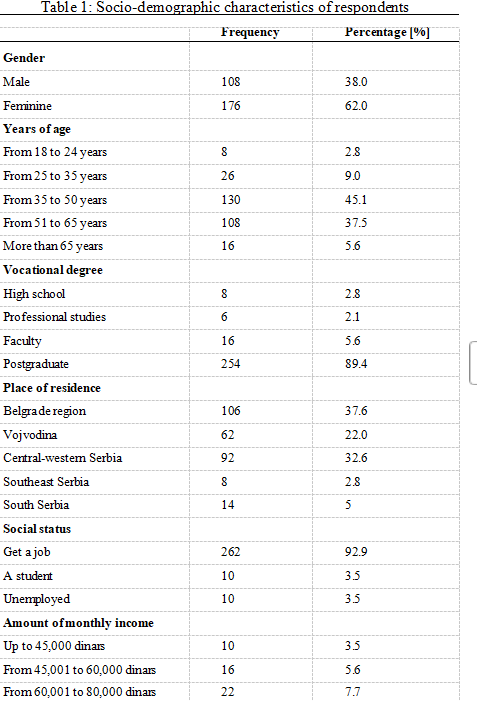
A total of 284 respondents participated in the research. The sample included adult respondents of different gender, age, educational level, employment status, and monthly income. The structure of the sample is presented in Table 1. The largest proportion of respondents belonged to the age categories from 36 to 50 years and from 51 to 65 years. Most respondents had completed postgraduate education and were employed.
A non-probability convenience sampling method was applied, since respondents voluntarily participated in the research and the questionnaire was distributed online to available participants. Although this type of sampling does not allow full generalization of the results to the entire population, it was considered appropriate for exploratory research focused on examining attitudes and perceptions regarding the use of the Internet and smart technologies in cultural tourism.
The survey instrument was an original questionnaire created for the purposes of this research, based on relevant literature and previously published studies in the fields of tourism, information technologies, and cultural tourism. The questionnaire consisted of two sections. The first section included socio-demographic questions related to gender, age, education, region of residence, employment status, and monthly income. The second section contained statements related to the use of the Internet and smart technologies in cultural tourism.
All statements were evaluated using a five-point Likert scale ranging from 1 (Strongly disagree) to 5 (Strongly agree). The collected data were analyzed using the Statistical Package for the Social Sciences (SPSS), version 26.0. The applied statistical methods included descriptive statistics, Cronbach’s α coefficient, independent samples t-test, one-way analysis of variance (ANOVA), Kruskal-Wallis test, and simple linear regression analysis.
Participation in the research was voluntary and anonymous, and respondents were informed that the collected data would be used exclusively for scientific research purposes.
4. Results and discussion
The research was conducted from the beginning of June to the end of August 2024, using an online questionnaire and a convenience sample. The questionnaire was compiled by the author based on the existing ones. The research involved 284 respondents, with 108 being male and 176 being female (Table 1). Most respondents are in the age co-category of 36 to 50 years (45.1%) and 51 to 65 years (37.2%) (Table 1). The majority of respondents are from the Belgrade region (37.6%) and central-western Serbia (32.6%), while the smallest number of respondents is from southeastern Serbia (2.8%) (Table 1). The vast majority of respondents completed postgraduate studies (89.4%), employed are (92.9%) with predominantly incomes of over 80,000 dinars (Table 1).

Source: Authors’ research
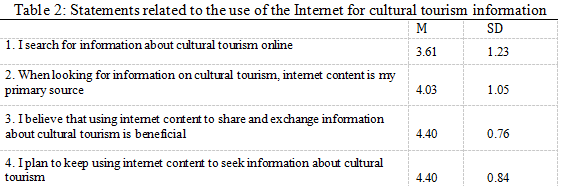
We examined claims related to the use of the Internet for cultural tourism information. The statements that using internet content to share and exchange information about cultural tourism is beneficial (M = 4.40, SD = 0.76) and that respondents are inclined to keep using the internet to gather information about cultural tourism (M=4.40, SD=0.84) received the highest level of agreement. On the other hand, the statement that respondents always search for information about cultural tourism on the internet received the lowest level of agreement (M= 4.40, SD = 0.76).
Source: Authors’ research
We then looked at statements related to how often you use the Internet for information about cultural tourism. Respondents most frequently accept a friend's invitation to exchange information and interesting facts about cultural tourism via the internet (M = 2.80, SD = 1.19) and enjoy using the internet to communicate with others about cultural tourism (M = 2.60, SD = 1.05). However, they rarely use the internet daily to search for information about cultural tourism (M = 1.91, SD = 0.95).
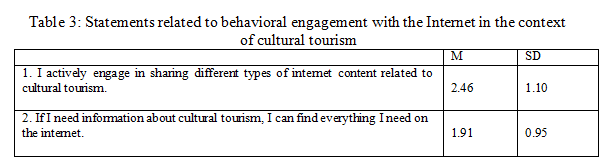

Note: These items were designed to reflect behaviors rather than precise time-based frequencies of Internet use.
Source: Authors’ research
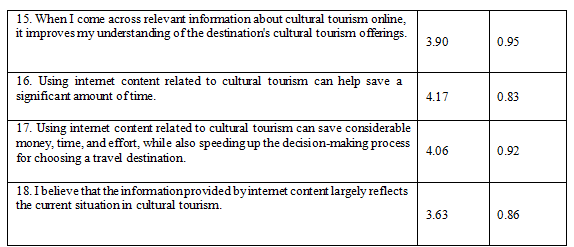
We looked at the statements related to the degree of agreement for statements about the internet and cultural tourism. The strongest agreement was with the statements that using the internet for cultural tourism can save significant amounts of time (M = 4.17, SD = 0.83) and that it can save money, time, and energy, while also speeding up the decision-making process regarding travel destinations through internet content related to cultural tourism (M = 4.06, SD
= 0.92). The weakest agreement was found for the statement that respondents use internet content to share their feelings and experiences related to cultural tourism (M = 2.71, SD = 1.11).
Three main variables were used in the research:
1. Use of the Internet for cultural tourism. This variable measures the purposes and motives of using the Internet in the context of cultural tourism. The focus is on why respondents use the Internet – whether to find out about events, plan visits, or find cultural content. It is measured through statements that examine different aspects of information about cultural content (Table 2).
2. Frequency and form of Internet use for cultural tourism. This variable measures the frequency and forms of Internet use for cultural tourism. It includes how often respondents search for information and which channels they use (Google, social networks, forums, etc.).
3. "Internet and cultural tourism" – Key research variable related to respondents' perception of the importance of the Internet for cultural tourism. It differs from the first two because it does not measure only the frequency of use, but also the impact of the Internet on tourists' decisions, time saving, availability of information and connection of users with cultural tourism content.
Therefore, all the mentioned research methods were used in the paper, multi-criteria decision-making was applied in the analysis of factors that influence the choice of cultural destinations, while the third variable "Internet and cultural tourism" has a broader analytical focus, because it does not measure only the habits of using the Internet, but also its overall perception and impact on tourism.
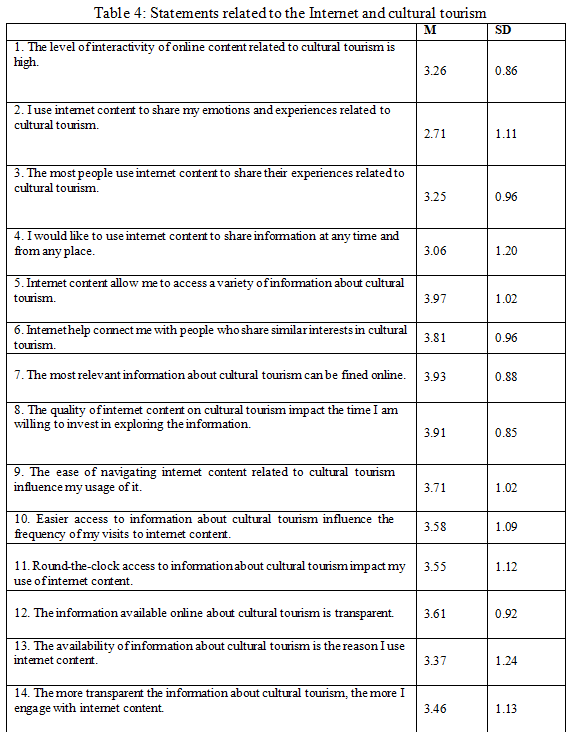
Note: Although these items are phrased as questions, they were rated on a 5-point Likert scale (1 = Strongly disagree, 5 = Strongly agree), in line with the other sections of the questionnaire. Source: Authors’ research
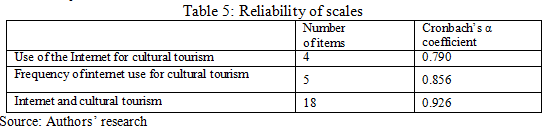
The reliability of the scales employed in the research was assessed using the Cronbach α coefficient. Based on the results in Table 5 and the Cronbach α coefficient value, it can be concluded that the reliability of the Internet and cultural tourism scale is excellent, the scale for frequency of Internet use for cultural tourism is good, and the scale for Internet use in cultural tourism is satisfactory.
As part of the study, an examination was conducted to determine if there is a difference in respondents' attitudes toward using the internet for cultural tourism based on their gender. To analyze these differences, an independent samples t-test was used. The results showed that the significance level of the t-test was higher than the observed statistical level for all variables. Based on this, we can conclude that there is no statistically significant difference in attitudes related to the gender of the respondents (as shown in Table 6).

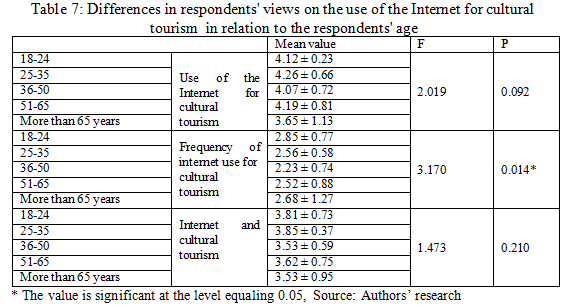
As part of the research, the study investigated whether there is a difference in respondents' attitudes toward using the internet for cultural tourism based on their age. A one-way analysis of variance (ANOVA) was conducted to evaluate these differences. The results revealed that the significance level of the ANOVA test was lower than the observed statistical threshold for the frequency of internet use for cultural tourism, indicating a statistically significant difference in attitudes based on age (Table 7). Specifically, a significant difference was found between respondents aged 36 to 50 and those aged 51 to 65 (p = 0.048), with older respondents using the internet more frequently for cultural tourism. However, for the other two variables, the significance level of the ANOVA test was higher than the observed statistical threshold, suggesting no statistically significant difference in attitudes based on age for these variables (Table 7).
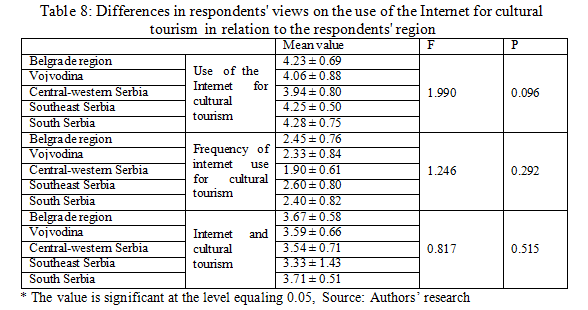
As part of the study, it was investigated whether respondents' views on using the internet for cultural tourism vary by region. A one-way analysis of variance (ANOVA) was conducted to assess these differences. The results showed that the significance level of the ANOVA test exceeded the observed statistical level for all variables. Therefore, we conclude that there is no statistically significant difference in respondents' views based on their region (Table 8).
As part of the research, it was investigated whether there are differences in the views of respondents regarding the use of the Internet for cultural tourism in relation to their level of education. A one-factor analysis of variance (ANOVA) was used to examine these differences. The results showed that the significance level of the ANOVA test was higher than the observed statistical level for all variables, leading us to conclude that there is no statistically significant difference in relation to the respondents' level of education (Table 9).
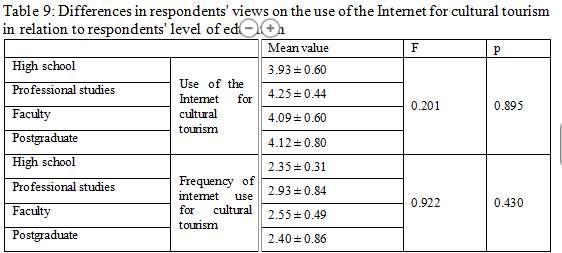

* The value is significant at the level equaling 0.05, Source: Authors’ research
As part of the research, it was examined whether there are differences in the views of respondents regarding the use of the Internet for cultural tourism in relation to their working status. A one-factor analysis of variance (ANOVA) was used to analyze these differences. The results indicated that the significance level of the ANOVA test exceeded the observed statistical level for all variables, allowing us to conclude that there is no statistically significant difference concerning the respondents' employment status (Table 10).
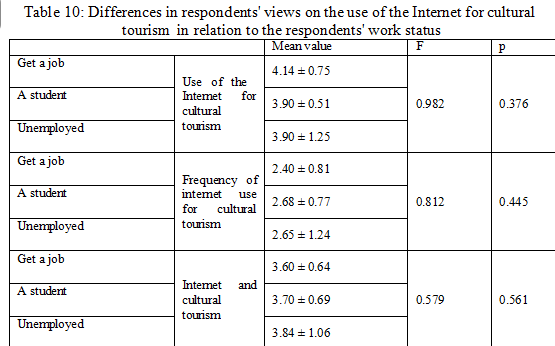
* The value is significant at the level equaling 0.05, Source: Authors’ research
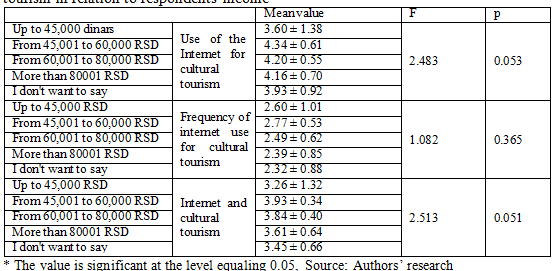
As part of the research, it was examined whether there is a difference in the respondents' attitudes regarding the use of the Internet for cultural tourism in relation to their income. A one-factor analysis of variance (ANOVA) was used to analyze these differences in attitudes regarding income. The results indicated that the significance level of the ANOVA test was higher than the observed statistical level for all variables. As a result, we conclude that there is no statistically significant difference regarding the respondents' income (Table 11).
Table 11: Differences in respondents' views on the use of the Internet for cultural tourism in relation to respondents' income
Based on the research results from the paper, here is the hypothesis analysis:
H1: The use of the Internet and smart technologies has a positive effect on tourists' awareness of cultural tourism. In order to test the first hypothesis (H1) stating that “The use of the Internet and smart technologies has a positive effect on tourists' awareness of cultural tourism,” a simple linear regression analysis was conducted. The independent variable was the level of use of the Internet and smart technologies (measured by the composite index formed from statements in Tables 2 and 3), and the dependent variable was tourists' awareness of cultural tourism (measured by the composite index from Table 4). The regression model was statistically significant: F(1, 288) = 98.74, p < 0.001, with a coefficient of determination R² = 0.38, indicating that 38% of the variance in tourists’ awareness of cultural tourism can be explained by the use of the Internet and smart technologies. The regression coefficient was β = 0.614, t = 9.94, p < 0.001, confirming that the relationship is both positive and statistically significant. Therefore, the hypothesis H1 is confirmed, and it can be concluded that the use of the Internet and smart technologies has a significant and positive impact on tourists’ awareness of cultural tourism.
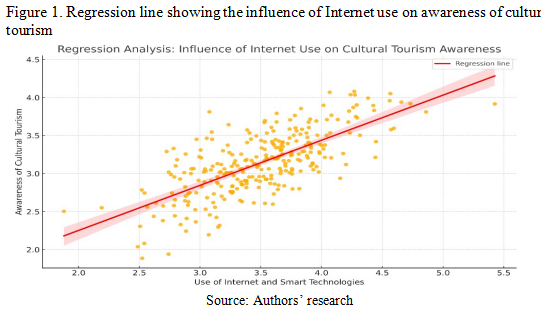
Figure 1 below shows the regression line illustrating the positive linear relationship between the use of Internet and smart technologies and tourists’ awareness of cultural tourism. H2: There are no significant differences in respondents' attitudes towards using the Internet for cultural tourism in relation to gender, level of education, region of residence and work status (Confirmed - Statistical analysis (t-test and ANOVA) showed that there are no significant differences in the attitudes of respondents in relation to gender, level of education, region of residence and work status). H3: Older respondents use the Internet more often for information about cultural tourism compared to younger generations Given the ordinal nature of the data and more than two groups, a Kruskal-Wallis test was conducted. The test result showed: H(2) = 8.25, p = 0.016. Since the p value is < 0.05, there is a statistically significant difference in the frequency of Internet use between age groups. Older respondents (especially the group 51+) show a higher Mean value compared to younger ones. Based on the results, hypothesis H3 is confirmed.
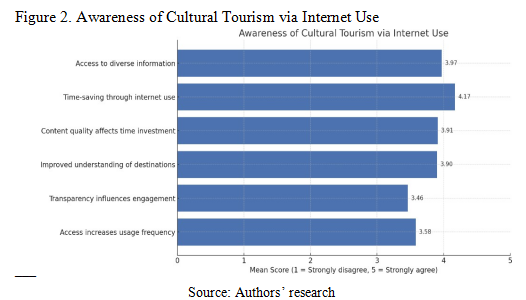
In response to the reviewer's comment regarding the unmeasured variable "awareness of cultural tourism," we clarify that this variable was indeed operationalized and measured through a specific set of statements in the questionnaire. These statements were designed to assess respondents’ perceptions of the usefulness, accessibility, transparency, and overall impact of internet content on their understanding and engagement with cultural tourism. Respondents evaluated these items using a 5-point Likert scale (1 = Strongly disagree, 5 = Strongly agree). Based on these items, a composite index was created to measure the variable "awareness of cultural tourism." The internal consistency of this scale was excellent, with a Cronbach’s alpha of 0.926. The following table presents the statements used to evaluate this variable, along with their mean scores and standard deviations:
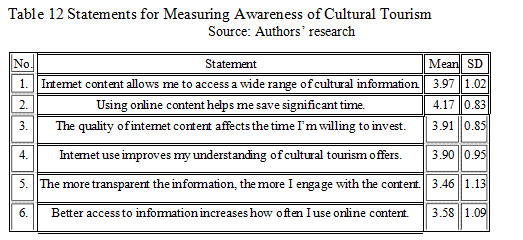
This confirms that the variable "awareness of cultural tourism" was both conceptually defined and empirically measured through specific, validated items. Consequently, the relationship between this variable and the use of internet/smart technologies was analyzed using regression analysis, confirming the hypothesis H1.
1. Conclusion
The primary objective of this research was to determine the frequency and manner of using the internet and smart technologies, as well as to gather respondents' opinions on the advantages of their usage when informing and deciding on the choice of a certain cultural tourism destination. This paper analyzes the way and frequency of using the internet and information technologies, along with respondents' opinions on the benefits and drawbacks of their use when choosing a cultural tourism destination in Serbia. It also investigates how respondents are informed about cultural heritage and the offerings of cultural tourism in Serbia. The findings revealed that the highest level of agreement was regarding the use of internet content to share and exchange information about cultural tourism, with respondents expressing a strong intention to continue using the internet for finding cultural tourism information. The lowest level of agreement was for the statement that respondents consistently search for cultural tourism information online. When it comes to the users' attitudes regarding how often they use the internet for information about cultural tourism, the results show that they most often accept invitations from friends to exchange information and interesting topics related to cultural tourism via the internet. Respondents also enjoy using the internet to communicate with others on the topic of cultural tourism, although they use the internet the least for daily searches related to cultural tourism. The majority of respondents recognized the benefits of using the internet and information technologies to learn about cultural heritage and make decisions about selecting a cultural tourism destination for vacations. They particularly highlighted the ability to save time, money, and energy, as well as to speed up the decision-making process regarding travel destinations through internet content related to cultural tourism. However, as a limitation, respondents noted that they rarely use internet content to share feelings and experiences related to cultural tourism. Based on the responses from 284 respondents in Serbia, the findings indicated a statistically significant difference concerning the age of the respondents. Regarding other examined socio-demographic variables—gender, professional education, place of residence, social status, and monthly income of the respondents - it can therefore be concluded that there is no statistically significant difference. Such findings may also be a result of unevenness in the structure of the sample. In addition, the use of a convenience sampling method and online data collection may limit the generalization of the findings to the wider population. It is likely that these findings would differ if there were a better distribution across the categories of variables related to the socio-demographic characteristics of the respondents. The research included only respondents from the territory of Serbia. Because the research is based on the self-assessment of respondents, it may include subjective biases and incorrect answers. Also, the homogeneity of the sample in terms of sociodemographic characteristics could have affected the results. Having in mind these main limitations of research, expanding the research to the countries of the Western Balkans in order to obtain a broader picture of the impact of digital technologies on cultural tourism, analysis of specific digital platforms and their impact on tourists' decisions and studying the effects of new technologies such as artificial intelligence, virtual and augmented reality in the promotion of cultural tourism are marked as main directions for future research.
Considering that this work is part of a research project, it is planned to conduct the research in other countries of the Western Balkans during 2025. The confirmation of the first hypothesis through regression analysis emphasizes the significant predictive power of Internet and smart technology usage on tourists' awareness of cultural tourism. This finding supports the strategic development of digital platforms for enhancing the sustainability of cultural tourism.
References
1.Bąk, I., Barej-Kaczmarek, E., & Sulikowski, P. (2022). Impact of Information and Communication Technologies on the Tourism Sector. European Research Studies Journal, Volume XXV, Issue 3. pp. 595-606. https://doi.org/10.35808/ersj/3052
2.Benckendorff, P.J., Sheldon, P.J., & Fesenmaier, D.R. (2014). Tourism Information Technology, 2nd ed.; CABI:Wallingford, UK.
3.Carbone, F., Oosterbeek, L., Costa, C., & Ferreira, A. M. (2020). Extending and adapting the concept of quality management for museums and cultural heritage attractions: A comparative study of southern European cultural heritage managers' perceptions. Tourism Management Perspectives, 35, 100698.
4.Gretzel, U., Fuchs, M., Baggio, R., Hoepken, W., Law, R., Neidhardt, J., Pesonen, J., Zanker, M., & Xiang, Z. (2020). e-Tourism beyond COVID-19: A call for transformative research. Information Technology and Tourism, 22, 187-203. https://doi.org/10.1007/s40558-020-00181-3
5.Das, G., Shailendra, P.J., Durairaj, M., Slotegraaf, R., & Srinivasan, R. (2021). Pandemics and Marketing: Insights, Impacts, and Research Opportunities. J. Acad. Mark. Sci.49, 835–854. doi: 10.1007/s11747-021-00786-y.
6.Di Pietro, L., Guglielmetti Mugion, R., & Renzi, M. F. (2018). Heritage and identity: technology, values and visitor experiences. Journal of Heritage Tourism, 13(2), 97-103.
7.Đurić, D., Vico, G., & Bodiroga, R., (2024). Upotreba različitih tehnika višekriterijumskog rangiranja u proceni razvijenosti organske proizvodnje. Ekonomija: teorija i praksa, 17(3), 33-49.
8.Elkhwesky, Z., Younès, M., & Islam, E.S. (2022). Driving Hospitality and Tourism to Foster Sustainable Innovation: A Systematic Review of COVID-19-Related Studies and Practical Implications in the Digital Era. Tour. Hosp. Res. 14, 115–133. https://doi.org/10.1177/14673584221126792
9.Femenia-Serra, F., Neuhofer, B., & Ivars-Baidal, J.A. (2019). Towards a conceptualisation of smart tourists and their role within the smart destination scenario. Serv. Ind. J. 39, 109–133. https://doi.org/10.1080/02642069.2018.1508458
10.Filipović, N. (2018). Intangible cultural heritage as a motive for choosing the tourist destination Aranđelovac. Hotel and Tourism Management, Vol. 6, No. 1: 53-62. https://doi.org/10.5937/menhottur1801053F
11.Kalia, P., Mladenović, D., & Acevedo-Duque, Á. (2022). Decoding the Trends and the Emerging Research Directions of Digital Tourism in the Last Three Decades: A Bibliometric Analysis. SAGE Open, 12. https://doi.org/10.1177/21582440221128179
12.Gireesh Kumar, T. K. (2021). Designing a comprehensive information system for safeguarding the cultural heritage: need for adopting architectural models and quality standards. Library Philosophy and Practice (e-journal), 2021(5392), 1-19.
13.Li, P., Zhou, Y., & Huang, S. (2023). Role of information technology in the development of e-tourism marketing: A contextual suggestion. Economic Analysis and Policy, 78, 307-318. https://doi.org/10.1016/j. eap.2023.03.010
14.Loureiro, S.M., Al-Ansi, A., Hyun, B.R., Ariza-Montes, A., & Hye-Shin, K. (2022). Culture, Heritage Looting, and Tourism: A Text Mining Review
Approach. Front. Psychol. 13, 944250.
https://doi.org/10.3389/fpsyg.2022.944250
15.Lv, H., Si, S., & Dogan, G. (2022). A Look Back and a Leap Forward: A Review and Synthesis of Big Data and Artificial Intelligence Literature in Hospitality and Tourism. J. Hosp. Mark. Manag. 31, 145–175. https://doi.org/10.1080/19368623.2021.1937434
16.Olearnik, J. (2016). Współczesny marketing w turystyce i jego specyfika.
Ekonomiczne Problemy Turystyki, 1(33), 9-19. https://doi.org/10.18276/ept.2016.1.33-01
17.Nikolić, M., Đurić, D., & Mitić, S. (2024). Strategijski menadžment, Univerzitet u Novom Sadu, Tehnički fakultet “Mihalo Pupin”, Zrenjanin.
18.Penjišević, A., Sančanin, B., Dimitrijovska Jankulovska, A., & Denkovska,
M. (2024). Preservation and promotion of material cultural heritage: a comparative analysis of the Republic of Serbia and the Republic of North Macedonia. SCIENCE International journal, 3(3), 117-124.
https://doi.org/10.35120/sciencej0303117p
19.Premović, J. (2023). Cultural heritage as a generator of sustainable development of tourism in local communities in the countries of the Western Balkans. In T. Sekulić (co-Ed.), Conference Proceedings: International Scientific and Professional Conference Politehnika 2023" (pp. 1177-1181). Belgrade, Serbia: The Academy of Applied Technical Studies "Belgrade.
20.Premović, J. (2021). Sociološko-kulturološki uticaji turizma u kontekstu širenja vrednosnih vidika u zemljama Zapadnog Balkana. U (S. Vujović (urednik), EКOM 2021: Značaj Mini Šengena za evrointegrcije Zapadnog Balkana (str. 228-243). Кosovska Mitrovica, Srbija: Ekonomski fakultet Univerziteta u Prištini sa privremenim sedištem u Кosovskoj Mitrovici. [in English: Social-cultural influences of tourism in the context of sreading value perspectivities in the Western Balkans countries. In (S. Vujović (Ed.), EKOM2021 Importance of the Mini-Schengen for the Euro Integration of the Western Balkans (pp. 228-243). Kosovska Mitrovica, Serbia: Faculty of Economics of the University of Prishtina with temporary headquarters in Kosovska Mitrovica.
21.Raji, A. A. H., Alabdoon, A. H. F., Shaker, A. S., & Almagtome, A. (2024). The Effect of National Cultural Values on the Financial Inclusion: An International Perspective. Futurity Economics&Law, 4(2). 65-82. https://doi.org/10.57125/FEL.2024.06.25.04
22.Ristić, V., Trišić, I., Štetić, S., Maksin, M., Nechita, F., Candrea, A. N., Pavlović, M., & Hertanu, A. (2024). Institutional, Ecological, Economic, and Socio-Cultural Sustainability—Evidence from Ponjavica Nature Park. Land, 13(5), 669. https://doi.org/10.3390/land13050669
23.Sančanin, B., Penjišević, A., & Stojanović, K. (2023). Key cultural-historical determinants of tourism improvements of the Municipality of Bač. Hotel and Tourism Management, Vol. 11, No. 1: 177-191. https://doi.org/10.5937/menhottur2301177S
24.Soliman, M., Cardoso, L., Almeida, G. G. F. de, Araújo, A. F., & Araújo Vila, N. (2021). Mapping smart experiences in tourism: A bibliometric approach. European Journal of Tourism Research 28, 2809, 1-26. https://doi.org/10.54055/ejtr.v28i.2254
25.Sustacha, I., Ba˜nos-Pino, J.F., & Del Valle, E. (2023). The role of technology in enhancing the tourism experience in smart destinations: A meta-analysis Journal of Destination Marketing & Management, 30(2023) 1-12. https://doi.org/10.1016/j.jdmm.2023.100817
26.Thomas, G. (2024). Challenges and Trends of Digital Innovation in the Tourism Sector: Contemporary Literature Review. Open Journal of Business and Management, 12, 179-190.
https://doi.org/10.4236/ojbm.2024.121013
27.Wiagustini, N. L. P., Aprilia, N. P. R., & Simanjuntak, G. R. M. (2024). The Significance of Cultural Capital in Enhancing the Efficiency and Long-Term Viability of Village Credit Institutions in Bali. Futurity Economics&Law, 4(3). 62-81. https://doi.org/10.57125/FEL.2024.09.25.05
28.Xiang, Z., Wang, D., O’Leary, J. T., & Fesenmaier, D. R. (2015). Adapting to the internet: Trends in travelers’ use of the Web for trip planning. Journal of Travel Research, 54 (4), 511–527. https://doi.org/10.1177/0047287514522883
29.Zdravković, S., & Peković, J. (2021). Cultural intelligence and heritage impact on choosing foreign tourist destination. Hotel and Tourism Management, Vol. 9, No. 1: 27-42.
https://doi.org/10.5937/menhottur2101027Z
Published in
Vol. 32 No. 1 (2026)
Keywords
Licence
This work is published under the Creative Commons Attribution 4.0 International (CC BY 4.0).
Authors retain copyright over their work.
Use, distribution, and adaptation of the work, including commercial use, is permitted with clear attribution to the original author and source.
Interested in Similar Research?
Browse All Articles and Journals