
Research in the Use of Social Networks in Business Operations

Abstract
This paper presents an analysis of the use of social networks from the various aspects of usage in the case companies, from the point of view of different activities and opportunities in the implementation of the obtained results for marketing purposes of these companies. Social networks are one of the most suitable basis for the collection of information that is by nature of a wide spectrum and enabling marketing activities developed under their influence. This paper presents the results of research in the frequency of the use of social networks. The valid sample in this study consisted of 200 questionnaires, on behalf of the 90 companies that responded. The results are statistically analyzed. After conducting research in this paper, data processing was done, and it is accounted for in the Figures. In accordance with the set of objectives, the results were analyzed. The research results indicate that the use of social networks positively affects many marketing activities and requires the adjustment of the existing model of marketing communications in companies. Research results can influence the understanding of the specificities of social networks and their impact on business operations and indicate the need to adapt to the different activities of this specific medium.
Article
Introduction
Today, globalization imposes new requirements on companies where social networks provide an essential channel for building connections between consumers and brands. The two most important advantages of social media at the global level are an increase in the visibility of the company in the market and an increase in sales (Jha, Verma, 2023). Among the various possibilities of using marketing activities on the Internet, social media are gaining more and more attention of researchers, educators, experts and policy makers with a high level of social presence (Kang, Choi, & Lee 2019; Franklin, 2019). Social media surveys are in a wide range of ways such as marketing messages (Wang, W. et al. 2019), social influence identification (Chen, Fan, Sun, 2019), habit formation (Goh, Xin, Jin, 2019), social media audience (Carpenter, Amaravadi, 2019) and others.
There are some basic strategies that can help companies to better take advantage of social networks as part of their overall strategies for the management of their relationships with customers (Martins, Patricio, 2018; Skoludova, 2014). Many companies already use social networks for managing customers, contacts, interactions and communications, so it makes sense to continue with the further use of tools for managing customer relationships when these activities are moved to social channels (Obradović, 2022). Also, the social media activity can be considered as an additional channel that could be used to expand and improve the capabilities of marketing with the new ways of engaging consumers and management conversations. In this way, consumers can be better listened to, analyzed and responded in a way that will have greater significance for them. In this regard, numerous research was conducted in the direction of advertising companies (Hafezalkotob, et al. 2018), influence of customer in value creation (Zhang, et al. 2017), social network analysis in international markets (Akgul, et al. 2017), public relations and social media (Costa-Sanchez, Fontela Baro 2016), various social innovations for companies using social networks (Okano, et al. 2016).
Social networks are one of the most suitable basis for the collection of information that is by nature of a wide spectrum, and enabling marketing activities developed under their influence. Marketing activities and results include various research studies and have broad significance for business operations (Jobber and Chadwick, 2016) and sociotechnical systems (Oosthuizen & Pretorius, 2016; Maluleke & Pretorius, 2016). Social networks have a positive impact on a large number of activities such as: research in the market demand, customer satisfaction and the awareness of consumers, the competition and possible product placement in certain markets, product innovation, analysis, the price, the promotion and the personnel policy. The use of the social network has a major influence on making business decisions for improving the business of companies (Liu, et al., 2019; Stojanović et al., 2021), represents a significant approach for multiperson decision making (Wu, et al., 2019) and decision - making frameworks (Urena, et al., 2019) by using various social network analysis (Dong, et al., 2018; Zhang, et al., 2018).
Due to an influence on numerous activities and communication, the introduction and impact of new technologies, it is necessary to mention all these aspects (Davidaviciene et al., 2017; Cipek & Ljutić, 2021), behaviors of social networking sites (Osatuyi, Hiltz, 2019) and spread of social networks (Song, Jamous, Turowski, 2019). On this basis we can assume that the use of social networks positively affects a large number of marketing activities and requires the adjustment of the existing model of marketing communications in companies (Zubic, Bojcetic, & Zezelj, 2016), modeling competitive marketing strategies (Goel, Singh, & Ghanbarnejad, 2019), development of marketing communications (Chernova, et al. 2019), marketing campaigns (Karczmarczyk, A., Jankowski, J., & Watrobski, J. (2018).
A case study
This paper presents research of the influence of social networks on the operations of companies in Serbia. The research topics are:
· frequency of using social networks,
· companies' reasons for using social networks,
· impact of social networks on the company's marketing activities.
The basic hypothesis is defined as:
H: The use of social networks positively influences a large number of marketing activities and requires adjustment of the existing model of marketing communications of companies. For defining the general hypothesis, the following auxiliary hypotheses were used:
H1: Knowing the capabilities of social networks and their expansion under the influence of Internet technology greatly influences their growing application in business.
H2: Employee education on new technologies positively affects the use of social networks in business.
H3: The present trend of increasing use of social networks in the Republic of Serbia positively influences their increasing use in the company's operations
H4: Social networks have a positive effect on adequate employment and provide an additional way of branding the company as an employer.
Quantitative research was used as the most appropriate type of research. The data is collected in direct contact with respondents or through online surveys. The survey involved 200 respondents from 90 companies (out of the predicted 95, which ensures high reliability of research results). The questionnaire, as the basic research instrument, consisted of 33 questions that were developed in accordance with the aims and subject of the research. The respondents were employed in managerial positions, top or middle marketing management. The type of sample in this study was a quota sample. The data collection phase was realized in the second half of 2022.
After conducting the research in this paper, data processing was done, and it is accounted for in the Figures. Then, using statistical data and methods (Wallace & Taylor, 2007), in accordance with the set of objectives, the results were analyzed by using the statistical analysis software IBM SPSS Statistics. To display the variables, the descriptive statistical methods: frequencies and percentages are used in this paper. The following reasons are typically given as the most important, i.e. crucial reasons for using social networks (Figure 1): better consumers’ awareness of products and services, the speed of obtaining feedback from consumers and the development of good relations with customers. Strengthening of loyalty and trust of consumers are typically given as the least important reasons for using social networks by companies. Creation and testing of new ideas are also common reasons.
Figure 1: Companies’ reasons for using social networks

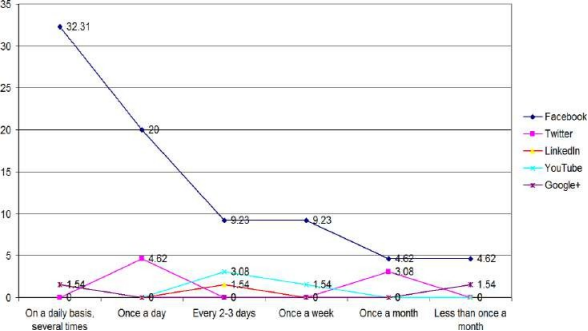
As shown in Figure 2, the highest percentage of companies that predominantly use the social network Facebook, use social networks many times during the day.
Figure 2: Dominant social networks and frequency of social networks use in operations
Source: Author’s research
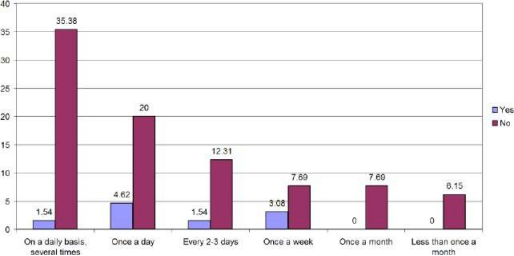
Figure 3 shows the correlation between the frequency of social networks use in operations and the use of geolocation service. Figure 3 shows that the highest percent of companies that use social networks several times or once a day do not use geolocation service.
Figure 3: Geolocation service use and frequency of social networks use in business
Source: Author’s research
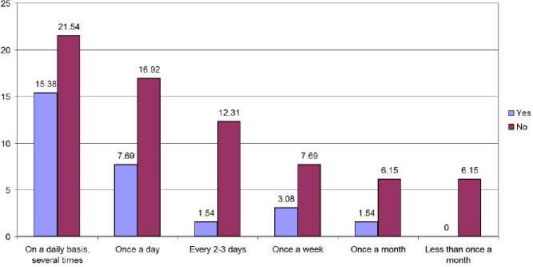
Correlation of Facebook Insights use and frequency of social networks use is shown in Figure (Figure 4).
Figure 4: Facebook Insights use and frequency of social networks use
Source: Author’s research
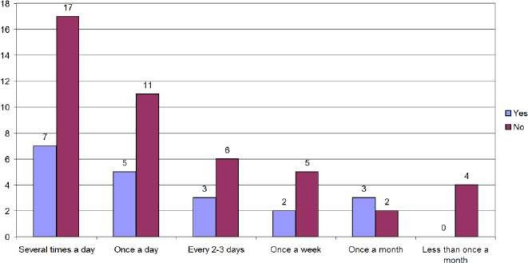
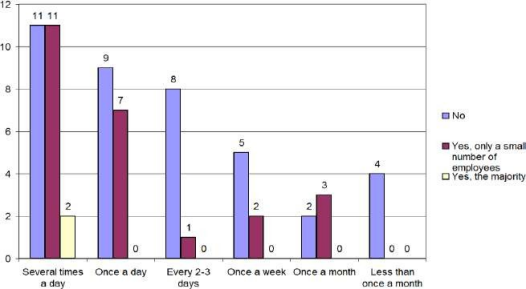
The majority of the surveyed companies believe that by using social networks, we can obtain equally useful information as that obtained through classical market research. When asked to state their reasons for using social networks in business, the companies responded by ranking the answers below in order of importance. Figure 5 contains the responses of the surveyed companies. Figure 5 shows the relationship between the frequency of the use of social networks in business and the possession of the regulations within the company with respect to the use of social networks.
Figure 5: The frequency of the use of social networks in business and the possession of the regulations on the use of social networks
Source: Author’s research
Figure 6 shows the connection between the frequency of the use of social networks and the employees’ participation in the training in the opportunities for and manners of using social networks.
Figure 6: The frequency of the use of social networks and the participation of the employees in the training in the opportunities for and manners of using social networks
Source: Author’s research
Figure 7 shows the connection between the use of networks in the selection of candidates and the budget allocated for marketing through social networks
Figure 7: The use of social networks in the selection of candidates and the budget for marketing via social networks

Source: Author’s research
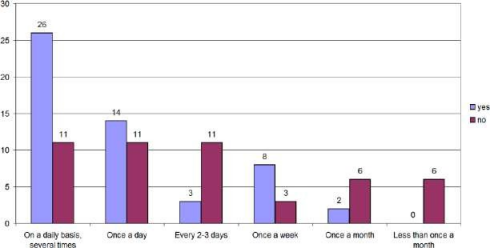
The link between the frequency of the use of social networks in business and the use of social networks for connecting with other companies is shown in the Figure 8. This indicates that the daily use of social networks (several times a day) is associated with the use of social networks for connecting with other companies.
Figure 8: The frequency of the use of social networks in business and networking with other companies
Source: Author’s research
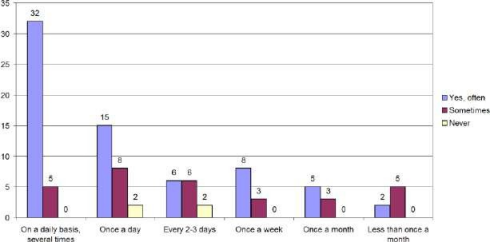
The link between the frequencies of taking into account the comments and suggestions received through social networks and the frequency of the use of social networks in business is shown in the following Figure 9.
Figure 9: The frequency of the use of social networks in business and the frequencies of taking into account comments and suggestions
Source: Author’s research
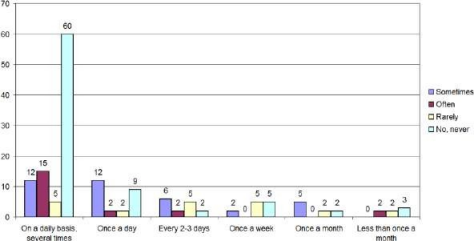
Figure 10 accounts for the connection between the frequency of the use of social networks and the frequency of giving benefits to the customers who follow the company on social networks. This connection suggests that the companies that use social networks on a daily basis more often give benefits to their consumers/clients through social networks.
Figure 10: The frequency of the use of social networks and giving benefits to customers
Source: Author’s research
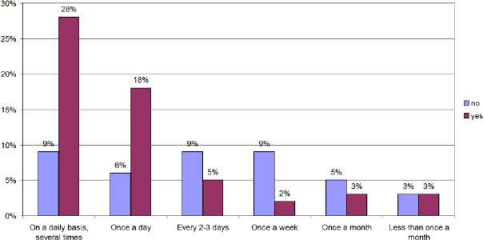
The link between the frequency of the use of social networks and an assessment of the impact that social networking has on a company’s operations as positive, is presented in Figure 11. This association suggests that the companies that use social networks in business on a daily basis make an assessment of the impact of using social networks on their business as positive.
Figure 11: The frequency of the use of social networks in business and the assessment of their impact as positive
Source: Author’s research
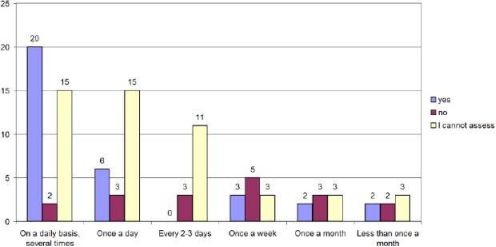
The link between the frequency of the use of social networks and the assessment that the use of social networks gives the company a better insight into the market needs, is shown in Figure 12.
Figure 12: The frequency of the use of social networks and the assessment of the insight into the market needs that they provide
Source: Author’s research
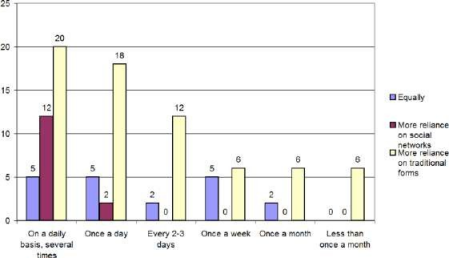
The link between the frequency of the use of social networks in business and the ratio of using the same in comparison with the traditional forms of a marketing promotion is shown in Figure 13. Figure 13: The frequency of the use of social networking in business and the use of social media compared to the traditional forms of marketing
Source: Author’s research
The link between the frequency of the use of social networks in business and an estimation of the savings from using them by a company is presented in Figure 14.
Figure 14: The frequency of the use of social networks in business and the estimations of the savings due to using social networks

Source: Author’s research
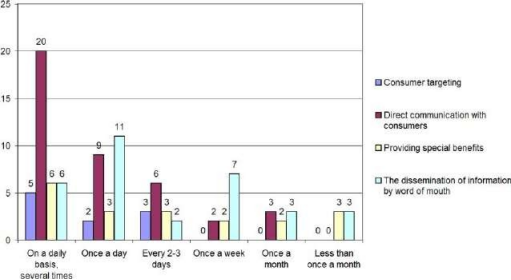
The link between the frequency of the use of social networks and the aspects of the contribution of the use of social networks to the positioning of the company is accounted for in Figure 15.
Figure 15: The frequency of the use of social networks in business and the contributions of social networks to the positioning of the company
Source: Author’s research
Discussion
The results of the conducted research have shown that from social networks, most companies use Facebook. Also, if a company uses more social networks, this network is the most dominant and dominant in their business. Companies that use social networks on a daily basis in the largest percentage use this social network.
The company's social networking as well as its use for marketing purposes must be designed, planned and aligned with other activities of the company. Employees should be well trained for new technologies, prepared for implementation and have full support and cooperation from the management in carrying out these activities.
In the survey that was conducted, 72% of companies in the Republic of Serbia use social networks in business, compared to 28% who do not. As far as the frequency of using social networks is concerned, the largest percentage of surveyed social networking companies use it on a daily basis - several times (37%), while a quarter of companies do it once a day (following companies using social media every 2-3 days - 14%, once a week - 10%, once a month - 8% and less than once a month - 6%). A large number of companies use social networks in their business, which indicates that the trend of using social networks in the Republic of Serbia is positively related to the increasingly frequent use of social networks in the operations of domestic companies, and we can conclude that the third auxiliary hypothesis has been confirmed.
Social networks can also be useful in hiring because companies that are present on the same considerably ease the search and selection of potential candidates that will meet the set criteria to the fullest extent. This area has always been tied to state services. Their role was to connect companies that show the need for new employees and job seekers. With the emergence of social networks, these services have been significantly improved. It is now much easier for the unemployed to monitor current trends in their field of work. Also, the information can come directly. The survey found that there are almost the same number of social network users that do not use social networks in selecting candidates for employment.
Among those using social networks in that choice, most companies invest less than 2% of the marketing budget through social networks. On the other hand, among companies that do not use social networks in selecting candidates, the largest number of those who have a very small percentage of the budget for this type of marketing. Based on the previous data, it can be concluded that these two variables do not have a clear relationship, that the selection of candidates is not clearly related to the amount of investment in marketing through social networks. On the other hand, companies that often use social networks in their business (several times during the day) mostly use social networks to connect with other companies. The highest percentage of companies that are frequently using social networks in their business often takes into account the comments and suggestions of their users via social networks.
As one can conclude, social networks certainly increase the effectiveness of the recruitment and selection process, but at the same time they place far greater demands on professionals who deal with those tasks. The first and greatest requirement is to achieve a personal approach in communicating with candidates. The second big challenge and challenge is to reconcile the image that is being built in the public, the company as an employer, the reality and real opportunities in the company, because it is easier for candidates today, using social networks, to check the credibility of the given information. Based on this, the fourth auxiliary hypothesis is considered confirmed.
It can be concluded from the research that companies that use social networks in their business use the largest percentage of new content on social networks at least once a week. Consumers or clients who follow them through social networks, over half of the companies surveyed give different benefits to their products and offer and take into account their comments related to the company's business. Those companies that use social networks on a daily basis, over time, are those that statistically significantly increase the convenience of their consumers who follow them through social networks compared to those that are less active on them.
Also, companies using social networks often track their competition on social networks. As a reason for their presence on social networks, companies often provide better consumer information about products and services, as well as the speed of obtaining feedback from consumers. It is this direct communication with the consumers (clients) of the company that is seen as the one that contributes most to their better positioning on the market (Jević et al., 2021).
Active companies, those who use social networks in their business on a daily basis, often over the course of the day, are the ones who, to a large extent, assess the impact of social networks on their business positively. The difference between these companies and those less active is statistically significant (Stevanović et al., 2022; Milanović, 2023). Also, those companies compared to those that are less active in the use of social networks statistically significantly less respond to the fact that activities on social networks do not have an impact on their business.
From the data presented, it can be concluded that greater engagement on social networks leads to more positive feedback on the marketing activities of companies, that the general hypothesis is confirmed. Also, this data also suggests that the familiarity of companies with the experience of other companies that are very active on social networks can positively affect them in the future to use social networks more in their business.
One way to categorize social networks in the business world is by their primary use case(Mihajlović et al., 2020). A matrix can be used to organize different social networks based on their primary use case and the type of audience they target (Jha, Verma, 2023). Here is an example of a matrix that classifies social networks based on these two criteria:
Matrix 1: Classification of social networks

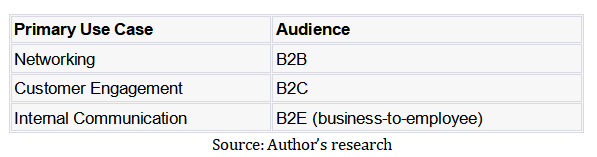
Examples of social networks that could fit into each category:
• Marketing: Instagram, Facebook, Pinterest
• Recruitment: LinkedIn, Glassdoor
• Networking: LinkedIn, Twitter
• Customer Engagement: Facebook, Twitter, Instagram
• Internal Communication: Slack, Microsoft Teams
It is worth noting that this is a simplified matrix, and social networks can be used for multiple purposes, and some social networks like LinkedIn, Twitter, and Instagram can be used for both B2B and B2C as well.
The future of social networks in the business world is likely to be characterized by continued growth and innovation (Avakumovic, et al. 2021). As more businesses adopt social media as a key component of their marketing and engagement strategies, the potential for social networks to drive revenue and growth will continue to increase (Rakesh, et al. 2021).
Overall, social networks will continue to play an important role in the business world, and companies that can effectively leverage these platforms will be well positioned to succeed in the digital economy.
Conclusion
In this paper are presented the results of research in the frequency of the use of social networks with the aim to understand the specificities of social networks and their impact on business operations and the research results indicate the need to adapt to the different activities of this specific medium. The interactivity of social networks as a medium allows advertisers to reach a voluntary, segmented audience cost-effectively, i.e. in a cost-effective manner, compared to the other media. It can be concluded that social networks certainly increase the effectiveness of recruitment and selection, but also put far greater demands on the professionals who deal with these matters. The first and greatest requirement is to achieve a personal approach in communication with candidates. Another major requirement and challenge is to align the image that is being built in public, about the company as an employer, with the reality and the actual situation in the company, since it is much easier for the candidates using social networks to check the authenticity of the information.
It is necessary to raise awareness of the safety of social networks. All the problems that social networks are faced with when it comes to individuals, can reflect on companies as well, the safety and protection of data are in the first place. Perhaps this is one reason, in addition to the general ignorance of the functioning of social networks, why a larger number of companies in this study do not use social networks in their business operations. Many people fear that information about their companies can be compromised, or that the company’s reputation can be damaged if the company’s fan page or profile is hacked.
Companies that use social networks in business operations should focus on strategies and tactics leading to success. Numerous studies worldwide, as well as research in this paper, have shown that companies can improve their results if they respect the following key recommendations:
1. Advertising on social networks should start with clear marketing objectives. Companies must define their most important priorities and goals before choosing tactics of advertising on social networks, and should focus on tactics that will help them in achieving their goals. For market actors focused on the brand, whose primary objective is to raise brand awareness, promoted content is the easiest way to create success. For market players focused on the response, whose primary purpose is to start buying, paid advertising presents the surest way to achieve the objectives.
2. It is necessary to increase the budget for marketing activities on social networks. Many market players continue to look at social networks as a free tool. But research data are clear: market players who have used paid forms of promotion on social networks – by paying for advertising on social networks or for promoting content on social networks - are more successful than those who did not. The conclusion is that marketing by using social networks may be free - or if you want results it should not be.
Finally, it should be noted that despite the fact that social networks are available and easy to access, no company or product whatsoever can exclusively use them as the sole advertising channel. Promotional campaigns must take into account the traditional promotional techniques. Also, the benefits of social networks are converted into their weaknesses, if a product does not correspond to the population on a particular social network. Thus, the emergence of social networks has given rise to the need for changing common business models. Social networks are ideal for conducting campaigns and positive eWOM marketing. A large number of potential clients and consumers are brought together in different locations. These groups are a huge potential for the implementation of communication activities and for marketing managers as well.
This research results can influence the understanding of the specificities of social networks and their impact on business operations, and indicate the need to adapt to different activities of this specific medium. The empirical data have been presented in such a manner as to contribute to the identification of the characteristic tendencies in this area.
References
2.Carpenter, C.J., Amaravadi, C.S. (2019). A Big Data Approach to Assessing the Impact of Social Norms: Reporting One's Exerciseto a Social Media Audience, Communication Research, 46(2), 236-249. DOI: 10.1177/0093650216657776
3.Cipek, K., & Ljutić, I. B. (2021). The influence of digitalization on tax audit. Oditor, 7(1), 37-69. https://doi.org/10.5937/Oditor2101037C
4.Chen, Z.Y., Fan, Z. P., & Sun, M. (2019). Individual-level social influence identification in social media: A learning-simulation coordinated method, European Journal of Operational Research, 273(3), 1005-1015. DOI: 10.1016/j.ejor.2018.09.025
5.Chernova, D.V. et al. (2019). Social Networks as a Tool of Marketing Communications in the Commodity and Service Market, 5th National Scientific and Practical Conference on Perspectives on the Use of New Information and Communication Technology (ICT) in the Modern Economy Feb. 01, 2018., Pyatigorsk, RUSSIA, Book Series: Advances in Intelligent Systems and Computing, 726., 943-949.
6.Costa-Sanchez, C., & Fontela Baro, B. (2016). Public Relations and Social Media. Spanish Companies Proactivity in the Audiovisual Social Networks, Revista Internacional de Relaciones Publicas, 6(11), 235-254. DOI: 10.5783/RIRP-11-2016-12-235-254
7.Davidaviciene, V., Pabedinskaite, A., & Davidavicius, S. (2017). Social Networks in B2B and B2C Communication, Transformations in Business & Economics, 16(1), 69-84.
8.Dong, Y. et al. (2018). Consensus reaching in social network group decision making: Research paradigms and challenges, Knowledge-Based Systems, 162, 3-13.
9.Franklin, T. (2019). The State of Social Media, Econtent, 42(1), 25-27.
10.Goel, R., Singh, A., & Ghanbarnejad, F. (2019). Modeling Competitive Marketing Strategies in Social Networks, Physica A- Statistical Mechanics and its Applications, 518, 50-70.
11.Goh, T.T., Xin, Z., & Jin, D. (2019). Habit formation in social media consumption: a case of political engagement, Behaviour & Information Technology, 38(3), 273-288. DOI: 10.1080/0144929X.2018.1529197 Hafezalkotob, A. et al. (2018). Cooperation of advertising companies in social networks: A graph and game theory approaches, Computers & Industrial Engineering, 125, 212-220. DOI: 10.1016/j.cie.2018.08.023
13.Jević, J., Pavković, V., & Jević, G. (2021). The role of social media in contemporary tourism business. Oditor, 7(2), 133-156. https://doi.org/10.5937/Oditor2102133J
14.Jha, A.K., Verma, N.K. Social Media Platforms and User Engagement: A Multi-Platform Study on One-way Firm Sustainability Communication. Inf Syst Front (2023). https://doi.org/10.1007/s10796-023-10376-8
15.Jobber, D., & Chadwick, E. (2016). Principles and Practice of Marketing, Maidenhead: McGraw-Hill Education.
16.Kang, J., Choi, H., & Lee, H. (2019). Deep recurrent convolutional networks for inferring user interests from social media, Journal of Intelligent Information Systems, 52(1), 191-209.
17.Karczmarczyk, A., Jankowski, J., & Watrobski, J. (2018). Multi- criteria decision support for planning and evaluation of performance of viral marketing campaigns in social networks, Plos One, 13(12), Article Number: e0209372
18.Liu, B. et al. (2019). Large-scale group decision making model based on social network analysis: Trust relationship-based conflict detection and elimination, European Journal Of Operational Research, 275(2), 737-754.
19.Maluleke, G., & Pretorius L. (2016). Modelling the impact of mining on socio-economic infrastructure development - a system dynamics approach, South African Journal of Industrial Engineering, 27(4), 66-76. DOI: 10.7166/27-4-1133
20.Martins, C.; & Patricio, L. (2018). Company social networks: customer communities or supplementary services?, Journal of Services Marketing, 32(4) 443-461.
21.Milanović, N. (2023). Financial sustainability management non- profit organizations. Održivi razvoj, 5(1), 7-17.
https://doi.org/10.5937/OdrRaz2301007M
22.Mihajlović, M., Nikolić, S., & Tasić, S. (2020). Sustainability of the
economic model of contemporary economy. Održivi razvoj, 2(2), 7-
13. https://doi.org/10.5937/OdrRaz2002007M
23.Obradović, D, (2022). Operations of influence on social networks as a hybrid threat, Social horizons, Vol. II (4), 217-233
24.Okano, M.T. et al. (2016). Relationship Networks: Social Innovation and Earnings for Companies, Conference: IFIP Working Group 5.7 International Conference on Advances in Production Management Systems (APMS), Sep. 03-07, 2016. Brazil, Book Series: IFIP Advances in Information and Communication Technology, 488, 86-95. DOI: 10.1007/978-3- 319-51133-7_11
25.Oosthuizen, R., & Pretorius, L. (2016). Assessing the impact of new technology on complex sociotechnical systems, South African Journal of Industrial Engineering, 27(2), 15-29. DOI: 10.7166/27-2-1144
26.Osatuyi, B., & Hiltz, S.R. (2019). The Impact of Cross-Addiction on Information Sharing Behaviors on Social Networking Sites, Journal of Computer Information Systems, 59(2), 105-115.
27.Rakesh R. Mallipeddi, Subodha Kumar, Chelliah Sriskandarajah, Yunxia Zhu (2021) A Framework for Analyzing Influencer Marketing in Social Networks: Selection and Scheduling of Influencers. Management Science 68(1):75-104. https://doi.org/10.1287/mnsc.2020.3899
28.Skoludova, J. (2014). Social Network - Tool to Increase the Copmetitiveness of Companies, 12th International Conference on Hradec Economic Days (HED 2014): Economic Development and Management of Regions Location: Univ Hradec Kralove, Czech Republic, Feb 04-05, 270-276.
29.Social Media Marketing Networking Club, Available at: http://www.socialmediaexaminer.com/clubs/
30.Song, J.,; Jamous, N., & Turowski, K. (2019). A dynamic perspective: local interactions driving the spread of social networks, Enterprise Information Systems, 13(2), 219-235
31.Stevanović, A., Mitrović, S., & Rajković, A. (2022). Application of information technologies and the internet in modern business. Oditor, 8(2), 54-74. https://doi.org/10.5937/Oditor2202054S
Stojanović, J., Nešić, Z., & Bulut Bogdanović, I. (2021). Digitalization of education in the function of economic development. Društveni horizonti, 1(1), 29-40. https://doi.org/10.5937/DruHor2101029S
33.Urena, R. et al. (2019). A review on trust propagation and opinion dynamics in social networks and group decision making frameworks, Information Sciences, 478, 461-475.
34.Urena, R. et al. (2019). A social network based approach for consensus achievement in multiperson decision making, Information Fusion, 47, 72-87.
35.Wang, W. et al. (2019) Media or message, which is the king in social commerce?: An empirical study of participants' intention to repost marketing messages on social media, Computers in Human Behavior, 93, 176-191. DOI: 10.1016/j.chb.2018.12.007
36.Wu, T. et al. (2019). A two-stage social trust network partition model for large-scale group decision-making problems, Knowledge-Based Systems, 163, 632-643.
37.Zhang, H. et al. (2018). Managing non-cooperative behaviors in consensus-based multiple attribute group decision making: An approach based on social network analysis, Knowledge-Based Systems, 162, 29-45.
38.Zhang, M. et al. (2017). Influence of customer engagement with company social networks on stickiness: Mediating effect of customer value creation, International Journal of Information Management, 37(3), 229-240. DOI: 10.1016/j.ijinfomgt.2016.04.010
39.Zubic, A., Bojcetic, N., & Zezelj, D. (2016). Integration of private social network in PLM systems, Tehnicki Vjesnik-Technical Gazette, 23(2), 611-616. DOI: 10.17559/TV-20150430143932
Published in
Vol. 29, No. 1, 2023.
Keywords
Licence
This work is published under the Creative Commons Attribution 4.0 International (CC BY 4.0).
Authors retain copyright over their work.
Use, distribution, and adaptation of the work, including commercial use, is permitted with clear attribution to the original author and source.
Interested in Similar Research?
Browse All Articles and Journals