
Analysis of Multidimensional Globalization Index on the Example of the Republic of Serbia and the Surrounding Countries
Abstract
Globalization of markets, products and services, in recent years has become one of the most important issues of today's business and business, creating numerous challenges, but also opportunities for domestic and international business. The subject of research in the paper is the analysis of the globalization index (KOF) with the aim of conducting a comparative analysis and the position of Republic of Serbia and other national economies. For this purpose, the available data of the KOF Swiss Economic Institute on the globalization coefficient has been analysed, as well as their dynamic changes during the period 2000-2020. The data have been summarized with the aim of showing global values and data for Serbia and the surrounding countries: Macedonia, Montenegro, Croatia, Slovenia and Bosnia and Herzegovina. The result of the research showed that the value of the globalization index - KOF for Serbia in the period 2000-2009. deviates from the average by 3.53, while in the period 2010-2020. deviates by 14.10 index points. The mean value of the KOF index is 66.96 points, which is 9.07 index points higher than the world average.
Article
Introduction
The development of the global character of the world economy removes market barriers, and this requires knowledge of individual - economic, legal, cultural characteristics and everything else that affects business. The economies of individual countries must change and develop culturally synergistic intelligence, and understand the peculiarities of other countries and peoples. Since globalization implies political, economic, social components and connections, which are not limited by territorial borders, i.e. states, it affects culture, economy and other aspects of social activity. Globalization creates global prefixes in all spheres of life and undoubtedly has a significant impact on international business flows.
In adapting to the demands of the global market, managerial abilities come to the fore, that is, it is necessary to adapt to different legal, market and cultural contexts of countries, while maintaining the necessary authenticity, originality and uniqueness (Jones, 2010).
Multicultural organizations arise as a result of doing business across national borders, and the main reasons are the search for lower production costs, access to new, more liberal markets, and economic integration (Singh, 2014). By expanding business across national borders, companies become more attractive and profitable, and managers need to develop new roles, to think in a different way, to communicate across borders. Synergy and globalization should respect individual values, managers should master cross-cultural training, in a word, communication and knowledge about different cultures must be improved. The development of awareness and self-confidence is important when interacting with different people and economies.
As a population, we are becoming more multicultural - people are no longer just for specific countries. While knowledge of consumer preferences for foreign products and services is important, understanding the level of animosity is equally important and could lead to the success or failure of a multinational corporation. Consumers who have economic animosity towards a particular country are likely to choose not to buy products produced in that country (Kalliny and LeMaster, 2005).
Huntington (1993), argues that differences in history, language, culture, tradition and, most importantly, religion will be the driving force for conflict. History is full of examples of wars fought over religious and cultural differences. Each country differs in many ways, historically, culturally, but also in some of their basic demographic and economic and institutional characteristics. Global business is influenced by numerous factors such as socio-economic, cultural, legal and political differences. That is why in this research we focused on understanding the process of globalization, in order to understand and identify the factors of globalization in the world and in certain countries. International business has expanded and simplified, but there is certainly still room for further improvements. Hence the motive to investigate economic, social and political globalization and their impact on international business. Knowing these factors can provide new experiences, innovations and boost a competitive position in the global business world.
The subject of research in the paper is the analysis of the globalization index, and the position of Serbia and other national economies is investigated through a comparative analysis. For this purpose, the statistical data of the globalization coefficient were reviewed, as well as their interpretation and development during the period. The data have been summarized with the aim of presenting through a comparison of several countries, Serbia, Macedonia, Croatia, Slovenia and Bosnia and Herzegovina. The questions we tried to answer during the research are: What is globalization and how does it affect developed countries and developing countries? What is the globalization coefficient and how do the obtained results affect the competitiveness of countries? The goal of the research is to look at areas that have a positive or limiting effect on competitiveness among countries. The research is focused on obtaining indices for Serbia, Slovenia, Macedonia, Croatia and Bosnia and Herzegovina, as well as their comparative analysis by year. The position of Serbia and the values presented in a long period were specially investigated. The complexity of the goal and subject of the research work requires the application of research methods in the form of methods of analysis and synthesis, statistical methods and qualitative-quantitative methods of data processing. The research uses data from the KOF Swiss Economic Institute, which are mostly annual reports.
Globalization and the national economy
Schulze and Ursprung (1999) state that globalization is a term we use to describe changes in societies, culture and the world economy that lead to a dramatic increase in international exchange (in trade, culture, people, ideas, etc.) (Ahmedov, 2020; Fulcher, 2000; Olivié & Gracia, 2020). Globalization is often viewed exclusively from the point of view of the economy, and then its effect on the liberalization of trade, i.e. the development of free trade, is put in the foreground (Gygli et al., 2019). Despite this, globalization encompasses much broader aspects of society (Enders, 2004; Dreher et al., 2008; Rekker, 2018). Between 1910 and 1950, a series of political and economic developments reduced the importance of the previous international trade flows. With the establishment of international economic institutions, such as the International Monetary Fund (IMF), globalization trends were reversed. In the post-war period, with the support of international institutions, trade developed drastically again, especially after the 1970s. Economic integration is the process of joining national economies to achieve certain goals, and above all, the removal of customs and non-customs barriers and other restrictive regulations in mutual trade. The free movement of people, (workforce), capital and other factors of production is ensured, as well as the relationship of integrated national economies with other countries of the world. The form of economic connection is implemented on different bases, most often based on complementary interests. Striking traces of efforts to regulate these processes and bring them under the established legal regime are visible. Supervision over the implementation of the integration process and management of the integration group is regulated by the agreement on the creation of economic integration. The end of the 20th century is characterized by a series of global changes in the structure, characteristics and types of products and services offered by providers of financial products and services in developed market economies (USA and EU countries). This was particularly evident in three areas: consolidation, unification and competition. At the same time, financial institutions faced numerous new challenges caused by rapid changes that occurred in information technology, deregulation, geographical and production expansion, business globalization, laws, accounting standards, the market and trends in the direction of numerous business combinations (Hadžić, 2005).
World globalization, driven by the rapid development of education, technique, technology and information systems, requires constant training of people to adapt to these changes. Throughout all periods of the history of civilization, education and learning have been essential elements in the development of man and society.
Turbulent way of life and constant growth of new knowledge requires quick adaptation, both of individuals and of state bodies and authorities, because the survival of the national economy of each country depends on a quick response to the newly created problem. Joldić et al. (2018) have concluded that the bursting of the financial bubble brings the market to a state of crisis and recession, which gives them a global character. The level of state activity in commercial and social activities varies depending on the political system (Vukosavljević et al., 2021). Throughout the history of their existence, most countries have gone through a period of transition, which to a greater or lesser extent had a negative or positive impact on the economy, the economy and the social status of the population. A country that had a stable national economy before the transition period, the transition did not have a strong impact on the economy and business.
Globalization coefficient – cof
The globalization index coefficient was the subject of studies by Feigin (2021); Nye & Donahue (2000), Norris, (2000), Keohane et al., (2002), Gozgor (2018), Dreher (2006) and numerous others. The authors define globalization as the process of creating a network of connections between actors on multiple distant continents through the mediation of various flows, including people, information and ideas, capital and goods (Clark, 2000).
Globalization is conceived as a process that erases national borders, integrates national economies, cultures, technologies and governance and produces complex interpenetrating relations between countries. According to the KOF Swiss Economic Institute, there are three dimensions of the KOF index and they are defined as Economic Globalisation, Social Globalisation, and Political Globalisation.
Table 1. Structure of the KOF index (Weights values are in %)
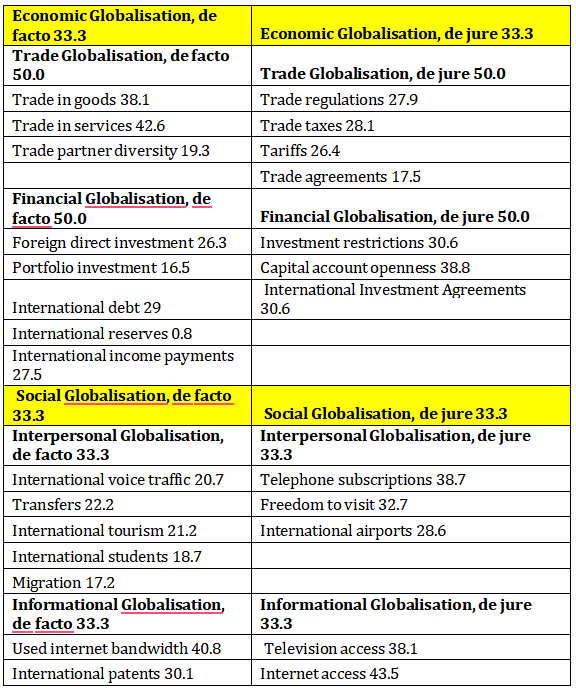
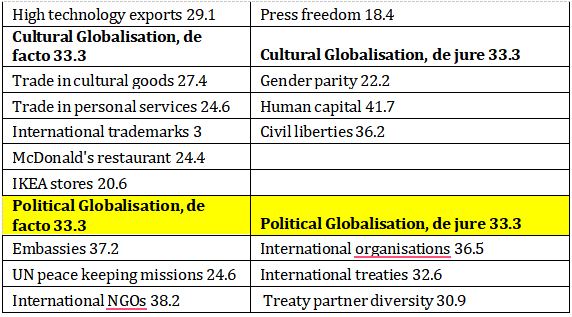
The data listed in Table 1 indicate that each of the three pillars of the index carries 33.3% of the total value. We notice that the three pillars have so-called de facto and de jure values, which carry a different percentage share in the total value (Index, 2021).
1. Economic globalization
a) The value of Trade Globalization de facto is further divided into Trade in goods, Trade in services and Trade partner diversity, while Trade Globalization de jure contains Trade regulations, Trade taxes, Tariffs and Trade agreements.
b) Financial Globalisation, de facto consists of: Foreign direct investment; Portfolio investment; International debt; International reserves, International income payments. Financial Globalisation, de jure includes: Investment restrictions, Capital account openness and International Investment Agreements.
2. Social globalization
a) Segments of social globalization de facto are: Interpersonal Globalization (International voice traffic; Transfers; International tourism; International students; Migration); Informational Globalization (Used internet bandwidth; International patents; High technology exports); Cultural Globalization (Trade in cultural goods; Trade in personal services; International trademarks; McDonald's restaurant and IKEA stores).
b) The segments of social globalization de jure are: Interpersonal Globalization (Telephone subscriptions; Freedom to visit, International airports), Informational Globalization (Television access, Internet access, Press freedom), Cultural Globalization (Gender parity, Human capital and Civil liberties).
3. Political globalization - the political situation of a country de facto has segments: Embassies, UN peace keeping missions and International NGOs. Political globalization de jure has segments: International organizations, International treaties and Treaty partner diversity.
Analysis of kof in the year 2020 for the leading 20 countries of the world
The following table shows the values of the globalization index for the leading 20 countries of the world and surrounding countries, which once formed a single country (Serbia, Macedonia, Croatia, Slovenia and Bosnia and Herzegovina). The table shows the Globalization Index values, overall, but also de facto and de jure values for 2020.
Table number 2. Globalization coefficient for 2020
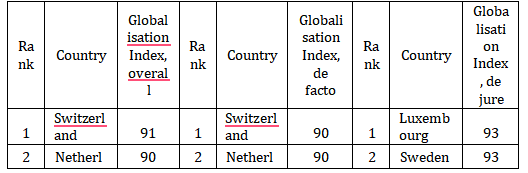
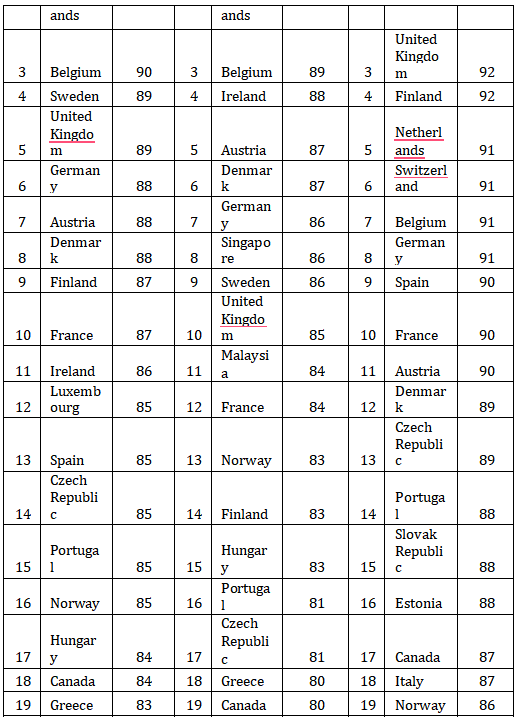
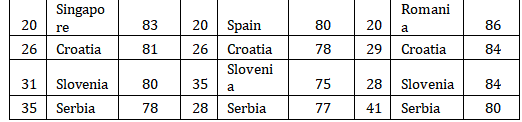
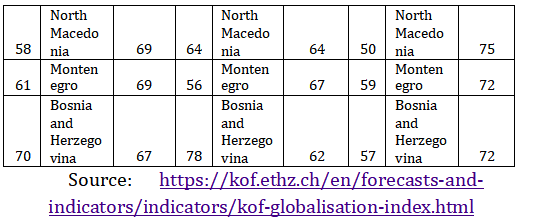
Based on the results in table number 2, we can conclude that Switzerland has the highest index values, total and de facto value. However, the de jure value for Switzerland is somewhat lower, so the country is in 6th place. Of the countries of circulation, Croatia and Slovenia are the best positioned countries, 26th and 31st respectively. We can also see that Serbia is much better positioned compared to Macedonia, Montenegro and Bosnia and Herzegovina.
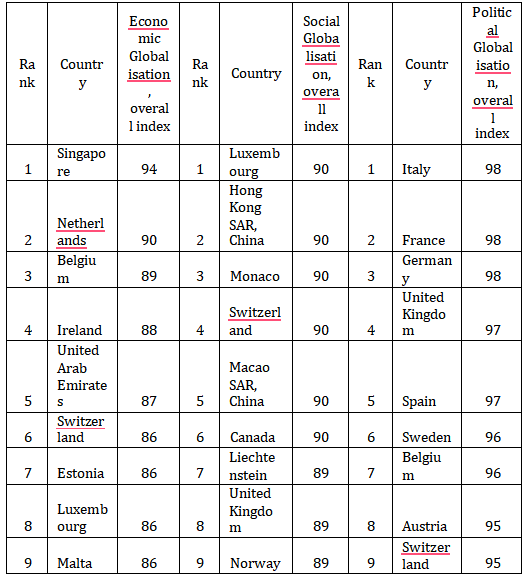
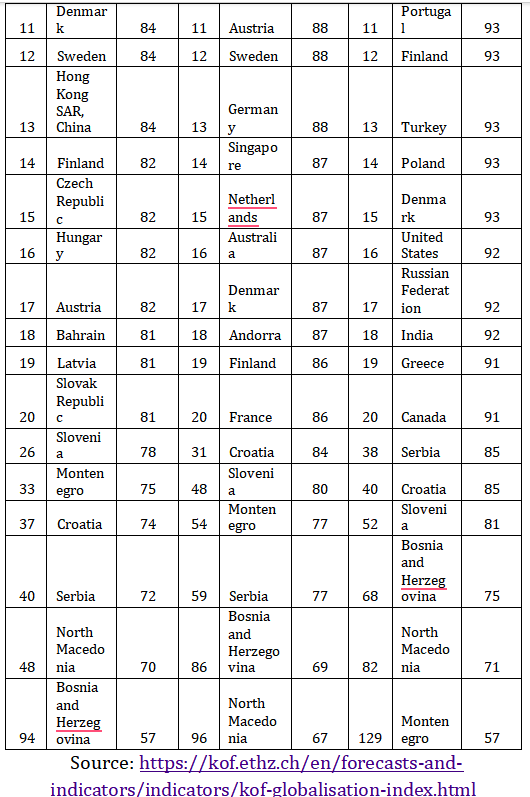
If we look at the three dimensions of the Globalization Index, economic, social and political, and accordingly the classification of countries, we can conclude that countries have achieved different levels in these segments of globalization - Table 3. The results of the Economic Globalization Index for the analyzed countries are as follows: in first place is Singapore with index values of 94, followed by the Netherlands, Belgium, Ireland and the United Arab Emirates. The values of social globalization are identical for the first 6 countries and amount to KOF = 90 (Luxembourg, Hong Kong SAR, China, Monaco, Switzerland and Macao SAR, China). Of the surrounding countries, the best positioned is Croatia in 31st place, and Slovenia in 48th place. Serbia is in 59th place with a value of KOF = 77. According to the index of political globalization, the best positioned countries are Italy (KOF=98), France (KOF=98) and Germany (KOF=98). From the surrounding countries, it looks like this: Serbia and Croatia (KOF=85), and Slovenia (KOF=81). Croatia and Slovenia are countries that are members of the EU, and it is logical that their economies are most oriented towards world trends and other countries in the world. Involvement in the world's economic, social and political events is at an enviable level compared to other surrounding countries (Macedonia, Bosnia and Herzegovina, Montenegro and Serbia).
Table number 3. Three pillars of the Globalization Coefficient in the year 2020 for the first 20 countries of Serbia and surrounding countries
Below, Table 4 shows the values of the KOF globalization index for the analyzed countries of circulation in the period from 2000-2020. years. For the purposes of dynamic analysis of changes in the value of the KOF index, mean values were calculated for the period 2000-2010, then for 2010-2020 and for the entire analyzed period. It is important to point out that we looked at the deviations of the mean values for each country from the mean values for all countries of the world according to periods.
Table number 4. Coefficient of globalization for the period from 2000-2020. year for Serbia and surrounding countries
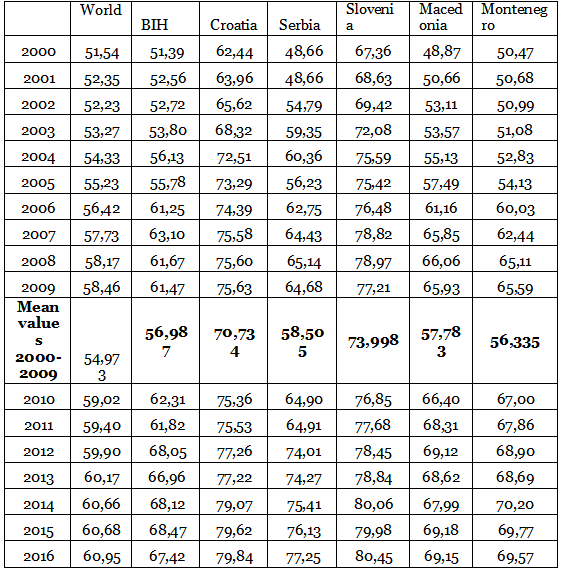
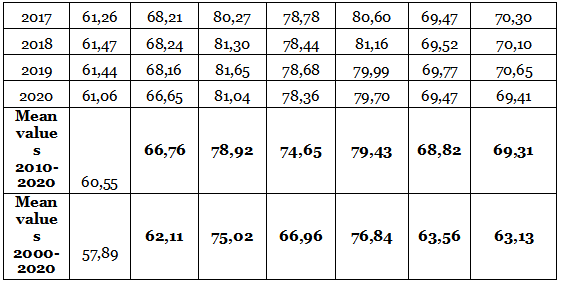
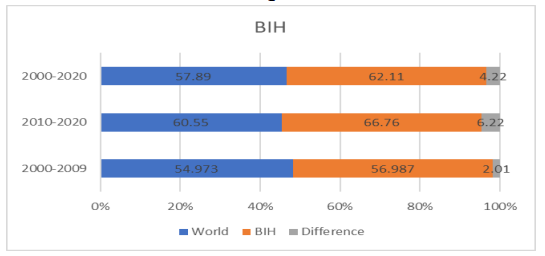
The results of the globalization index - KOF for BIH by period show that the biggest deviation is in the second period, more precisely in the period 2010-2020. (6,22). The mean value of the KOF index for the period 2000-2009. shows a positive difference in favor of BiH, which is significantly higher in the following period. Nevertheless, viewed as a whole, BiH has a higher mean value of the KOF index by 4.22 index points.
There is an interesting turn in the economic globalization between Macedonia and Bosnia and Herzegovina, where in 2014 Bosnia and Herzegovina is ranked better than Macedonia, which was not the case in 2013. Serbia is in last place in this analysis and comparison of four countries, as it has been in 2013.
Graph 1. Mean values of the KOF index for Bosnia and Herzegovina
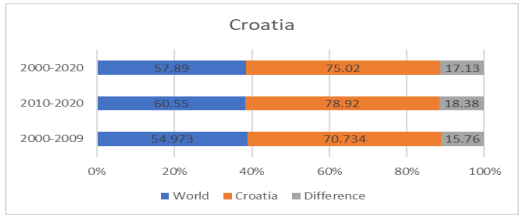
The results of the globalization index - KOF for Croatia by period show that the biggest deviation is in the second period, more precisely in the period 2010-2020. (18,38). The mean value of the KOF index for the period 2000-2009. shows a positive difference in favor of Croatia, which is significantly higher in the following period. Nevertheless, viewed as a whole, Craoatia has a higher mean value of the KOF index by 17.13 index points.
Graph 2. Mean values of the KOF index for Croatia (2000- 2020)
The results of the social globalization index for 2014 are as follows: Croatia 43rd place, Serbia 60th place, Macedonia 62nd place and BiH 65th place. Out of all the analyzed countries, Croatia is ranked best in terms of social globalization, Serbia is right behind it, while BiH is far below in 65th place. In relation to 2013, the data did not change significantly, Croatia was still in first place compared to the countries in the table, there is a slight growth and decline on par with other countries, and this did affect the world scene so that the other countries took different positions, but that did not change the essence, which is that in terms of social globalization, little progress was made compared to previous years. The results of the political globalization index for 2014 are as follows: Croatia 41st place, BiH 64th place, Serbia 88th place and Macedonia 142nd place. As with the previous results, Croatia took the leading place in this index as well, but the same ranking of Serbia's index as in 2013 is noticeable. Macedonia's ranking in 2014 is also far below the analyzed countries from table number 21.
Graph 3. Mean values of the KOF index for Serbia (2000- 2020)
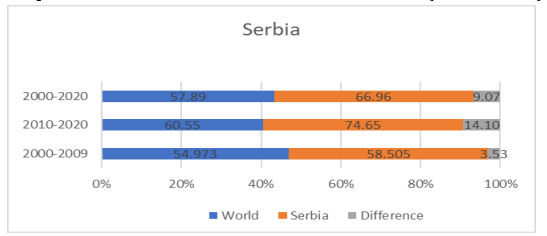
The results of the globalization index - KOF for Serbia by period show that the biggest deviation is in the second period, more precisely in the period 2010-2020. (14,10). The average value of the KOF index for the period 2000-2009. shows a positive difference in favor of Serbia (3.53), which is significantly higher in the following period. Nevertheless, viewed in summary, Serbia has a higher mean value of the KOF index by 9.07 index points.
Graph 4. Mean values of the KOF index for Slovenia (2000- 2020)
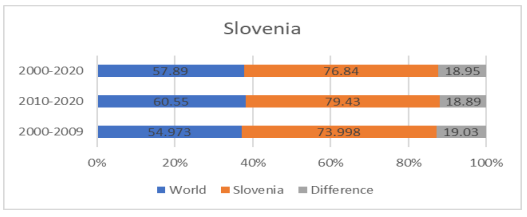
The results of the globalization index - KOF for Slovenia by period show that the mean deviation in all three periods is similar. The mean value of the KOF index for the period 2000- 2009. shows a positive difference in favor of Slovenia, which is significantly higher in the following period. Nevertheless, viewed in summary, Slovenia has a higher mean value of the KOF index by 18.95 index points.
KOF analysis, the best ranked country is still Croatia, which is in 33rd place, the same as in 2013, followed by BiH in 50th place, and which has improved compared to Serbia and took second place, so that Serbia is now third in this analysis, it is in 63rd place, which is 10 places below compared to 2013 and Macedonia, which is in 74th place. Compared to 2013, the ranking places did not change significantly in the analysis of these countries, except for the exchange of places in the analysis of the observed countries, where BiH is in a better position compared to Serbia, which was not the case the previous year.
Graph 5. Mean values of the KOF index for Macedonia (2000- 2020)
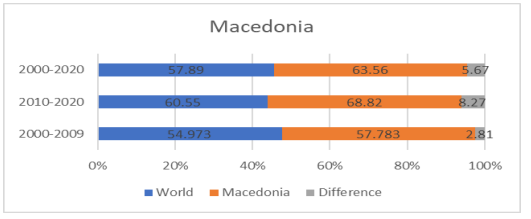
The results of the globalization index - KOF for Macedonia by period show that the biggest deviation is in the second period, more precisely in the period 2010-2020. (8,27). The mean value of the KOF index for the period 2000-2009. shows a positive difference in favor of Macedonia, which is significantly greater in the following period. Nevertheless, viewed as a whole, Macedonia has a higher mean value of the KOF index by 5.67 index points.
Graph 6. Mean values of the KOF index for Montenegro (2000- 2020)
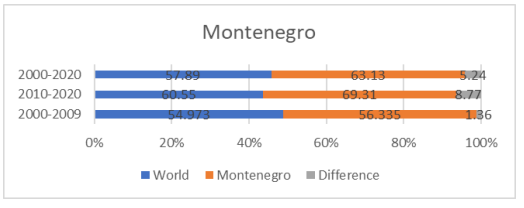
The results of the globalization index - KOF for Montenegro by period show that the biggest deviation is in the second period, more precisely in the period 2010-2020. (8.77). The mean value of the KOF index for the period 2000- 2009. shows a positive difference in favor of Montenegro, which is significantly higher in the following period. Nevertheless, viewed in summary, Montenegro has a higher mean value of the KOF index by 5.24 index points.
In 2013, the analyzed countries did not progress when it comes to economic globalization, but even recorded a slight decline. Regarding the ranking among the analyzed countries, Croatia is still in the first place, while Serbia is in the last place.
The results of the social globalization index for 2013 are as follows: Croatia 40th place, Serbia 50th place, Macedonia 53rd place and BiH 81st place. Out of all the analyzed countries, Croatia is ranked best in terms of social globalization, Serbia is right behind it, while Bosnia and Herzegovina is far below in 81st place. In relation to 2012, the data did not change significantly, Croatia was still in first place compared to neighboring countries, there was a slight increase and decrease on par with other countries, but this did not significantly affect the world scene.
The results of the political globalization index for 2013 are as follows: Croatia 40th place, BiH 65th place, Serbia 88th place and Macedonia 143rd place. As with the previous results, Croatia took the leading place in this index as well, but there is a noticeable drop in Serbia's index compared to 2012, from 57th place to 88th place. Macedonia's ranking also dropped in 2013 to 143rd place, which is far below the other analyzed countries.
Croatia is the best-ranked country in 2012, which is in 33rd place, followed by Serbia in 53rd place, BiH in 61st place and Macedonia in 70th place. Compared to 2012, the ranking places did not change significantly in the analysis of these countries, while there were changes at the world level because each of the mentioned countries had a slight shift in the ranking up or down and this affected the other countries.
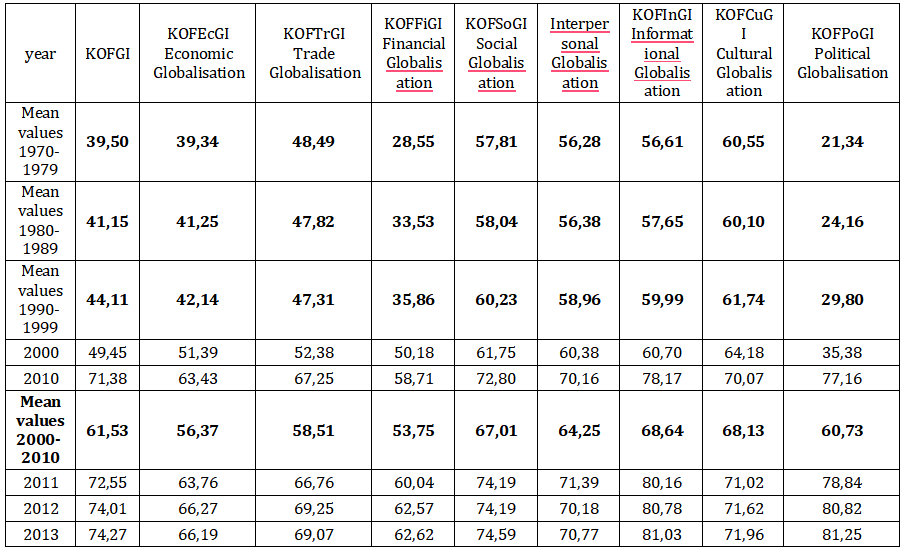
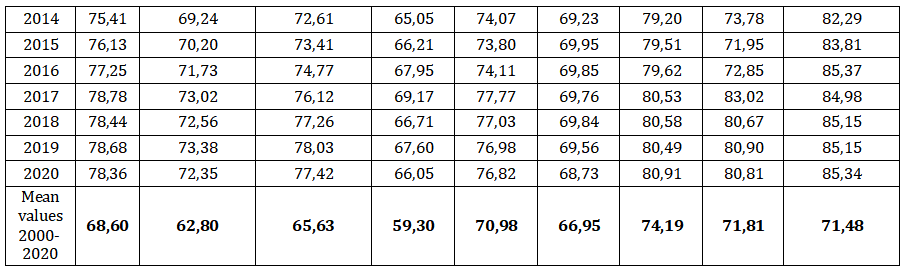
Table 5. Values of the KOF index for Serbia in the period from 1970-2020
Graph 7. Display of all columns of the KOF index in the period from 1970-2020
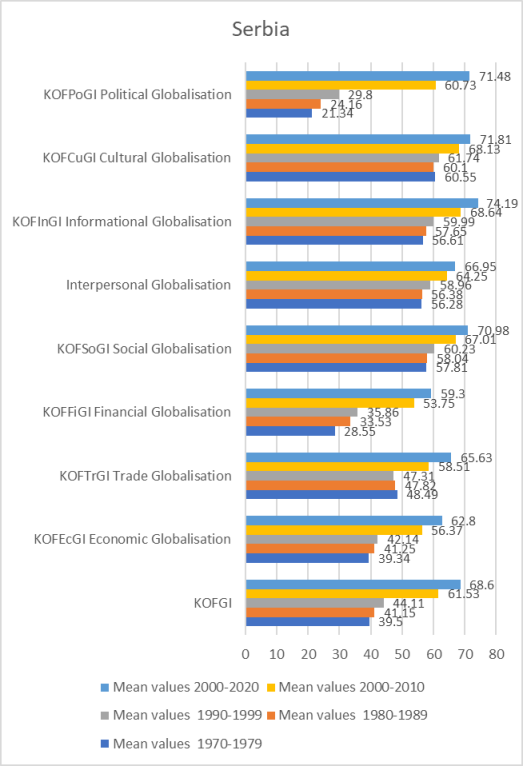
The analysis of the values shown in table 5 shows that Serbia has made significant progress in recent years and that the value of the KOF index has increased. Mean values for 1970-1979 is 39.5 index points and in the following period 1980-1989 is 41.15 index points. The value of the index did not change significantly in the following ten-year period and amounts to 44.11 index points. Only the period after 2000 brought more serious changes in the KOF index. Thus the value of the index for the period 2000-2020 amounts to 68.6 points.
Conclusion
World globalization and the new industrial age based on the concept of efficiency, productivity and economy no longer gives results as was the case in the past time. Today, one remaining unused resource is represented by people with their knowledge. The success of the country depends on whether the country and its management staff are able to recognize the importance of this resource and all components of knowledge and to create conditions for young people based on this knowledge and prevent the outflow of educated people and recognized scientists, at the world level. Success in education and channeling existing knowledge, as well as the creation of new intellectually conscious beings, depends to a great extent on the education system and politics of a country. The past and historical results of the country have a great influence, because they determine the future course and position of the country at the world level. The global financial crisis arose as a result of irregularities in the use of financial resources, and as such it soon turned into an economic crisis, and in this way, first the underdeveloped and poor countries, and then the most developed and rich ones, were severely affected.
If a certain country was going through great historical events, wars, battles, political chases and riots, and was financially unstable, it did not use its material and natural resources enough, and in the end it was going through a hard transition (excessive population gap between rich and poor, lack of food, excessive prices, inflation, unemployment...) it is natural to expect that that same country is going to have an unenviable position on the world ranking list and it concerns globalization coefficients, global competitiveness indices, results of gross domestic product per capita, knowledge economy index, etc.
It is difficult to recover from such "blows", even if the country has been poor and unstable then a great effort is needed from ruling parties in each mandate and the help of the population, to bring the country economic, educational, political and social competitiveness at the world level.
Countries that centuries ago had stable political and historical changes that are accompanied by excellent financial situation in the country, they can boast of a good rank and coefficient at the world level. Such countries become an aspiration and, in a way, a guideline for how a country should be organized in every sense. The results of those countries concerning the coefficients of the knowledge economy, globalization and competitiveness are at an enviable level.
World reports and results of such countries are indicators of successfully led countries through the changes that were happening. By comparing the results obtained from the World Economic Forum and the World Bank, a realistic picture and condition of all the countries that have been on that list is obtained.
KOF is an index that shows the ratio of total exports and imports with total gross domestic product for the observed period. As foreign trade is very important for the development of any country, so is KOF. In the analysis of KOF for the period from 2012 to 2014 207 countries participated, Serbia recorded for the year 2012 ranking number 45, which is a very good position compared to other countries from the region, where the only leader is Croatia, which is in 32nd place that year. In 2013, Serbia has been in 53rd place, which is 8 places worse compared to the previous year, but it is still in a better position compared to the majority of the region, except for Croatia, which in that year also had the best position among the countries from of the region, the rank is 33. The year 2014 was not the best year for the KOF analysis for Serbia, namely in that year it recorded a drop from 53rd place from 2013 to 63rd place.
It is interesting that BiH is in a better position than Serbia in 2014 and it took 50th place, Croatia is still the best in the region and it is in 33rd place as in the previous year, Macedonia achieved the worst result in 2014 and it is on the 74th place. The result of the research showed that the value of the globalization index - KOF for Serbia in the period 2000-2009 deviates from the mean value by 3.53, while in the period 2010-2020 it deviates by 14.10 index points. The mean value of the KOF index is 66.96 points, which is 9.07 index points higher than the world average.
References
2.Barać, S., Hadžić, M., Stakić, B., and Ivaniš, M (2005). Poslovno bankarstvo. Beograd: Univerzitet Singidunum, Fakultet za finansijski menadžment i osiguranje.
3.Clark, W. (2000). Environmental Globalization, in: Joseph S. Nye and John D. Donahue (eds.), Governance in a Globalizing World, Brookings Institution Press, Washington, D.C.: 86-108.
4. Dreher, A. (2006). Does globalization affect growth? Evidence from a new index of globalization. Applied economics, 38(10), 1091-1110.
5.Dreher, A., Gaston, N., and Martens, P. (2008). Measuring globalisation. Gauging its Consequences Springer, New York.
6.Enders, J. (2004). Higher education, internationalisation, and the nation-state: Recent developments and challenges to governance theory. Higher education, 47, 361-382.
7. Feigin, G. (2021). Globalization of World Economy: Trends and Contradictions. Mirovaia ekonomika i mezhdunarodnye otnosheniia, 65(4), 5-13.
8.Fulcher, J. (2000). Globalisation, the nation-state and global society. The sociological review, 48(4), 522-543.
9.Gozgor, G. (2018). Robustness of the KOF index of economic globalisation. The World Economy, 41(2), 414-430.
10.Gygli, S., Haelg, F., Potrafke, N., & Sturm, J. E. (2019). The KOF globalisation index–revisited. The Review of International Organizations, 14, 543-574.
11.Huntington, S. P. (1993). The Clash of Civilizations. Foreign Affairs, 72(3), 22-49.
12.Index, K. G. (2021). KOF Globalisation Index.
13.Joldić, N., Vasiljević, S., and Krstić, S. (2018). Globalne ekonomske krize kao posledica kapitalizma. Oditor, 4(1), 52-
62. https://doi.org/10.5937/Oditor1801052J
14.Jones, G. (2010). Multinational Strategies and Developing Countries in Historical Perspective. Harvard business School, Working Paper 10-076.
15.Kalliny M. and LeMaster J. 2005. Before You Go, You Should Know: The Impact of War, Economic, Cultural and Religious Animosity On Entry Modes. Marketing Management Journal, 15 (2): 18-28.
16. Keohane, R. O., Nye, J. S., and Donahue, J. D. (2002). Governance in a globalizing world. Power and governance in a partially globalized world, 193-218.
17. Norris, P. (2000). Global governance and cosmopolitan citizens. In J. S. Nye, & J. D. Donahue (Eds.), Governance in a globalizing world. (pp. 155-177). Washington DC: Brookings Institution Press.
18. Nye, J. S., and Donahue, J. D. (Eds.). (2000). Governance in a globalizing world. Washington DC: Brookings Institution Press.
19.Olivié, I., & Gracia, M. (2020). Is this the end of globalization (as we know it)? Globalizations, 17(6), 990-1007.
20.Rekker, R. (2018). Growing up in a globalized society: Why younger generations are more positive about the European Union. Young, 26(4_suppl), 56S-77S.
21.Schulze, G. G., and Ursprung, H. W. (1999). Globalisation of the Economy and the Nation State. World Economy, 22(3), 295-352.
22.Singh, D. (2014). Managing Cross-Cultural Diversity: Issues and Challenges in Global Organizations. Journal of Mechanical and Civil Engineering, 3, 43-50.
23.Vukosavljević, D., Kaputo, J., Tešić, A., and Vukosavljević, D. (2021). Macroeconomic environment and the public sector: Place and role. Oditor, 7(3), 37-50. https://doi.org/10.5937/Oditor2103037V
24. http://globalization.kof.ethz.ch/
Published in
Vol. 29, No. 1, 2023.
Keywords
Licence
This work is published under the Creative Commons Attribution 4.0 International (CC BY 4.0).
Authors retain copyright over their work.
Use, distribution, and adaptation of the work, including commercial use, is permitted with clear attribution to the original author and source.
Interested in Similar Research?
Browse All Articles and Journals