
Investment in the Banking Sector as a Basis for Money Laundering
Abstract
The problem of money laundering is present on a national and international level and is significantly expressed in those societies where organized crime intents to legalize through criminal money laundering and to infiltrate financial and economic flows, with the aim of controlling certain economic and political processes.
The criminal activity that precedes the acquisition of illegal revenuess, the methods of money laundering and the methods of counteraction, contains certain specifics without which it is not possible to percieve all aspects of money laundering, especially in terms of choosing the appropriate strategy for combating it. All this points to the importance of research this issue, especially money laundering in the function of terrorist financing.
Article
Introduction
Money laundering is the incorporation of money acquired through illegal transactions in the grey economy into normal financial and economic flows, which implies the granting of legal illegally acquired cash which - first by transferring to a bank account, is transferred into giro money and then from there to cash(Miletić et al., 2021). At the same time, money laundering also involves injecting money into the normal economic flows which came from criminal activity (drug and arms trafficking, smuggling, robbery, organized crime, tax avoidance, corruption, etc.) to prevent detection of its origin(Milojević et al., 2018).
The gray economy in the country leads to an increasing criminalization of society: at the beginning it creates the impression that the country is prospering, but soon the gray economy operators and money launderers gain reputation, richness and power and they are trying to take control of the entire financial and economic system.(Krstić, & Vukasović, 2018; Milosavljević Pantelejić Đ., Međedović, 2019) Such countries have no problem with crime because they cannot control it, since criminal organizations control the state. Therefore, anti-money laundering measures, which will prevent criminals from using or restrict their illicit acquisition of property, are crucial in the state's fight against organized crime(Avakumović et al., 2021).
The problem observed in this paper is the selection of an appropriate strategy to reduce the risk of money laundering and the gray economy through banks and to include more concepts that need to be defined initially.(Simić, Teuta, Yang, 2019) Choosing the best banking strategy is the aim of this problem. Based on the definition of decision-making that it is the choice of one of a set of possible alternatives(Arce et al., 2015; Falagario et al., 2012), where there must be at least two alternatives in the set, it can be concluded that the application of decision-making theory in the procedure itself is possible.
The definition of the criterion plays an important role in the decision-making process. The term "creature" refers to attributes that are related to the alternatives between which we make the selection. They can be divided into qualitative and quantitative criteria depending on the degree of measurability.(Mihajlović et al., 2016). Quantitative criteria are those that can be accurately measured and expressed by different units of measurement. Qualitative criteria are those that cannot be expressed numerically(Veslinović, 2014). They can be classified into two sub- groups: attributes whose values cannot be accurately measured, but can still be classified by “intensity” and attributes by which no quantitative comparison of alternatives can be made.
Formulating the mathematical model of multicriteria decision making
The multicriteria decision model has the following mathematical formulation (Čupić, Suknović, 2010; Sameh et al., 2016):
max [f1(x), f2(x),..., fp(x)], p≥ 2
with restrictions
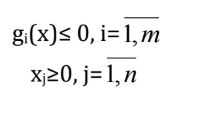
wherein:
n – number of variables;
p – number of criteria functions;
m – number of restrictions;
X – n-dimensional vector of variables xј, ј=1, n ;
fk - function (objective) of criteria, к=1, p ;
gi(x) – set of restrictions, i=1, m .
It should be emphasized that the maximization of the vector of the function of the target is performed under the given constraints, since the minimization criteria can be translated into the massimization criteria, namely (Đurković, Radosavljević, & Stanković, 2019):
max fr (x)=-min [-fr (x)], r ϵ (1,р)
Solving this model gives a set of admissible solutions, a vector X which belongs to the set of natural numbers X Є Rn , to which it applies:
X=[x | gi(x)≤0, i=1, m , xj≥0, j=1, n ]
The set of solutions X thus obtained corresponds to the set of values of the criterion function, that is, the vector f (x), so that the set of admissible solutions X can be mapped to the criterion set S(Kuo et al., 2015):
f(x)=[ f1(x) f2(x), ..., fР(x)]
S= [f(x) | x ϵ X ]
Combining anp and topsis methods in bank benefit assessment
Developing an appropriate decision support system for choosing a bank for the purpose of reducing money laundering risk and the grey economy is the problem that will be solved by a combination of ANP methods and TOPSIS(Bobar et al., 2015). Eligibility criteria based on the alternatives that will be evaluated in this case are (Đukić, 2011): K1- Bank liquidity; K2- Efficiency; K3- Bank Profitability and K4- Bank solvency.
These criteria will be examined on the basis of collected data of indicators of financial performance of banks in the Republic of Serbia in 2018, taking into account the operations of ten banks.
The first subsystem of the decision support system is the database, which in our case consists of the collected data and is presented in Table 1:
Table 1: Decision matrix (database)

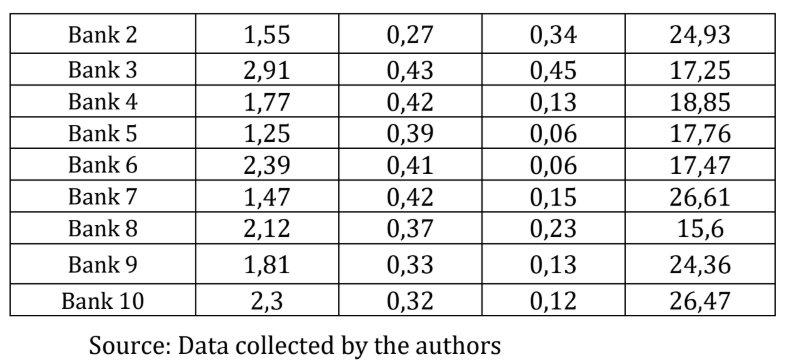
At the beginning of problem solving, it is necessary to start by determining the relative weights of the criteria and the significance of the criteria. The ANP method(Nazari et al., 2016) will be used here to determine the relative weights of the criteria. The Saaty scale (Saaty, 1980) will be used to estimate the relative weights of the criteria:
Table 2: Assessment of relative weights of the criteria
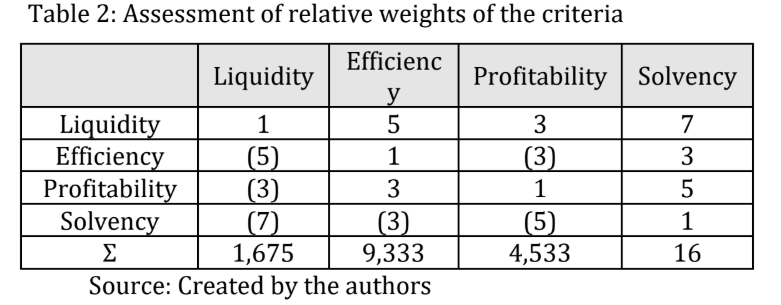
Table 3: Eigenvector computation of the corresponding eigenvalues
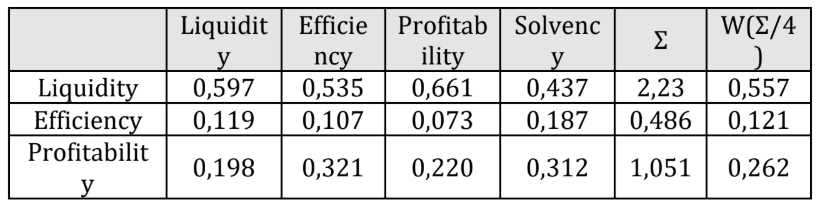

The second part of the model involves the application of the TOPSIS method to find the optimal solution of the observed problem.
Table 4: Decision matrix which should be normalized
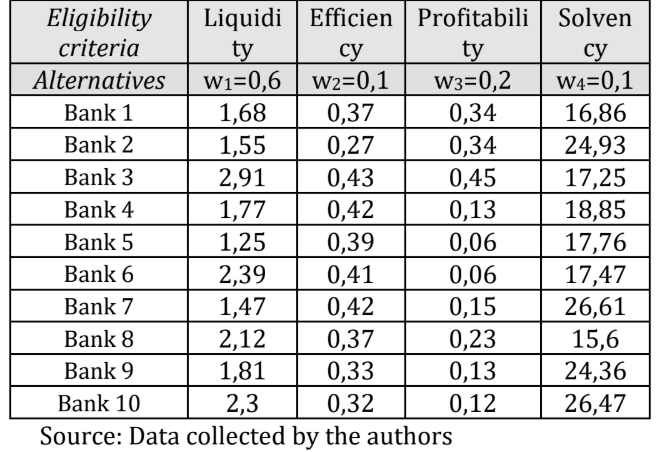
Table 5: Normalized decision matrix
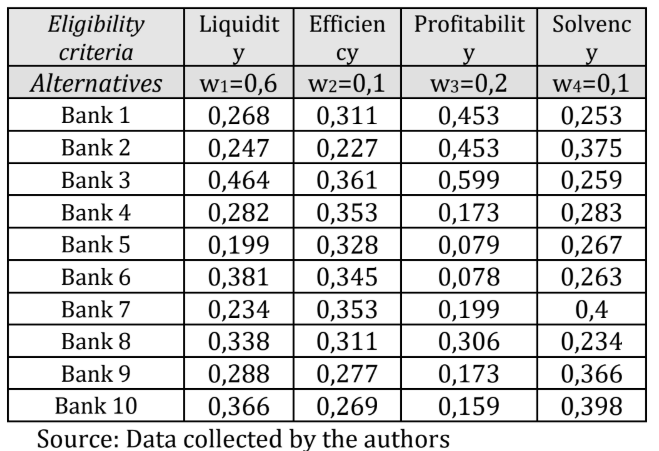
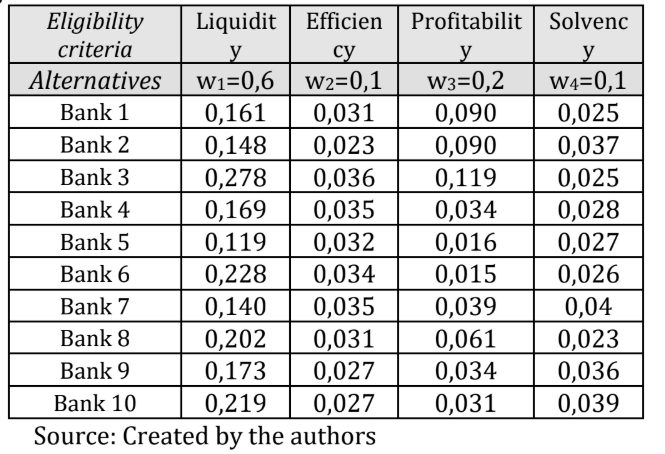
Table 6: Multiplication of normalized matrix values by criterion weights
Considering the fact that all the criteria belong to the maximization criteria it follows that:
Ideal solution: А* = {0.278, 0.036, 0.119, 0.04}
Negative ideal solution: А- = {0.119, 0.023, 0.015, 0.023}
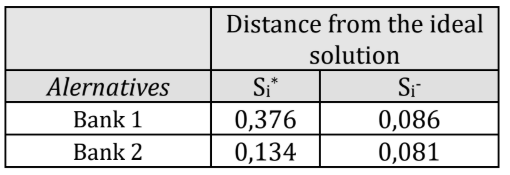
If we denote the distances from the ideal solutions with Si * and Si-, we gets the results shown in Table 7.
If we denote the distances from the ideal solutions with Si* и Si- we gets the results shown in Table 7.
Table 7: Determining the distance of alternatives from ideal solutions
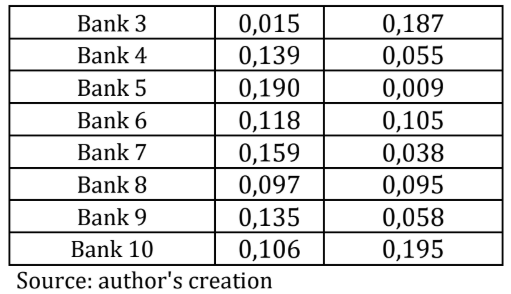
Determining the relative proximity of alternatives to the ideal solution is the next stage, which involves calculating using the following formula(Rodríguez, 2015):
Qi*= Si-/ Si*+ Si- , i=1,…n
Based on the obtained solutions, the ranking of alternatives can be performed as follows:
Table 8: Ranking of alternatives
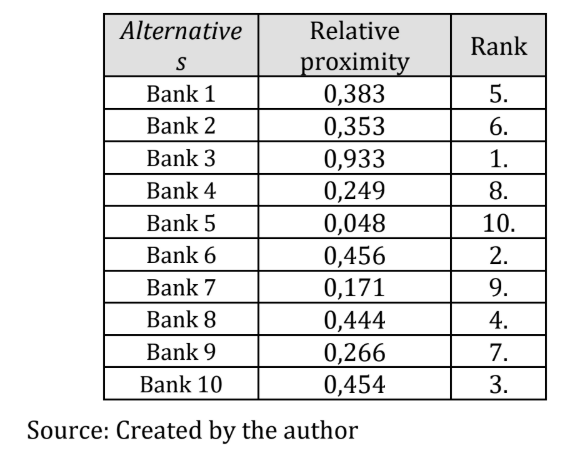
Based on the TOPSIS method implemented, a obtained solution is that the most suitable investment bank is the bank 5, which has the highest ranking among all alternatives.
Discussion of results
The results indicate the bank's ranking for the investor as a potential money laundering client.
Graph no. 1: The final ranking of alternatives
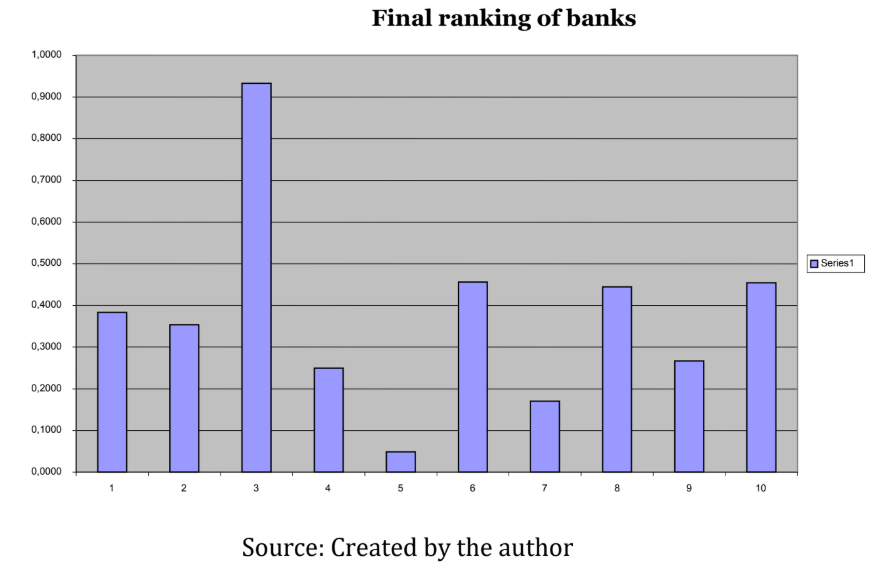
Final ranking of banks
The stability of the obtained solution in case of change of criteria can be performed by the sensitivity analysis procedure(Bergman & Lundberg, 2013). Figure 1 shows the impact of the criteria on each bank or alternative.
Graph no. 2: The impact of changing the weight of all criteria on alternatives
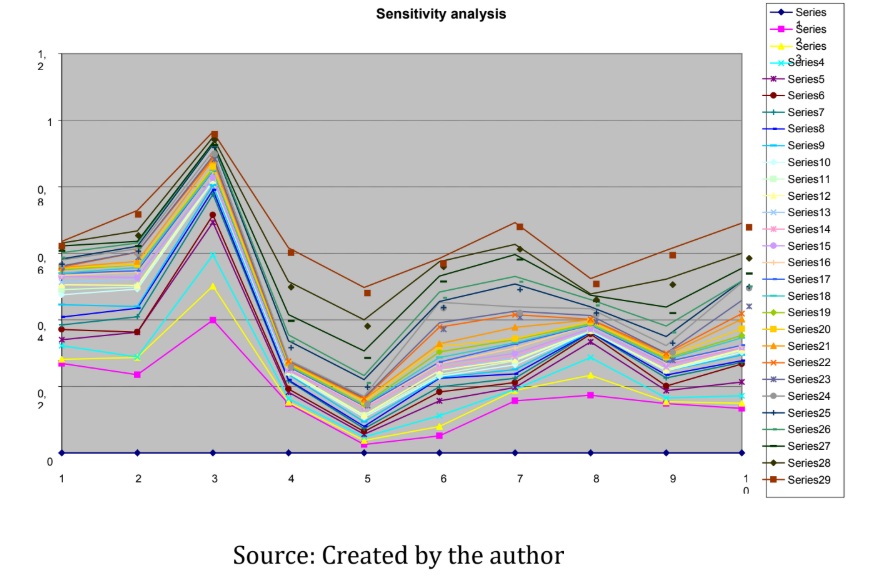
From the chart above, it can be seen that the biggest change in value is achieved by alternative 3 where, due to the decrease in the weight of the "liquidity" criterion, the increase in the weight of other criteria only further condition the conclusion reached and the budget shows that this bank shows the lowest risk of money laundering in the payment system as a support. the gray economy. Also, generally speaking, with other alternatives, the conclusion is that due to the increase in the weights of the criteria "efficiency", "profitability" and "solvency", their value increases, but still not enough to achieve greater value than alternative 2.
Conclusion
Everybody - individuals, politicians, experts, business people, every day considers and makes small and big decisions - decisions that affect individuals, families, business systems or social communities - regions, states and the whole world. In the most cases and problems that need to be solved there are multiple solutions. But the question that comes is which solution to choose? One who considers and makes a decision takes into account several aspects of the problem he is solving: some reasons speak in favor of making a decision in one way, but other reasons say that such a decision is reviewed and often revised.
Thus, the problem solving practices in the financial sector shows that they can be solved in different ways, respecting the relevant criteria. In the past years, considering the financial sector of the Republic of Serbia, there have been positive changes, which is confirmed by the parameters that indicates an increase in the efficiency of the banking system, growth of loans and deposits with banks, growth of capital market turnover, stimulation of household savings, etc. which has a positive effect on reducing the risk of money laundering and the grey economy. In order to achieve even better results, it is necessary to provide additional investment funds from clients, as well as to establish a network of monitoring clients' inflows and outflows of money, which will make decisions based on appropriate indicators that will be obtained by applying the best ways to measure bank performance which is certainly the responsibility of the National Bank of Serbia.
The application of decision support system combines the results of economic theory with the data provided by economic statistics. Key features of high-performing banks are reflected in providing high liquidity, maximizing profits, controlling costs and more. There are multiple approaches to measuring the performance of commercial banks. They all boil down to a larger or smaller selection of certain coefficients or ratios. Financial coefficients or indicators are representing relative ratios that need to give advance consideration to the degree of certainty that a bank will be able to monitor the balance of payments of deposits and placements.
Obtained sizes can be compared with other banks, planned sizes or with the sizes of the bank realized in the previous period, as well as with international payments and foreign banks.
Ability to use a number of representative methods available to the process of making a decision on the system of reducing the risk of money laundering for each bank, which facilitates business and raises the level of decision quality to a higher level. It is precisely by using the combination of the ANP and the TOPSIS method that it is shown how a precise procedure can be made, while respecting all the set criteria on the basis of which the selection is made. It has also been shown in this way that there are significant arguments for making the selection process based on scientific basis.
Decision support systems were developed at a set of 10 banks in the Republic of Serbia. Data on their business are related to 2011, and were collected from the annual financial statements. Applying the appropriate system, the banks were ranked and it was determined that the bank 3 with its indicators have the best characteristics.
References
2. Avakumović, J., Tešić, R., & Karić, D. (2021). Menadžment tranzicionim procesima u funkciji održivog razvoja. Održivi razvoj, 3(1), 7-16. https://doi.org/10.5937/OdrRaz2101007A
3. Bergman, S.A. & Lundberg, S. (2013). Tender evaluation and supplier selection methods in public procurement. Journal of Purchasing & Supply Management, 19(2), 73–83
4. Bobar, V., Mandić, K., Delibasić, B., Suknović, M. (2015). An Integrated Fuzzy Approach to Bidder Selection in Public Procurement: Serbian Government Case Study. ACTA Polytechnica hungarica, 12(12), 193-211
5. Čupić M., Suknović M. (2010). Odlučivanje. Fakultet organizacionih nauka, Beograd, 2010
6. Đukić, Đ., Upravljanje rizicima i kapitalom u bankama , drugo izdanje, Ekonomski fakultet Beograd, 2011
7. Đurković, V., Radosavljević, M., & Stanković, R. (2019). Primena AHP metode u određivanju značaja primene savremenih bankarskih proizvoda na uspešnost poslovanja banaka. Oditor - časopis za Menadžment, finansije i pravo, 5(1), 70-80.
8. Falagario, M., Sciancalepore, F., Costantino, N., & Pietroforte, R. (2012). Using a DEA-cross efficiency approach in public procurement tenders. European Journal of Operational Research, 218(2), 523-529
9. Krstić, D., & Vukasović, D. (2018). On-line finansijske transakcije u plaćanjima malih vrednosti. Oditor - časopis za Menadžment, finansije i pravo, 4(2), 39-47.
10. Kuo, R.J., Hsu, C.W. & Chen, Y.L. (2015). Integration of fuzzy ANP and fuzzy TOPSIS for evaluating carbon performance of suppliers. International Journal of Environmental Science and Technology 12(5), 3863-3876. doi:10.1007/s13762-015-0819-9
11. Milojević I., Mihajlović M., Vukša S. (2018) Novčani tokovi privrednog
subjekta kao predmet revizije, Vojno delo, Vol. 70, No 3, str. 361-371
12. Miletić, A., Trajković, S., & Mrdak, G. (2021). Uticaj strateškog opredeljenja na odnos između upravljanja inovacionim portfoliom i uspeha. Oditor, 7(1), 165-194.
https://doi.org/10.5937/Oditor2101165M
13. Milosavljević S., Pantelejić Đ., Međedović D. (2019). Primena i mogućnost unapređenja ekonomskih činilaca u realizaciji održivog razvoja. Održivi razvoj, 1(1), 7-14.
14. Mihajlović M., Krstić S., Šegrt S., Pavlović D., Jovanović D., Simeunović T., (2016) Economic analysis of the influence of milk market concetration on procurement efficiency in the defense system, Ekonomika poljoprivrede, 63(3), 973-986, ISSN: 0352-3462, UDC: 664.644.4:339.13.
15. Nazari, A., Vandadian, S., & Abdirad, H. (2016). Fuzzy AHP Model for Prequalification of Engineering Consultants in the Iranian Public Procurement System. ASCE Journal of Management in Engineering, 33(2), 43-54
16. Rodríguez, A. (2015). A fuzzy method for the selection of customized equipment suppliers in the public sector. Artificial Intelligence Research, , 4(1) 36-44, doi: 10.5430/air.v4n1p36
17. Saaty, T., „The Analytic Hierarchy Process”, McGraw-Hill, New York, 1980.
18. Sameh, S., Noufal, K., Abdalah, M. (2016). A fuzzy-AHP multi-criteria decision making model for procurement process. International Journal of Logistics Systems and Management (IJLSM), 23 (1), 1-24.
19. Simić N., Teuta K., Yang J. (2019). Regulatorni instrumenti održivog razvoja. Održivi razvoj, 1(1), 15-26.
20. Veslinović I. (2014). Multi-criteria methods and models for decision making in public procurement, Facta Universitatis Series: Economics and Organization 11(3), 261 – 279
Published in
Vol. 27, No. 1, 2021.
Keywords
Licence
This work is published under the Creative Commons Attribution 4.0 International (CC BY 4.0).
Authors retain copyright over their work.
Use, distribution, and adaptation of the work, including commercial use, is permitted with clear attribution to the original author and source.
Interested in Similar Research?
Browse All Articles and Journals